
The 3 Powerful MCP Patterns Reshaping Enterprise AI: From Tool Access to Governed Agent Networks
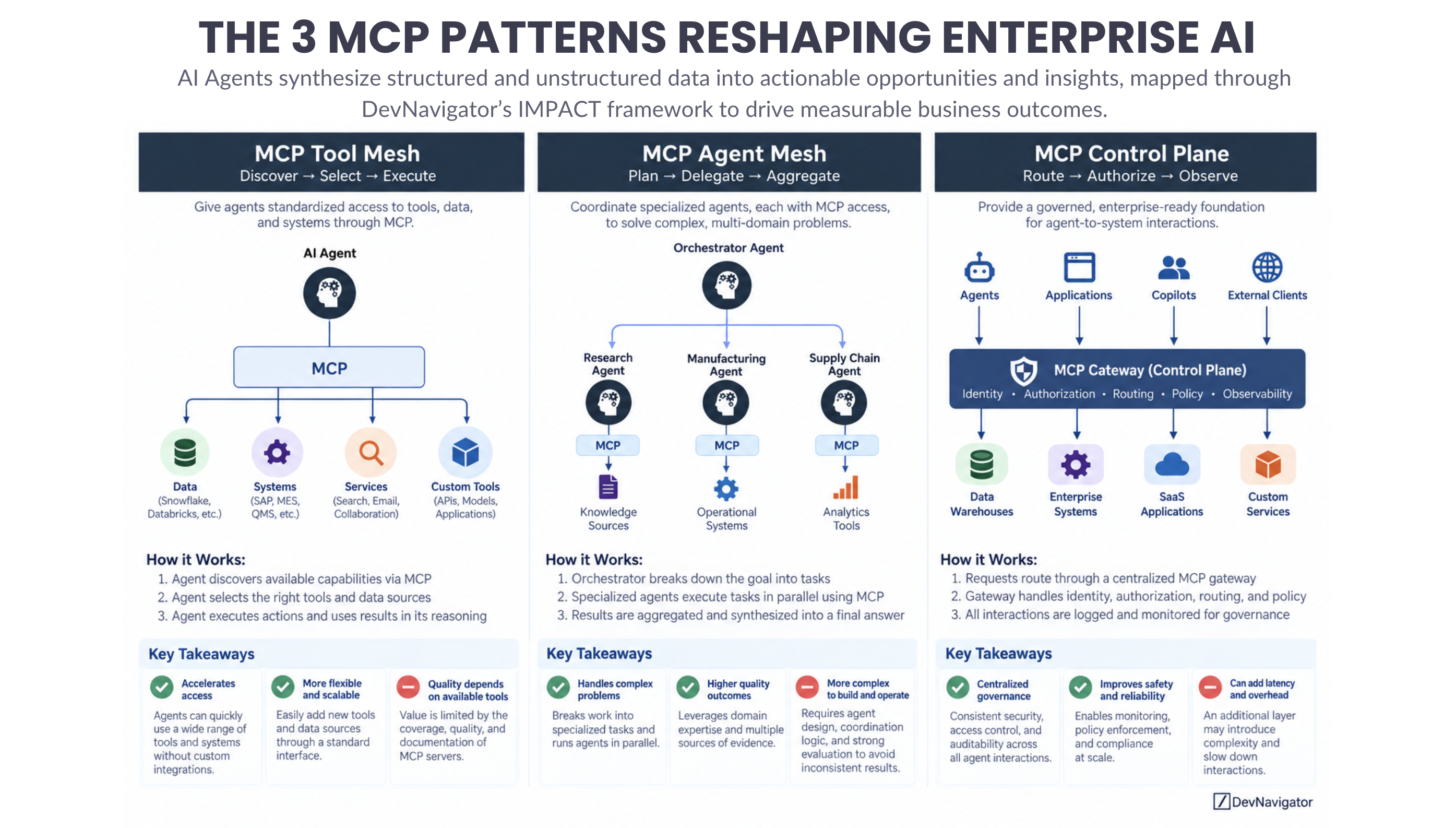
The Model Context Protocol (MCP) is quickly moving beyond its original role as a standardized way for AI applications to connect with external tools and data. The latest MCP specification makes the protocol stateless, cacheable, routable through standard HTTP infrastructure, and better suited for enterprise authorization, while the project’s latest roadmap explicitly prioritizes agent identity and enterprise-ready security.
For leaders, the more important development is what organizations are beginning to build around MCP. As MCP patterns become infrastructure for agentic systems, three useful architectural patterns are emerging: Tool Mesh, Agent Mesh, and Control Plane. These are not official MCP protocol classifications. They are practical architectural MCP patterns for understanding how MCP can create value at increasing levels of complexity.
Table of Contents
Executive Takeaways
- MCP Tool Mesh standardizes capability access. Agents can discover and interact with tools, enterprise systems, data, and services through a common interface instead of relying on individually engineered integrations.
- MCP Agent Mesh expands the model from tools to coordinated work. Specialized agents can operate across different domains while MCP provides standardized access to the capabilities each agent needs.
- MCP Control Plane addresses the enterprise scaling problem. Gateways, identity, authorization, routing, observability, and auditability provide a governed layer between potentially thousands of agents and enterprise capabilities.
Expanded Insights
MCP Patterns Becoming Infrastructure
MCP began with a relatively straightforward proposition: give AI applications a standard way to connect to external capabilities.
That proposition has expanded considerably.
The July 2026 specification introduced a stateless protocol core, header-based routing, cacheable tool catalogs, stronger authorization, extensions, and improved support for long-running agentic work. The MCP maintainers report close to half a billion monthly downloads across Tier 1 SDKs, suggesting that MCP is increasingly becoming part of the infrastructure underneath agentic applications. The architectural question is therefore changing. Instead of asking: “How do I connect an LLM to a tool?” Organizations increasingly need to ask: “How should hundreds of agents, tools, systems, and data sources interact?” Three MCP patterns help answer that question.
1. MCP Tool Mesh: Discover → Select → Execute
The MCP Tool Mesh is the simplest and probably the most immediately useful MCP pattern.
An AI agent sits above a collection of MCP-accessible capabilities. Depending on the task, the agent discovers available capabilities, selects the appropriate tool or data source, executes the request, and incorporates the result into its reasoning.
A single enterprise agent could potentially interact with data platforms such as Snowflake or Databricks, operational systems such as SAP or MES, search services, internal APIs, and other applications through MCP.
The key architectural change is standardization.
Without MCP, every connection can become its own integration project. With MCP, applications interact with capabilities through a common protocol.
The latest MCP specification makes this MCP pattern more scalable because clients can cache tool catalogs and requests can be routed across ordinary HTTP infrastructure without maintaining persistent protocol-level sessions.
There are two major advantages. First, agents gain much broader capability access without requiring bespoke integrations for every combination of agent and system. Second, the architecture becomes more modular because tools can be added, replaced, or improved behind a standardized interface.
There is also an important limitation: MCP patterns does not make the underlying capability good. Poorly documented tools, unreliable APIs, weak permissions, or low-quality data remain poor capabilities regardless of how elegantly they are exposed.
MCP standardizes access. It does not automatically standardize quality.
2. MCP Agent Mesh: Plan → Delegate → Aggregate
The second MCP pattern becomes relevant when the problem is too complex for one agent and one collection of tools.
An MCP Agent Mesh introduces specialization.
Imagine an orchestrator receiving a question involving manufacturing performance. Instead of solving everything itself, it could decompose the problem and delegate portions to specialized manufacturing, supply-chain, quality, or research agents.
Each agent could then access its own MCP-enabled tools and data.
The results return to the orchestrator, which reconciles the findings and produces the final response.
This architecture can be particularly valuable for complex enterprise problems because domain-specific agents can operate with different instructions, context, permissions, tools, and evaluation criteria.
MCP itself should not be confused with the orchestration mechanism here. The protocol provides standardized capability access; the surrounding agent architecture handles planning, delegation, coordination, and synthesis.
The MCP roadmap nevertheless shows the protocol moving closer to this world. Tasks now support long-running work, while the August 2026 roadmap identifies agent identity as a priority as cloud-based agents increasingly act autonomously, on behalf of users, and delegate narrower authority to subagents.
The advantage is potentially much stronger problem solving across organizational domains.
The disadvantage is complexity.
More agents introduce more coordination logic, additional model calls, greater latency and cost, harder evaluation, and more opportunities for inconsistent conclusions. Multi-agent architectures therefore make the most sense when specialization genuinely improves the outcome, not simply because multiple agents are technically possible.
3. MCP Control Plane: Route → Authorize → Observe
The third MCP pattern addresses a different problem.
Imagine an organization operating hundreds of agents and MCP servers. Directly connecting every agent to every capability quickly creates a difficult security and governance problem.
The MCP Control Plane introduces a managed gateway between AI applications and enterprise capabilities.
Instead of allowing uncontrolled point-to-point connections, requests pass through infrastructure responsible for identity, authorization, routing, policy enforcement, observability, and auditing.
This MCP pattern is rapidly becoming more concrete.
MCP’s Enterprise-Managed Authorization extension became stable in June 2026 and allows organizations to centrally provision access to MCP servers through their identity provider. AWS has also released an open-source MCP Gateway and Registry architecture that centralizes discovery, authentication, authorization, and audit logging for MCP servers, agents, skills, and other AI assets.
Microsoft describes a similar direction with its Foundry infrastructure, using a unified MCP endpoint to bring tools together while centralizing governance, identity, and observability.
The benefit is straightforward: organizations gain a central place to determine who or what can access which capability, under what conditions, and with what record of the interaction.
The tradeoff is another infrastructure layer.
Poorly designed gateways can introduce latency, bottlenecks, configuration complexity, or single points of failure. The control plane therefore needs to be engineered as production infrastructure rather than treated as another AI feature.
What Leaders Should Take Away
The strategic importance of MCP is not simply that another technology standard has emerged, and we need to adopt it to stay competitive and up to date. The bigger development is interoperability, and connectivity. The three MCP patterns we explored today offer an avenue for this.
Organizations have spent years building fragmented APIs, applications, data products, AI models, automation platforms, and enterprise systems. Agentic AI dramatically increases the number of intelligent consumers that may need access to those capabilities.
Building another generation of point-to-point integrations does not scale.
MCP offers a potential standard interface between intelligence and capability. Tool Mesh architectures make those capabilities accessible. Agent Mesh architectures coordinate them around complex work. Control Plane architectures make the resulting ecosystem manageable.
The protocol itself is still evolving. The August 2026 roadmap continues work on transport hardening, agent identity, enterprise security, server-initiated events, and other capabilities, so organizations should avoid assuming today’s implementation MCP patterns are permanently settled.
But the direction is increasingly clear.
MCP is evolving from a convenient way to connect AI to tools into an architectural layer for how enterprise agents discover, access, coordinate, and govern capabilities at scale.
That is where its long-term importance may ultimately lie.