
OpenAI Agents API: 8 Powerful Takeaways on the Operating Layer for Autonomous Work
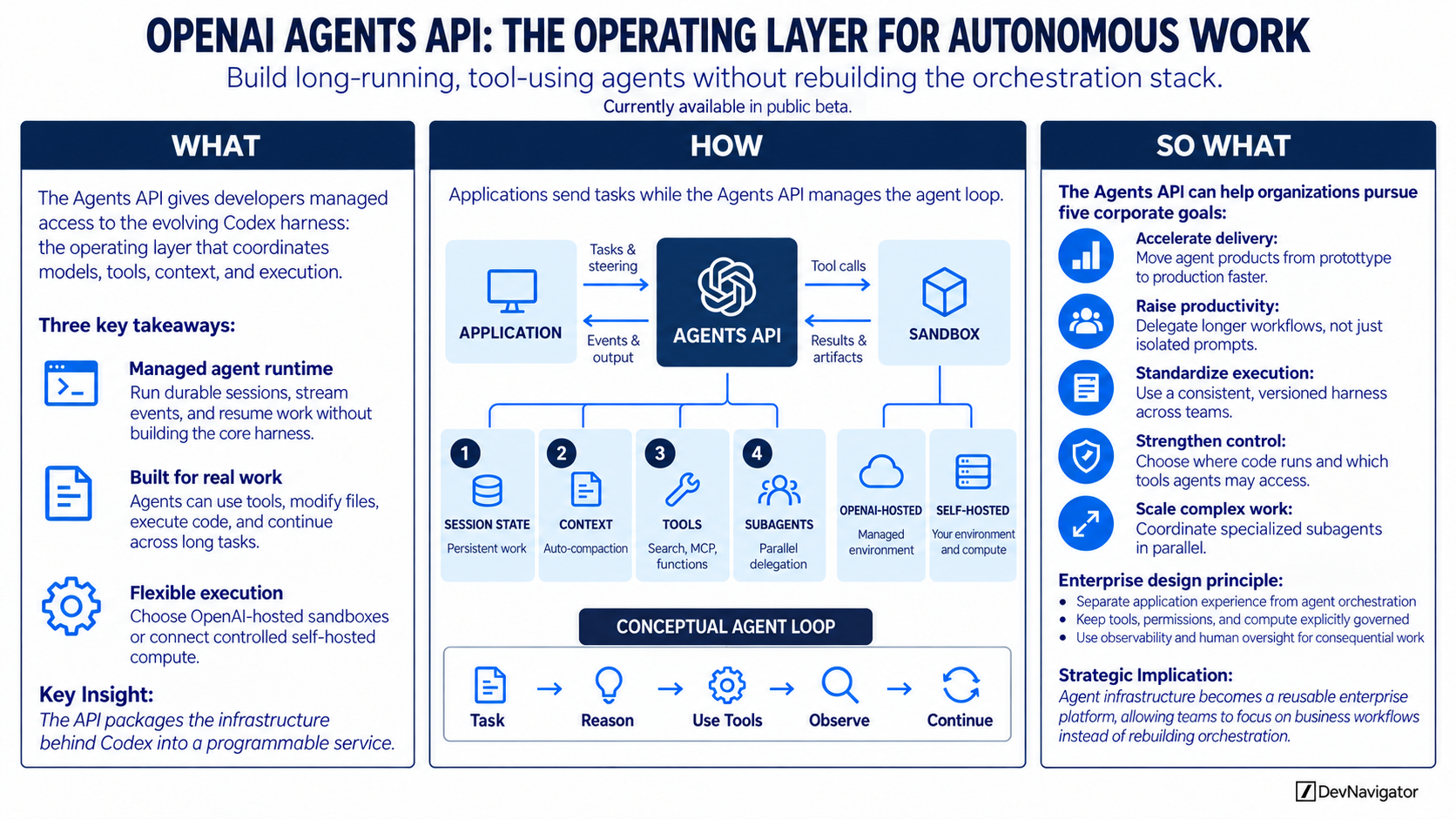
The Agents API gives developers managed access to the Codex harness as a programmable foundation for durable, tool-using agents. It brings together session management, context compaction, sandboxed execution, tools, recovery, observability, and parallel subagents while leaving the application in control of the user experience and operating boundaries. The timing matters because agent development is shifting from isolated demonstrations toward systems expected to complete longer workflows across real business environments. For leaders, the opportunity is a reusable execution layer that can reduce duplicated engineering and accelerate deployment. Capturing that value still requires disciplined use-case selection, trusted data, evaluation, security controls, human oversight, and accountable ownership.
Table of Contents
EExecutive Summary
- The OpenAI Agents API packages the managed Codex harness into a programmable service, giving developers durable sessions, context management, tools, sandboxed execution, recovery, and subagent coordination through one API.
- Applications retain control of the experience and operating boundaries, while OpenAI manages the agent loop and organizations choose between OpenAI-hosted sandboxes and their own execution environments.
- The strategic opportunity is reusable agent infrastructure, allowing teams to reduce duplicated orchestration work and focus investment on valuable, governed workflows supported by trusted data and measurable outcomes.
Expanded Insights
The Agents API turns the Codex harness into infrastructure
The Agents API represents an important step in the evolution of enterprise agents. Developers can access the harness used by Codex through a managed API. That harness coordinates the model, instructions, tools, context, session state, execution environment, recovery, and any delegated subagents required to complete a task.
Capable models alone do not produce dependable agent systems. Long-running work requires mechanisms for preserving state, managing context limits, selecting tools, executing code, handling files, recovering from interruptions, and reporting progress to the surrounding application. Development teams have historically assembled much of that infrastructure themselves. The Agents API packages those responsibilities into a reusable operating layer.
According to the official OpenAI Agents API overview, OpenAI manages sessions, orchestration, context compaction, and recovery, while the application provides tools and selects the execution environment. The service is currently available in public beta, so capabilities and interfaces may continue to change as OpenAI learns from production use.
The leadership implication is larger than a new developer endpoint. A managed harness can become a shared enterprise capability. Instead of funding separate teams to repeatedly solve session management, tool routing, recovery, and delegation, organizations can concentrate engineering effort on workflow design, data access, controls, and measurable business outcomes.
Durable sessions make longer workflows practical
A session is a durable instance of an agent that retains its configuration, conversation, and saved work over time. Applications can submit an initial task, stream events as the agent works, provide steering during an active turn, and return later with follow-up instructions. This creates a stronger foundation for work that extends beyond a single request and response.
Automatic context compaction is particularly important. As a session approaches its context limit, the harness summarizes earlier work while preserving information needed to continue. That allows workflows to span multiple context windows without forcing every application team to invent its own memory-management strategy.
Durability should be understood as an engineering capability rather than a promise of unlimited autonomous operation. Production systems need clear completion criteria, timeout behavior, approval gates, recovery logic, and escalation paths. Leaders should ask how a workflow fails, who intervenes, which intermediate results are preserved, and how the business resumes safely after an interruption.
Applications send work while the harness manages the loop
The architecture separates the user-facing application from the agent harness and its execution environment. The application submits tasks, receives events and outputs, and handles the product experience. The managed harness reasons through the assignment, selects tools, maintains context, and coordinates the work. When a task requires code execution or file access, the harness exchanges commands and results with a sandbox.
That sandbox can be hosted by OpenAI or connected from the organization’s own infrastructure. An OpenAI-hosted environment is provisioned and managed for the session. A self-hosted environment places compute, files, connectivity, and lifecycle management under the developer’s control and can run on a laptop, container, remote sandbox, or other supported compute. OpenAI continues to operate the agent harness in both cases; self-hosting applies to the execution environment rather than the entire Agents API.
This gives organizations a practical control point. Managed environments can support rapid development and standardized deployment. Self-hosted environments may be more suitable when workloads require private networks, specialized software, custom compute, regulated data boundaries, or tighter control over files and credentials. The right choice should follow the workload’s security, integration, latency, and operational requirements.
Tools and context determine what the agent can accomplish
The model provides reasoning, but tools give the agent reach. The Agents API can connect agents to custom functions, MCP servers, built-in tools, and sandbox capabilities. Agents can search for information, call business systems, run commands, edit files, execute code, and produce artifacts when those capabilities are configured.
Tool search helps an agent discover relevant tools without loading every definition into context at once. Programmatic tool calling allows related operations to be run, chained, filtered, or combined efficiently. Together, these capabilities support agents that can work across larger tool ecosystems while controlling unnecessary context usage.
The enterprise principle is explicit access. An agent should receive the minimum tools, permissions, network access, and credentials required for its assignment. Tool availability is part of the operating model. As the agent’s ability to act expands, observability, validation, and human approval become more important around consequential steps.
This is where the execution layer must connect with verification. DevNavigator’s overview of AI verifiers and their role in autonomous systems explains how semantic review, grounded checks, and formal constraints can create a stronger trust boundary between generated work and real action. For leaders, orchestration and verification should be designed together.
Subagents provide native parallel execution
Complex assignments often contain independent streams of work. An incident investigation may require separate reviews of deployment history, error logs, and downstream dependencies. A research assignment may require several sources or technical domains to be investigated in parallel. Multi-agent support allows the primary agent to delegate those components to focused subagents and combine their findings.
Each subagent maintains its own context, which reduces interference between unrelated tasks. Parallel execution can also reduce elapsed time when the work genuinely decomposes into independent pieces. The main agent remains responsible for coordination and synthesis.
Subagents are most valuable when boundaries are clear. Short sequential tasks generally belong in the primary agent, and multiple agents editing the same files require deliberate coordination. Parallelism also increases the number of model and tool operations, so faster execution may come with higher cost and a larger observability surface. Leaders should evaluate subagents against workflow performance rather than treating agent count as a measure of sophistication.
How the Agents API compares with other frameworks
The Agents API enters a market that already includes capable agent frameworks. LangGraph emphasizes explicit graph-based orchestration, checkpointed state, human intervention, replay, and fault tolerance. Its persistence documentation shows how checkpoints support memory, recovery, human review, and inspection of prior states. Google’s Agent Development Kit provides an open-source, model-agnostic framework for building and deploying modular multi-agent systems. Microsoft Agent Framework combines agent abstractions with structured workflows, orchestration patterns, checkpoints, and Azure-oriented hosting options.
These alternatives overlap in areas such as tools, memory, multi-agent coordination, observability, and durable execution, but they begin from different operating assumptions. Frameworks such as LangGraph give developers granular control over workflow state and graph structure. Google ADK and Microsoft Agent Framework align naturally with their respective cloud and application ecosystems. The Agents API is differentiated by managed access to the Codex harness and by the option to pair that harness with either OpenAI-hosted or self-hosted execution.
The choice should not be reduced to a feature checklist. Leaders should decide how much orchestration they want to own, which model and cloud ecosystems they need to support, how much portability matters, where code and data may run, and what internal engineering capability they are prepared to maintain. A managed harness can reduce infrastructure work, while a framework-led approach may offer greater control or fit more naturally with an existing platform strategy.
The corporate value is a reusable execution layer
For organizations, the larger opportunity is standardization. A managed and versioned harness can become a shared foundation for multiple agent products instead of a collection of isolated orchestration stacks. Teams can reuse patterns for sessions, context, tools, execution, delegation, recovery, and observability while adapting the knowledge and workflow to each business problem.
This can accelerate delivery because product teams begin with more of the operating layer already assembled. It can support productivity by enabling longer workflows that cross several tools and handoffs. It can strengthen control by making environments, permissions, tools, and human checkpoints explicit. It can also support more complex work by coordinating specialized subagents within a governed session.
These outcomes are possibilities rather than guarantees. The Agents API does not determine whether a workflow is valuable, safe, or operationally sound. Organizations still need strong use-case selection, dependable data, well-designed tools, evaluation criteria, security controls, accountable ownership, and clear escalation paths.
The economics also deserve attention. A managed API may lower platform-engineering effort, but long-running sessions, tool calls, sandbox usage, and parallel subagents can create variable operating costs. Business cases should measure completed outcomes, quality, cycle time, human intervention, and total cost per workflow instead of focusing on token consumption alone.
What leaders should decide now
The immediate decision is whether the organization needs a common agent execution layer. If several teams are independently building tool access, session state, sandboxing, recovery, and observability, the case for a reusable platform is already forming. The goal should be to establish shared infrastructure without centralizing every workflow decision.
Product teams should own the user journey and business process. Platform teams should establish approved tools, environment patterns, observability, and deployment standards. Security and risk leaders should define permission boundaries, credential handling, logging requirements, and escalation rules. Business owners should remain accountable for the outcome and determine where human approval is mandatory.
A sensible starting point is a bounded workflow with clear inputs, observable actions, reversible steps, and measurable value. Track completion quality, intervention rates, latency, cost, tool failures, and business outcomes. Use those results to decide whether the workflow warrants greater autonomy, broader access, or wider deployment.
The strategic implication is straightforward: agent infrastructure is becoming a reusable enterprise platform. The Agents API gives developers a managed starting point built around the Codex harness. The organizations that create the most value will connect that infrastructure to trusted data, purposeful tools, disciplined evaluation, and human accountability.