
Autodata: 5 Powerful Ways AI Agents Are Revolutionizing Synthetic Data Generation
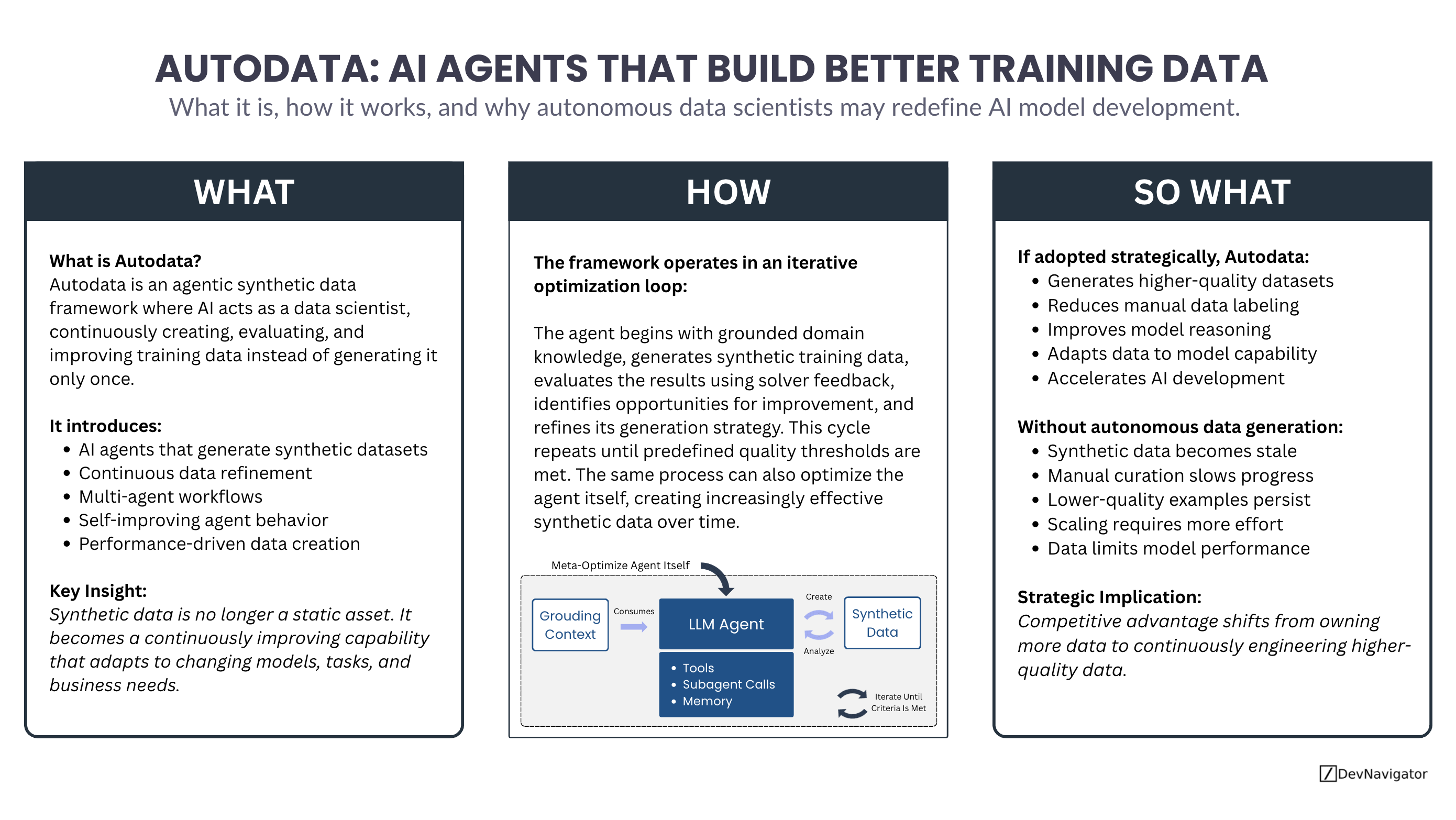
Autodata introduces a new way to think about synthetic data generation. Instead of relying on one-time prompts or manually curated datasets, it treats data creation as an ongoing optimization process. An AI agent takes on the role of a data scientist by generating training data, evaluating its quality, learning from feedback, and refining future datasets through continuous iteration. The result is higher-quality synthetic data that is better aligned with the capabilities of the models it is designed to train. As AI systems continue to improve, approaches like Autodata may become an important way to convert additional inference compute into stronger training data rather than simply building larger models.
Table of Contents
Executive Takeaways
- Autodata transforms synthetic data generation into a continuous learning process instead of a one-time generation task.
- AI agents can iteratively improve both the quality of training data and the process used to generate it through evaluation and feedback.
- As synthetic data becomes more important for modern AI systems, autonomous data generation could reduce manual effort while improving downstream model performance.
Expanded Insights
Autodata Treats AI Like a Data Scientist
Traditional synthetic data generation typically follows a simple workflow. A model receives a prompt, generates a dataset, and the process ends. Autodata replaces this static approach with an autonomous workflow where an AI agent performs many of the same activities as a human data scientist.
The agent generates synthetic data, evaluates whether it achieves the desired outcome, analyzes failures, updates its strategy, and repeats the process until predefined quality criteria are satisfied. Rather than viewing synthetic data as a finished product, Autodata treats it as something that continuously evolves through experimentation and feedback.
This shift is significant because the quality of modern AI systems increasingly depends on the quality of their training data.
Data Quality Becomes the Optimization Target
One of the most interesting aspects of Autodata is that success is measured by model performance rather than by the appearance of the generated dataset.
Instead of asking whether a question looks challenging, the framework evaluates how different models actually perform on it. If weaker models solve the task too easily, the agent generates more difficult examples. If even stronger models struggle, the agent simplifies the task until it becomes an effective learning signal.
This creates training datasets that are intentionally calibrated to the capability of the target model rather than relying on human intuition alone.
Continuous Improvement Extends Beyond the Dataset
The paper also introduces an outer optimization loop that improves the agent responsible for creating the data.
As the framework gathers experience, it identifies weaknesses in its own prompting strategy, modifies its behavior, and evaluates whether those changes produce better synthetic datasets. In effect, Autodata is capable of improving not only the training data but also the data scientist responsible for generating it.
This represents an important evolution in agentic AI. The system is no longer limited to completing tasks. It is continuously improving how those tasks are performed.
Why This Matters for Enterprise AI
Organizations often focus on selecting the right model, increasing context windows, or scaling infrastructure. Those investments are valuable, but they do not address one of the largest constraints on AI performance: data quality.
High-quality datasets remain expensive to build, maintain, and refresh. Autonomous approaches such as Autodata have the potential to reduce that burden by automatically generating and refining new examples as business requirements evolve.
For enterprises building domain-specific AI systems, this could eventually shorten development cycles while reducing dependence on manual data engineering and annotation.
The Future May Belong to Autonomous Data Engineering
The biggest contribution of Autodata is not simply that it generates synthetic data. It reframes synthetic data generation as a continuous capability rather than a one-time project.
Future AI systems may spend as much effort improving their own training data as they spend solving user requests. As models become increasingly capable, better data may provide greater returns than simply adding more parameters or larger compute budgets.
Autodata represents an early example of this direction. It suggests that the next phase of AI development may be defined not only by smarter models, but by autonomous systems that continuously engineer the data those models learn from.