
AI Verifiers: 3 Powerful Layers Making Autonomous AI More Reliable
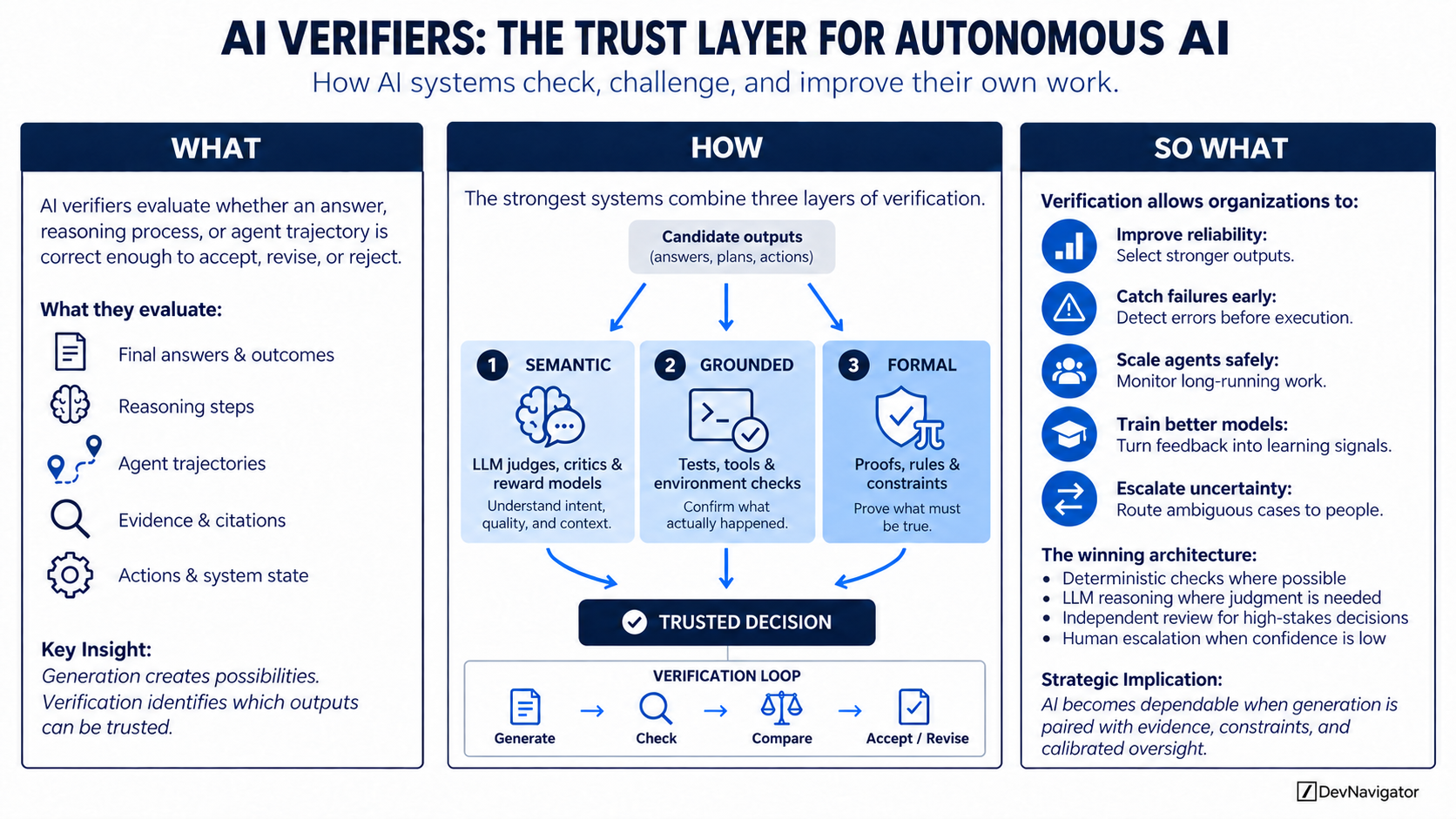
AI systems can now generate answers, write code, use tools, and complete increasingly complex workflows. Yet generation alone cannot tell us whether the result is correct. AI verifiers provide the missing trust layer by evaluating outputs, inspecting evidence, testing outcomes, and deciding whether work should be accepted, revised, rejected, or escalated.
Table of Contents
Executive Takeaways
- AI verifiers evaluate more than final answers. They can examine reasoning steps, evidence, agent trajectories, actions, and changes to system state.
- The strongest verification architecture combines three layers: semantic judgment, grounded execution checks, and formal rules or proofs.
- Verification could become AI’s next scaling frontier. Better selection and feedback can improve reliability without requiring a larger underlying model.
Expanded Insights
What Are AI Verifiers?
Artificial intelligence is becoming extraordinarily good at generating possibilities. A model can propose an answer, produce several plans, write software, analyze evidence, or execute a sequence of actions across multiple systems.
The harder problem is determining which result should be trusted.
AI verifiers evaluate whether an output or action is correct enough to accept, revise, or reject. Depending on the application, they may inspect:
- Final answers and outcomes
- Intermediate reasoning steps
- Agent actions and trajectories
- Supporting evidence and citations
- Tool results and system state
- Compliance with rules and constraints
This expands on the familiar idea of an “LLM-as-a-Judge.” A judge usually scores or compares answers. A verifier can take a more active role by gathering evidence, executing tests, challenging assumptions, monitoring progress, or confirming that an agent’s actions produced the intended result.
LLM-as-a-Verifier: A More Granular Judge
A recent framework called LLM-as-a-Verifier evaluates complete agent trajectories without requiring additional model training.
Traditional LLM judges typically return a discrete score, such as seven out of ten. That single number conceals the model’s underlying uncertainty. The model may have considered a six, seven, and eight nearly equally likely, but only one score appears.
LLM-as-a-Verifier instead calculates an expected score using the probability distribution across the possible scoring tokens. This produces a more continuous signal that can better distinguish similar candidates.
The framework scales verification through:
- Score granularity: Use additional scoring levels to distinguish closely matched outputs.
- Repeated evaluation: Average multiple assessments to reduce variability.
- Criteria decomposition: Evaluate correctness, completeness, efficiency, and other dimensions independently.
In the researchers’ experiments, verifier-based selection improved results on Terminal-Bench V2, SWE-Bench Verified, and MedAgentBench. The same verifier signals were also used to estimate task progress and provide denser feedback for reinforcement learning.
The important distinction is that this remains probabilistic judgment. A more precise model score is valuable, but it is not equivalent to objective evidence or proof.
How: The Three Layers of Verification
1. Semantic Verification
Semantic verifiers use language or multimodal models to evaluate meaning, quality, intent, and reasoning.
This category includes LLM judges, critic models, reward models, process verifiers, and multi-agent review systems. These systems are useful when correctness cannot be captured entirely by deterministic rules—for example, whether a report is complete, an argument is balanced, or a response addresses the user’s actual intent.
Their strength is flexibility. Their weakness is that the verifier may share the generator’s biases, blind spots, or misconceptions.
2. Grounded Verification
Grounded verification checks what actually happened using observable evidence.
A grounded verifier might run unit tests, validate citations, inspect files, compare database states, replay agent actions, execute calculations, or confirm API responses.
This is often more reliable than asking whether an answer merely appears correct. Code either passes its tests or it does not. A record either changed correctly or it did not.
However, these checks are only as complete as the tests and evidence behind them. A system can satisfy an incomplete test while still missing the user’s broader intent.
3. Formal Verification
Formal verification expresses requirements as mathematical rules that can be proven or disproven by deterministic systems.
Proof assistants such as Lean, constraint solvers such as Z3, static analyzers, type systems, and model-checking tools can verify whether an output satisfies a defined specification. Google DeepMind’s AlphaProof demonstrates this approach by constructing mathematical proofs that must pass the Lean proof checker.
Formal methods provide the strongest guarantees, but only relative to the specification. If the specification is incomplete, the proof may be correct while the underlying requirement is wrong.
So What: Verification Makes Autonomy Dependable
The future of AI verifiers is unlikely to involve one model grading another model in isolation. The strongest systems will combine model judgment with evidence, executable tests, formal constraints, independent review, and human escalation.
This matters because verification can:
- Select stronger results from several candidates
- Detect failures before actions are executed
- Monitor long-running agents
- Convert feedback into learning signals
- Escalate ambiguous or high-risk decisions
- Create an auditable boundary between generation and action
The model is therefore only one component of a dependable AI system. The surrounding verification architecture determines where that model can operate safely and how much autonomy it should receive.