
EU AI Act: 4 Important Takeaways Every AI Leader Must Know
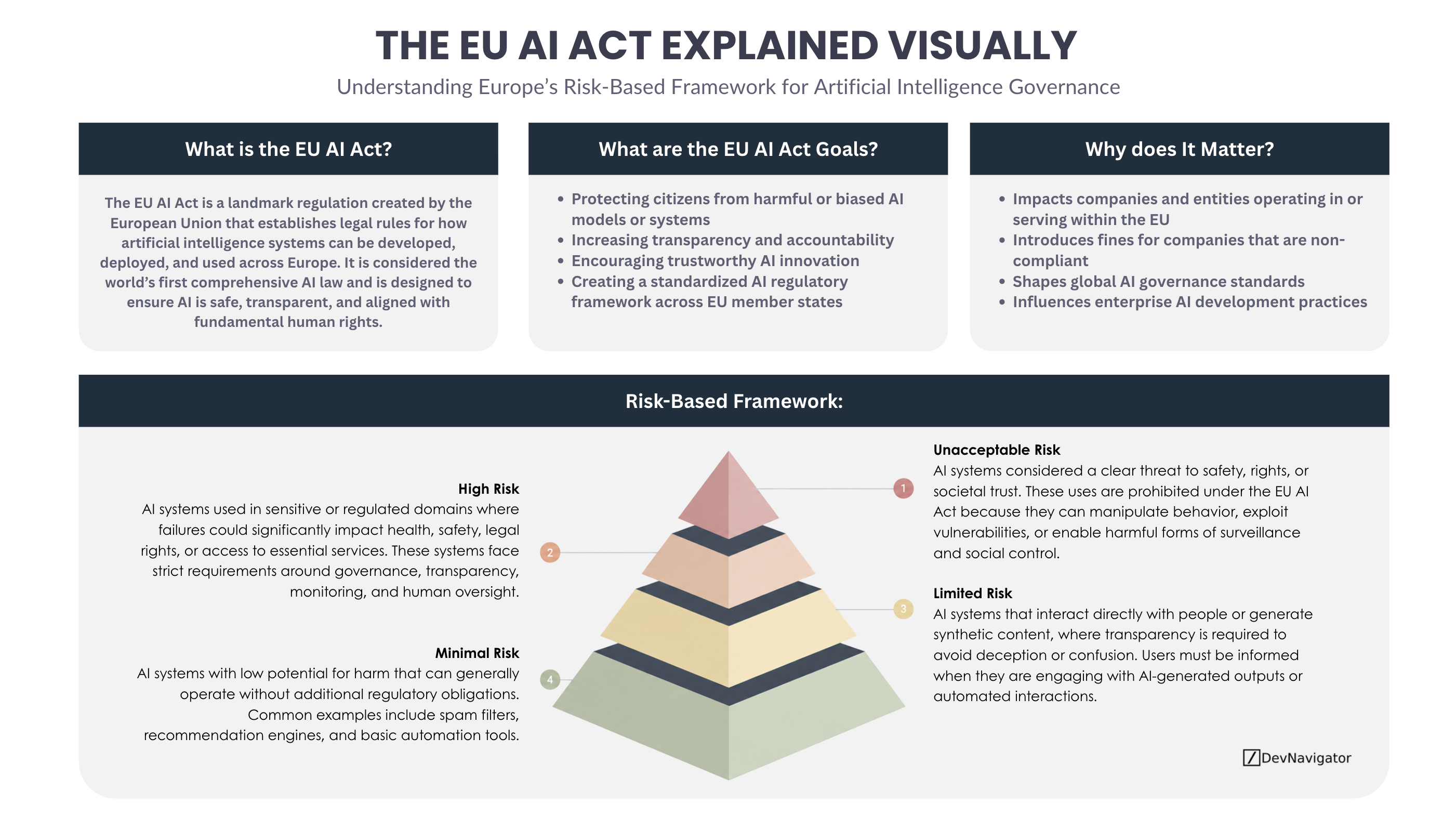
The EU AI Act is rapidly becoming one of the most important regulatory frameworks shaping the future of artificial intelligence. Designed by the European Union, the EU AI Act introduces a risk-based approach that categorizes AI systems according to their potential impact on safety, rights, and society. While many organizations associate AI regulation with compliance burdens, the EU AI Act is also creating clearer expectations for responsible AI development, governance, and transparency.
For enterprise leaders, developers, and data science teams, understanding the EU AI Act is no longer optional. Even companies outside Europe may be affected if their AI systems are used within the EU market. This visual guide breaks down the four major risk categories and explains why the EU AI Act is influencing global AI strategy far beyond Europe itself.
Table of Contents
Executive Takeaways
- The EU AI Act uses a risk-based framework that applies stricter requirements to AI systems with higher potential for harm.
- High-risk AI systems face extensive obligations around governance, transparency, documentation, monitoring, and human oversight.
- The EU AI Act is influencing global AI governance standards and will likely shape how enterprises operationalize AI worldwide.
Expanded Insights
What Is the EU AI Act?
The EU AI Act is a comprehensive artificial intelligence regulation developed by the European Union to establish rules for how AI systems are created, deployed, and monitored. The primary objective of the EU AI Act is to ensure that AI technologies remain safe, transparent, and aligned with fundamental human rights.
Unlike many earlier technology regulations that focused primarily on privacy or cybersecurity, the European AI Act directly addresses how AI systems themselves operate and impact society. This includes concerns around algorithmic bias, transparency, automated decision-making, and harmful uses of artificial intelligence.
One reason the EU AI Act has attracted global attention is because it introduces one of the first large-scale legal frameworks specifically focused on AI governance. Organizations building or deploying AI systems in Europe may need to demonstrate compliance depending on how their systems are classified.
The Risk-Based Framework Behind the EU AI Act
At the core of the European AI Act is a simple principle:
The greater the potential harm created by an AI system, the stricter the regulatory requirements.
The European AI Act divides AI systems into four major risk categories.
Unacceptable Risk
The highest category within the European AI Act includes AI systems considered a direct threat to safety, rights, or democratic values. These uses are prohibited within the European Union.
Examples may include manipulative AI systems, exploitative behavioral systems targeting vulnerable populations, or certain forms of social scoring and surveillance technologies.
This category represents the strongest restrictions within the European AI Act because regulators view these systems as fundamentally incompatible with European values and rights protections.
High Risk
High-risk systems are among the most important categories for enterprises to understand under the EU AI Act.
These systems may be used in areas such as:
- Hiring and recruiting
- Healthcare and medical diagnostics
- Financial services
- Education
- Critical infrastructure
- Law enforcement
Under the EU AI Act, high-risk AI systems must meet extensive requirements around risk management, human oversight, documentation, transparency, cybersecurity, monitoring, and data governance.
For many organizations, this is the category that will require the largest operational and governance investments.
Limited Risk and Minimal Risk Systems
Not every AI system falls into heavily regulated territory under the European AI Act.
Limited Risk
Limited-risk systems typically involve AI systems that interact directly with people or generate synthetic content. Examples may include chatbots or AI-generated media.
The EU AI Act generally focuses on transparency obligations for these systems. Users should understand when they are interacting with AI or consuming AI-generated outputs.
Minimal Risk
Minimal-risk systems face very limited obligations under the European AI Act. These systems are considered low risk and include common technologies such as spam filters, recommendation engines, and basic automation tools.
This approach allows the European AI Act to avoid overregulating lower-risk innovation while still focusing attention on systems with greater societal impact.
Why the EU AI Act Matters Globally
Although the European AI Act originates in Europe, its influence will likely extend well beyond EU borders.
Many multinational companies operate across global markets and may choose to standardize AI governance practices to align with EU requirements. Similar patterns emerged after the introduction of GDPR, which influenced privacy practices worldwide.
The AI Act is also accelerating conversations around responsible AI, enterprise governance, model transparency, and operational accountability. As organizations scale generative AI and agentic AI systems, regulatory expectations around oversight and risk management will likely continue to grow.
For leaders in AI, data science, and enterprise operations, the AI Act represents more than regulation. It signals the beginning of a broader shift toward structured, accountable, and production-ready AI governance.