
AI Chatbot Data Collection Exposed: 7 Hard Truths About What You Reveal When You Chat
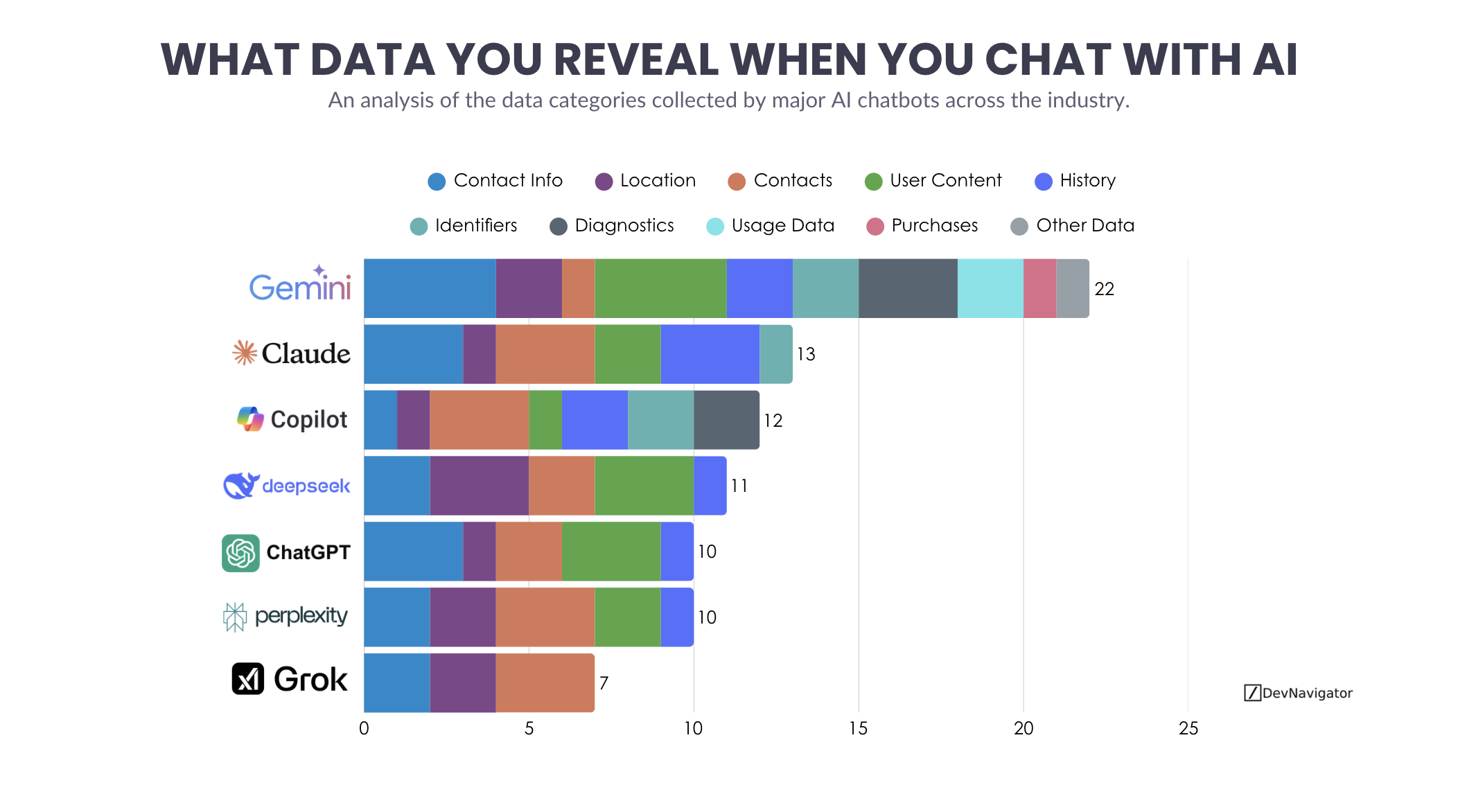
AI chatbots have become embedded in daily work, from drafting documents to accelerating analysis and decision-making. Yet behind every prompt lies a less visible exchange: data. AI chatbot data collection varies significantly across platforms, shaping not only user experience but also privacy risk, governance complexity, and enterprise readiness. This article examines how major AI chatbots differ in the data categories they collect, why those differences exist, and what leaders should consider when deploying these tools in professional and regulated environments.
Table of Contents
Executive Takeaways
- AI chatbot data collection differs dramatically across platforms, with some tools collecting more than double the number of data categories compared to others.
- Identifiers, usage data, and user-generated content are consistently collected across nearly all major AI chatbots, forming the core of AI interaction data.
- Organizations integrating AI into enterprise workflows must treat AI chatbot data collection as a governance decision, not just a technology choice.
Expanded Insights
Why AI Chatbot Data Collection Exists
AI systems rely on data to function effectively. At a baseline, AI chatbot data collection supports response accuracy, system reliability, and service improvement. User content provides context for generating relevant answers, while usage data helps platforms understand performance patterns and demand. Identifiers and diagnostics enable account continuity, security, and troubleshooting.
However, the scope of AI chatbot data collection is shaped by design philosophy. Some platforms emphasize deep personalization and ecosystem integration, while others prioritize minimalism and privacy alignment. These strategic choices directly influence how much data is collected and retained during everyday interactions.
Comparing Data Footprints Across AI Chatbots
When comparing AI chatbot data collection across leading platforms, the variation is striking. Tools like Gemini collect a broad range of categories, including identifiers, usage data, diagnostics, contacts, and historical interactions. This approach supports advanced personalization and cross-product integration but expands the overall data footprint.
In contrast, platforms such as Perplexity and Grok collect fewer categories. Their AI chatbot data collection strategies favor lighter-weight usage models, often appealing to users who value reduced data exposure. Other platforms, including ChatGPT, Claude, Copilot, and DeepSeek, fall somewhere in between, balancing performance, usability, and data governance considerations.
These differences are not inherently good or bad. They reflect trade-offs between capability depth and privacy surface area.
What This Means for Enterprises and Regulated Industries
For enterprises, AI chatbot data collection has real operational implications. In regulated environments like pharmaceuticals, healthcare, finance, and legal services, data categories such as user content, interaction history, and diagnostics can intersect with compliance obligations.
Organizations must consider how AI chatbot data collection aligns with internal policies on data residency, auditability, retention, and acceptable use. A chatbot that captures extensive usage history may improve continuity and insights, but it may also introduce additional review requirements under regulatory frameworks.
This is especially relevant when AI tools move from experimentation into production workflows. What feels acceptable for individual productivity may require stricter controls when scaled across teams handling sensitive or proprietary information.
The Trade-Off Between Performance and Exposure
One of the central tensions in AI chatbot data collection is the balance between value and risk. Richer data enables better contextual understanding, improved personalization, and more seamless experiences across devices and applications. At the same time, every additional data category increases the surface area for potential misuse, misconfiguration, or regulatory scrutiny.
Leaders should recognize that AI chatbot data collection decisions shape long-term trust. Employees are more likely to adopt AI tools when expectations around data use are transparent and aligned with organizational values.
Choosing AI Tools With Intentionality
Selecting an AI chatbot should not be driven solely by feature lists or model benchmarks. AI chatbot data collection deserves equal consideration. Understanding what data is collected, why it is collected, and how it is governed allows organizations to deploy AI responsibly.
For privacy-conscious users and enterprises alike, comparing AI chatbot data collection practices is becoming a necessary step. As AI continues to mature, the most successful deployments will be those that pair technical capability with clear governance, risk awareness, and informed choice.
Ultimately, every prompt reveals more than just a question. AI chatbot data collection determines how much of that interaction becomes part of a broader digital footprint, making awareness a critical component of modern AI adoption.