OpenClaw AI Agent: 5 Powerful Reasons This Local-First Assistant Is Changing Personal Automation
The OpenClaw AI Agent represents a new category of personal automation tools that move beyond traditional chatbots. Instead of only answering questions, the OpenClaw AI Agent can execute real actions on a user’s machine by connecting messaging platforms, system tools, and external APIs. This local-first design allows users to interact with an AI assistant through familiar messaging apps while maintaining control over their data and environment.
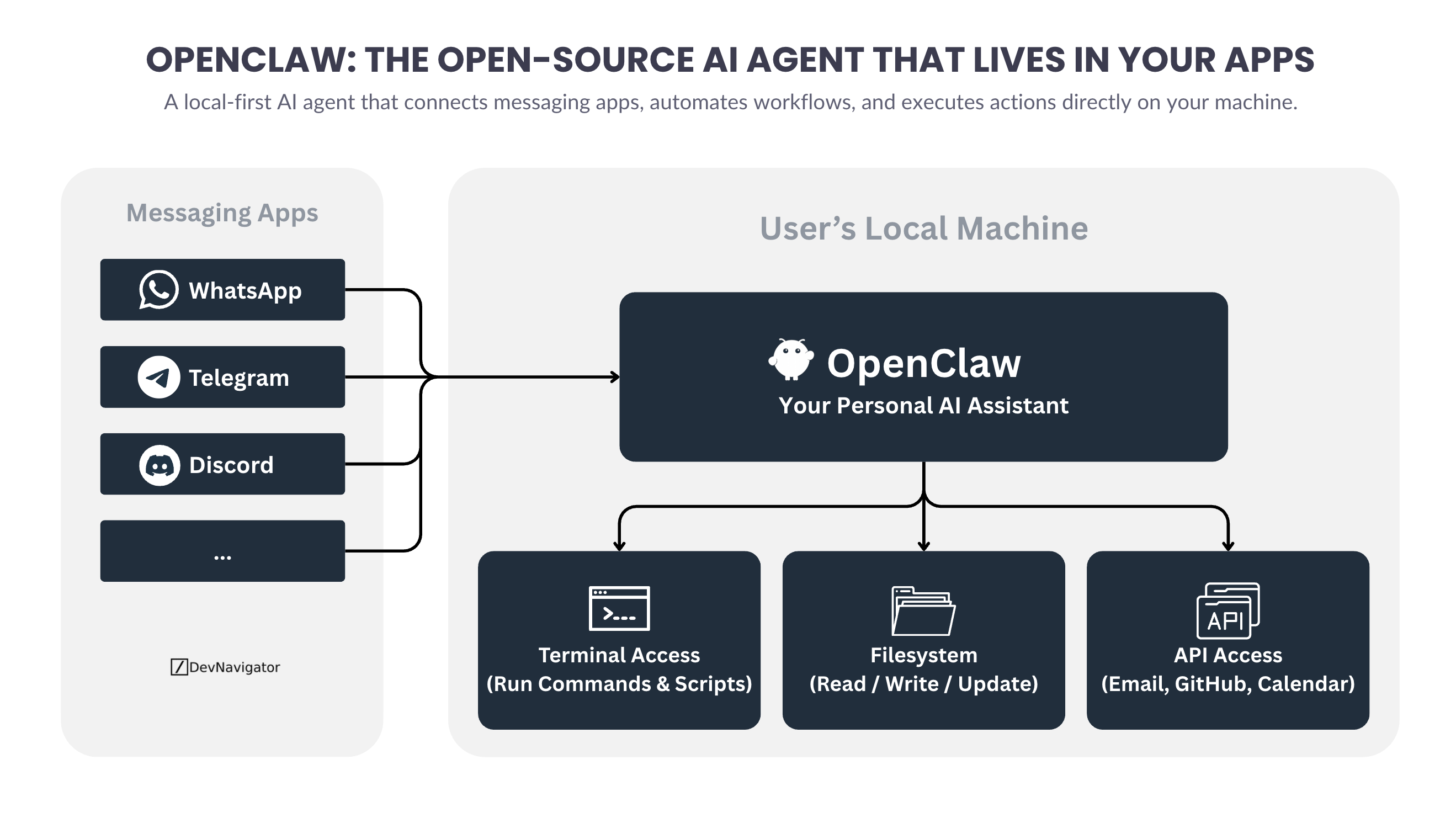
In this architecture, the OpenClaw AI Agent acts as a bridge between communication channels and local system capabilities. Messages received through apps such as WhatsApp, Telegram, or Discord are interpreted by the AI, which can then trigger actions through terminal commands, filesystem operations, or external APIs. The result is a flexible automation system capable of handling development tasks, personal workflows, and integrations without relying entirely on cloud infrastructure.
Table of Contents
Executive Takeaways
- The OpenClaw AI Agent enables real system actions, allowing AI assistants to execute commands, interact with files, and trigger APIs directly on a user’s machine.
- Local-first architecture improves privacy and control, since the OpenClaw AI Agent operates primarily on the user’s local environment rather than relying solely on cloud services.
- Messaging apps become command interfaces, allowing users to control their OpenClaw AI Agent through platforms like WhatsApp, Telegram, and Discord.
Expanded Insights
The Rise of the OpenClaw AI Agent
The OpenClaw AI Agent is part of a growing movement toward agent-based AI systems that do more than generate text. Traditional AI chat interfaces are designed to answer questions, summarize information, or produce content. While useful, these systems often stop short of taking meaningful actions in a user’s environment.
The OpenClaw AI Agent introduces a different model. Instead of treating AI as a conversational assistant, it treats the AI as an automation orchestrator capable of executing tasks across multiple tools. By combining messaging platforms, local computing resources, and external services, the OpenClaw AI Agent transforms natural language instructions into operational workflows.
This shift aligns with a broader trend in AI development where language models serve as decision engines that coordinate real software tools.
Messaging Platforms as AI Control Interfaces
One of the most distinctive features of the OpenClaw AI Agent is its use of messaging platforms as the primary interface. Instead of building a dedicated application, the AI Agent integrates with common communication tools such as WhatsApp, Telegram, and Discord.
Users interact with the system by sending messages in these platforms. The AI Agent receives the message, interprets the intent using an AI model, and determines the actions required to fulfill the request.
This approach offers two advantages. First, it lowers the barrier to entry since users already understand how messaging apps work. Second, it enables asynchronous interaction where the AI Agent can execute tasks in the background while reporting results through the same chat interface.
How the OpenClaw AI Agent Executes Tasks
The operational power of this AI Agent comes from its access to local system tools. After interpreting a user request, the agent can call several types of capabilities available on the machine.
Terminal access allows this AI Agent to execute shell commands or run scripts. This capability makes it useful for developers who want to automate routine tasks such as running build processes, launching applications, or managing development environments.
Filesystem access allows this AI Agent to read, write, or update files. For example, the assistant could generate a document, update configuration files, or organize directories automatically.
API integrations extend this AI Agent beyond the local machine. Through APIs the assistant can interact with services such as email platforms, GitHub repositories, or calendar systems. This enables the AI agent to coordinate workflows across multiple tools.
Why Local-First AI Matters
Many AI assistants operate primarily in cloud environments, which can create concerns around privacy, security, and data ownership. The OpenClaw AI Agent addresses this by focusing on a local-first architecture.
In a local-first system, the core runtime operates on the user’s machine rather than a remote server. This approach allows users to maintain greater control over their data and how the AI interacts with their environment.
It also improves extensibility. Because this AI Agent runs locally, developers can extend it with custom scripts, integrations, or tools that match their workflows.
The Future of Personal AI Agents
The OpenClaw AI Agent illustrates how AI assistants are evolving from passive chat interfaces into active software agents. By connecting messaging platforms, local system tools, and external APIs, the OpenClaw AI Agent provides a glimpse into how individuals might manage automation in the future.
Instead of switching between multiple applications, users can delegate tasks through natural language instructions. The AI interprets the request, selects the appropriate tools, and executes the workflow.
As agent frameworks continue to mature, systems like the OpenClaw AI Agent could become central to how individuals manage development environments, personal productivity, and digital infrastructure.