Find the visual for the conversation you need to lead.
Search all 157 DevNavigator articles and infographics by keyword, category, or tag.
3 visualsPage 1 of 1
AI & Data Science · Apr 4, 2026
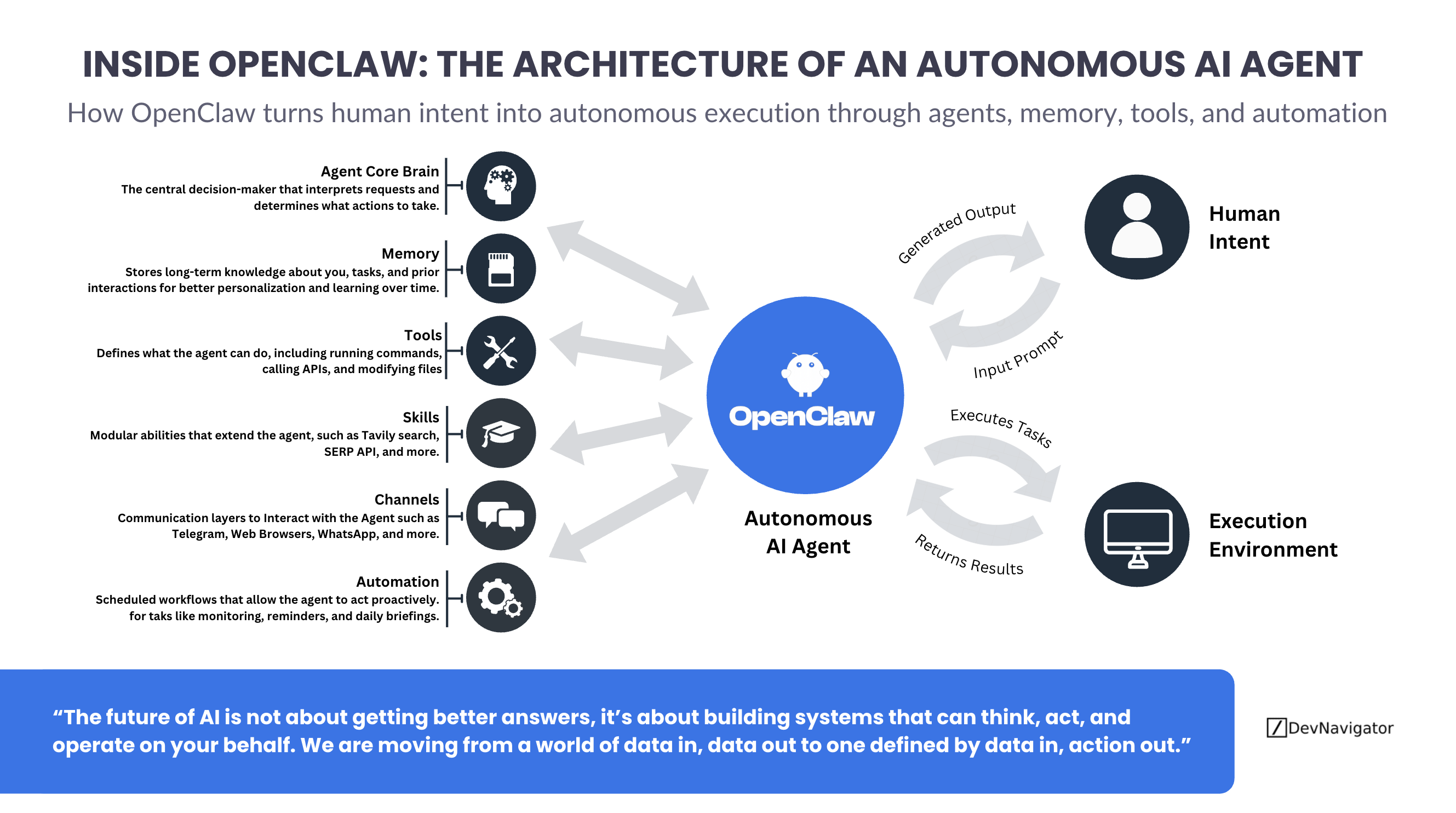
OpenClaw Architecture: 6 Powerful Components That Turn AI Into Action, Not Just Answers
Most AI tools today are built for interaction. You ask a question, you get an answer, and the process stops there. The OpenClaw architecture, like many others up and coming packages, represents a shift away from that model. Instead of focusing on responses, it focuses on execution. This article breaks down the OpenClaw architecture into its six core components and explains how they work together to turn human intent into real-world action. If you have been using AI as a tool, this is the framework that shows what it looks like when AI becomes an assistant.
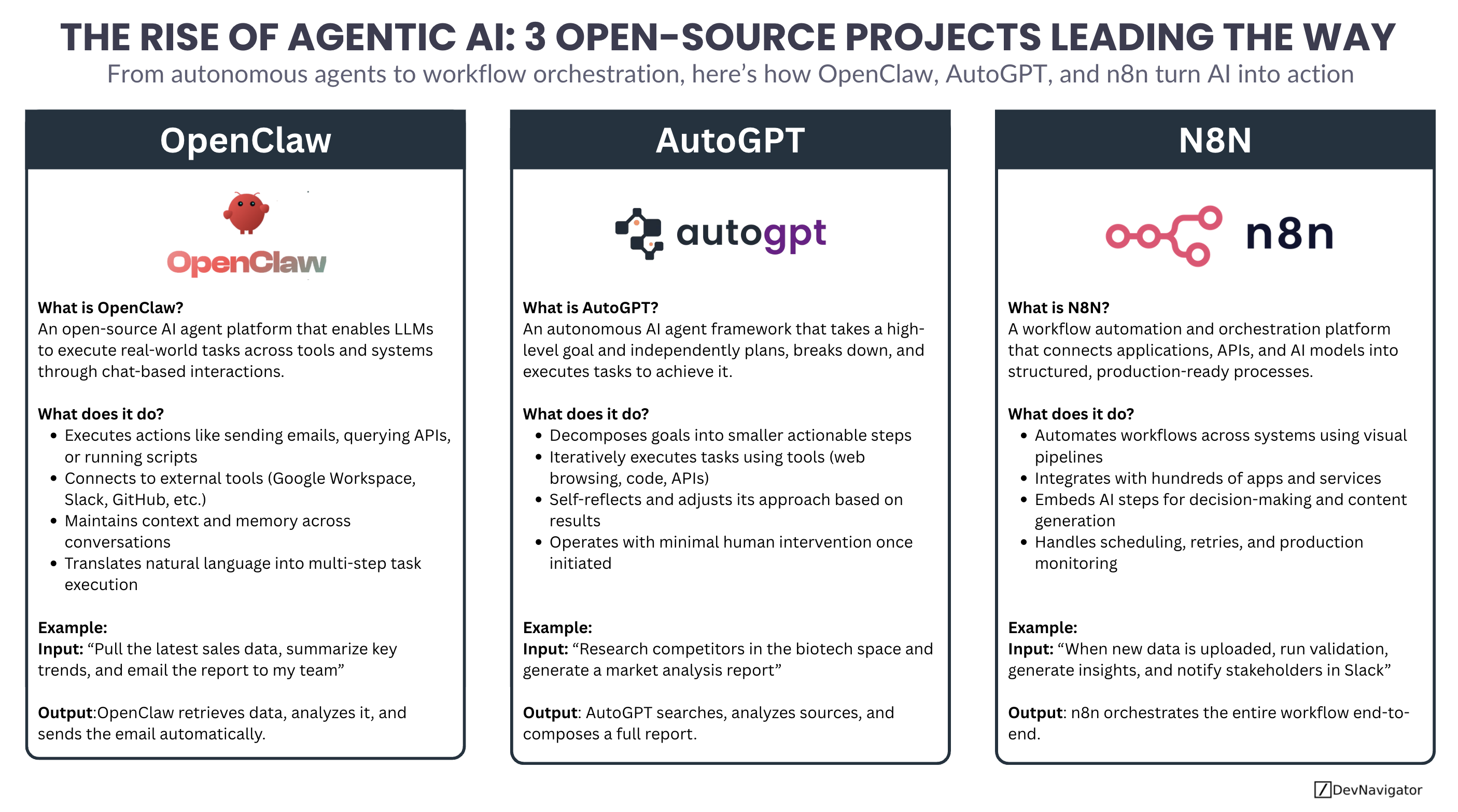
Agentic AI Open Source: 3 Powerful Projects Transforming How AI Gets Work Done
The rise of Agentic AI Open Source projects is reshaping how organizations and individuals use artificial intelligence. Instead of limiting AI to generating text or insights, these systems enable models to take action, interact with tools, and execute workflows. Three standout examples leading this shift are OpenClaw, AutoGPT, and n8n.
Each represents a different layer of the agent ecosystem. OpenClaw focuses on local-first personal agents that execute tasks through messaging interfaces. AutoGPT pushes toward autonomous agents that plan and execute multi-step objectives. n8n brings structured workflow orchestration, enabling production-ready automation across systems.
Together, these Agentic AI Open Source tools illustrate a broader transition from passive AI to active systems that can operate across environments, integrate with APIs, and deliver real outcomes.
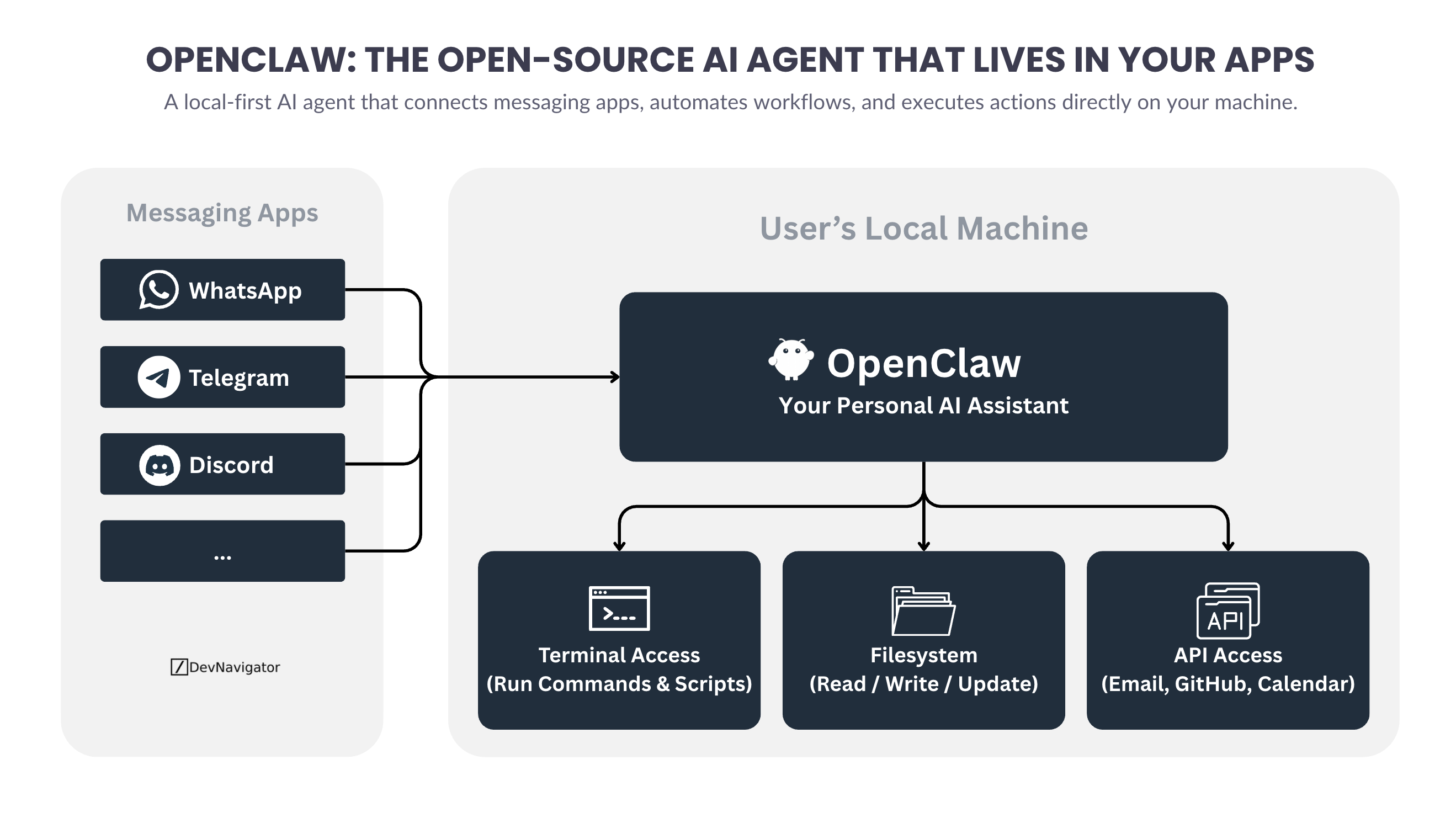
OpenClaw AI Agent: 5 Powerful Reasons This Local-First Assistant Is Changing Personal Automation
The OpenClaw AI Agent represents a new category of personal automation tools that move beyond traditional chatbots. Instead of only answering questions, the OpenClaw AI Agent can execute real actions on a user’s machine by connecting messaging platforms, system tools, and external APIs. This local-first design allows users to interact with an AI assistant through familiar messaging apps while maintaining control over their data and environment.
In this architecture, the OpenClaw AI Agent acts as a bridge between communication channels and local system capabilities. Messages received through apps such as WhatsApp, Telegram, or Discord are interpreted by the AI, which can then trigger actions through terminal commands, filesystem operations, or external APIs. The result is a flexible automation system capable of handling development tasks, personal workflows, and integrations without relying entirely on cloud infrastructure.

 AI & Data Science · Apr 4, 2026
 AI & Data Science · Mar 20, 2026
 AI & Data Science · Mar 16, 2026