
Agentic AI Open Source: 3 Powerful Projects Transforming How AI Gets Work Done
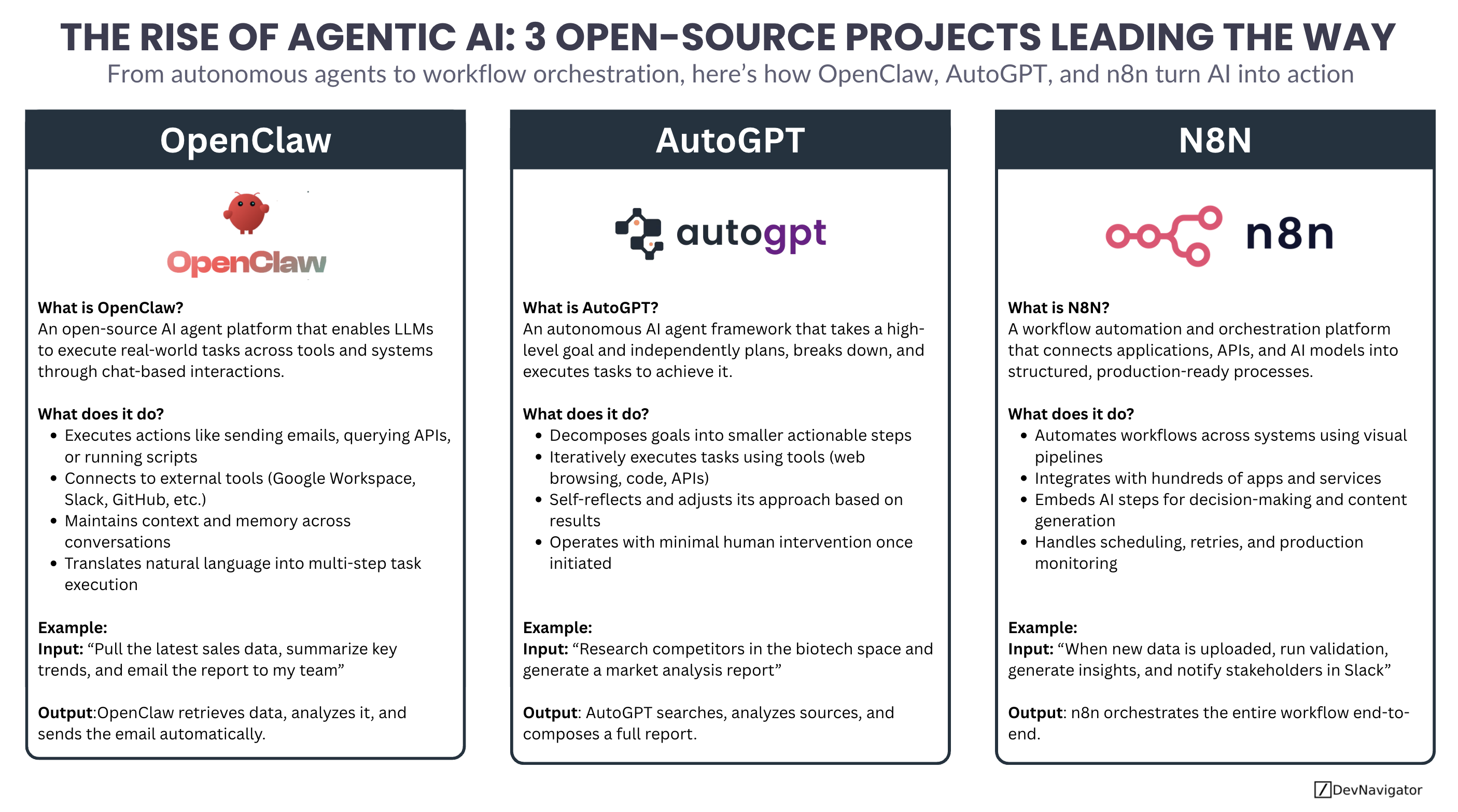
The rise of Agentic AI Open Source projects is reshaping how organizations and individuals use artificial intelligence. Instead of limiting AI to generating text or insights, these systems enable models to take action, interact with tools, and execute workflows. Three standout examples leading this shift are OpenClaw, AutoGPT, and n8n.
Each represents a different layer of the agent ecosystem. OpenClaw focuses on local-first personal agents that execute tasks through messaging interfaces. AutoGPT pushes toward autonomous agents that plan and execute multi-step objectives. n8n brings structured workflow orchestration, enabling production-ready automation across systems.
Together, these Agentic AI Open Source tools illustrate a broader transition from passive AI to active systems that can operate across environments, integrate with APIs, and deliver real outcomes.
Table of Contents
Executive Takeaways
- Agentic AI Open Source tools are shifting AI from insight to action, enabling systems to execute tasks across tools, APIs, and environments.
- Each project targets a different layer of automation, with OpenClaw focusing on local agents, AutoGPT on autonomy, and n8n on orchestration.
- The future of AI lies in combining these approaches, where reasoning, execution, and workflow management operate together.
Expanded Insights
The Emergence of Agentic AI Open Source
The concept of Agentic AI Open Source reflects a growing shift in how AI systems are designed. Traditional models respond to prompts, but agentic systems go further by planning actions, selecting tools, and executing workflows.
This shift is driven by the need for AI to operate in real environments. Businesses and developers are no longer satisfied with answers alone. They want systems that can complete tasks such as sending emails, analyzing data, or orchestrating workflows.
The rise of Agentic AI Open Source projects makes this possible by providing frameworks that connect language models with tools, APIs, and execution layers.
OpenClaw and the Local-First Agent Model
OpenClaw represents a unique approach within the Agentic AI Open Source landscape by focusing on local execution and messaging-based interaction.
Rather than relying entirely on cloud infrastructure, OpenClaw runs on a user’s machine and connects to messaging platforms like WhatsApp, Telegram, and Discord. This allows users to interact with their AI assistant in a familiar way while maintaining control over local resources.
The OpenClaw agent can execute terminal commands, manipulate files, and interact with APIs. This makes it particularly useful for personal automation and developer workflows where local context matters.
Within the broader Agentic AI Open Source ecosystem, OpenClaw emphasizes privacy, control, and direct system access.
AutoGPT and Autonomous Task Execution
AutoGPT takes a different approach by focusing on autonomy. In the Agentic AI Open Source space, it is one of the most well-known examples of a system that can take a high-level goal and break it down into actionable steps.
Instead of requiring constant user input, AutoGPT plans tasks, executes them iteratively, and adjusts its approach based on results. It often uses tools such as web browsing, code execution, and APIs to complete objectives.
This makes AutoGPT well suited for research, analysis, and exploratory tasks. However, it also highlights the challenges of agentic systems, including reliability, cost, and the need for oversight.
Even with these challenges, AutoGPT demonstrates the potential of Agentic AI Open Source systems to operate with a higher degree of independence.
n8n and Workflow Orchestration at Scale
While OpenClaw and AutoGPT focus on agents, n8n brings structure to the Agentic AI Open Source ecosystem through workflow orchestration.
n8n is a visual automation platform that connects applications, APIs, and services into structured pipelines. It allows users to define workflows that can include AI steps alongside traditional automation tasks.
For example, a workflow might trigger when new data is uploaded, run validation checks, generate insights using AI, and notify stakeholders through Slack or email.
n8n’s strength lies in its ability to manage production workflows with scheduling, retries, and monitoring. In the context of Agentic AI Open Source, it provides the backbone needed to operationalize AI-driven processes.
Bringing It All Together
The most important takeaway from these three projects is how they complement each other. The future of Agentic AI Open Source is not about choosing one approach but combining them.
OpenClaw provides local execution and user interaction. AutoGPT introduces autonomous reasoning and task planning. n8n delivers structured orchestration and scalability.
Together, they form a blueprint for how AI systems can evolve into full automation platforms. As these tools continue to mature, the line between software and intelligent agents will continue to blur, shaping a new generation of systems that do more than assist, they act.