
Enterprise AI Transformation: The 3 Horizons That Drive Sustainable Competitive Advantage
Enterprise AI Transformation is no longer a technology initiative. It has become a business imperative. While many organizations have successfully launched AI pilots and proof-of-concept projects, far fewer have developed a structured roadmap for scaling AI across the enterprise and ultimately transforming how they operate.
The challenge is that AI adoption does not occur overnight. Organizations typically progress through distinct stages of maturity, each with different objectives, investments, risks, and expected outcomes. Understanding these stages can help leaders allocate resources effectively, manage expectations, and build momentum toward long-term value creation.
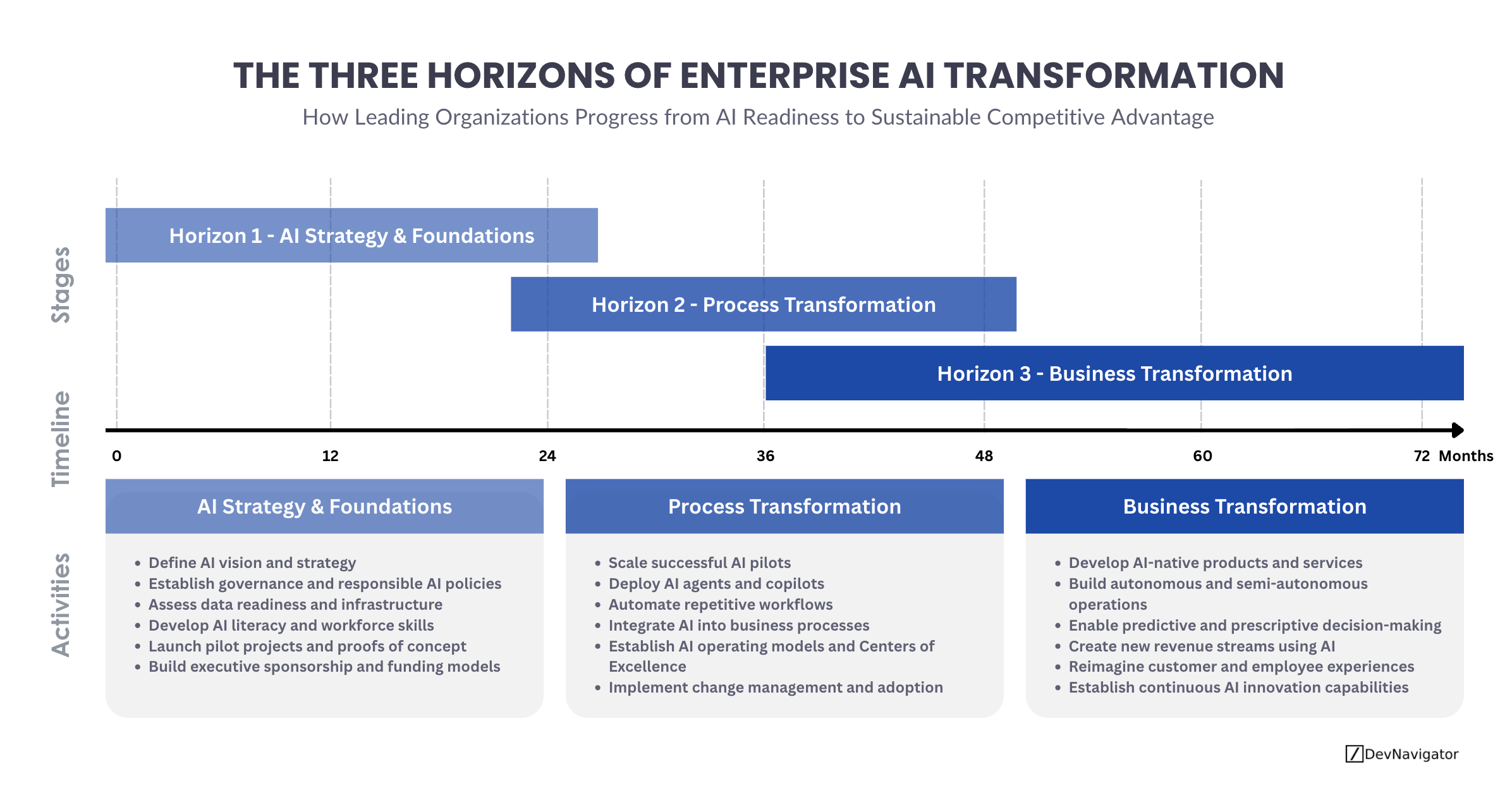
This framework introduces the three horizons of Enterprise AI Transformation, providing a practical view of how organizations move from foundational readiness to operational transformation and ultimately to AI-enabled business reinvention.
Table of Contents
Executive Takeaways
- Enterprise AI Transformation is a journey, not a single project. Organizations must build foundational capabilities before attempting large-scale transformation.
- The greatest value often emerges during the second horizon. Process redesign, AI agents, automation, and enterprise adoption frequently generate the most immediate operational benefits.
- Long-term competitive advantage comes from business transformation. Organizations that successfully reach the third horizon use AI to create new products, services, operating models, and revenue streams.
Expanded Insights
Horizon 1: Building the Foundation for Enterprise AI Transformation
The first stage of Enterprise AI Transformation focuses on readiness. Before organizations can scale AI successfully, they must establish the capabilities required to support long-term adoption.
This phase often begins with defining an AI vision and strategy that aligns with business objectives. Leadership teams identify priority use cases, establish governance frameworks, and develop policies that promote responsible AI adoption. Data readiness assessments are equally important, since AI systems depend heavily on high-quality, accessible, and trusted data.
Organizations also invest in workforce education and AI literacy. Employees need to understand how AI can support their work, while leaders need confidence that investments are aligned with measurable business outcomes.
Pilot projects and proof-of-concept initiatives play a critical role during this stage. Their purpose is not simply to demonstrate technical capability but to generate organizational learning and build confidence in future investments.
The primary outcome of this horizon is readiness. Organizations establish the foundation required to support future Enterprise AI Transformation efforts.
Horizon 2: Transforming Processes Through Scale
Once foundational capabilities are established, organizations enter the second stage of Enterprise AI Transformation. This horizon focuses on scaling successful pilots and integrating AI into everyday business operations.
Many organizations discover that isolated AI projects provide only limited value. Real impact occurs when AI becomes embedded within workflows, decision-making processes, and operational systems.
This stage frequently includes the deployment of AI assistants, copilots, intelligent automation platforms, and agent-based solutions. Organizations redesign workflows rather than simply automating existing tasks. As a result, productivity improvements can extend across departments such as operations, finance, supply chain, quality, customer service, and engineering.
Successful organizations also establish formal operating models for AI. Centers of Excellence, governance committees, and adoption programs help ensure consistency while reducing duplication of effort across business units.
Change management becomes particularly important during this horizon. Technology alone rarely delivers transformation. Employees must understand how new AI-enabled processes improve outcomes and support their day-to-day responsibilities.
For many organizations, this phase delivers the largest measurable return on investment within their Enterprise AI Transformation journey.
Horizon 3: Reinventing the Business with AI
The final stage represents the most ambitious form of Enterprise AI Transformation. Rather than improving existing processes, organizations begin fundamentally rethinking how they create value.
At this stage, AI becomes embedded within products, services, customer experiences, and business models. Decision-making becomes increasingly predictive and prescriptive. Some organizations deploy autonomous or semi-autonomous systems capable of executing complex workflows with limited human intervention.
AI-native products and services often emerge during this horizon. Companies may create entirely new offerings, open new revenue streams, or develop differentiated customer experiences that competitors struggle to replicate.
The most mature organizations view AI not as a standalone capability but as a core component of their operating model. Innovation becomes continuous rather than project-based, allowing the organization to adapt rapidly as technologies evolve.
This is where Enterprise AI Transformation delivers its most strategic outcome: sustainable competitive advantage.
The Importance of Managing All Three Horizons
One of the most common mistakes organizations make is focusing exclusively on a single horizon. Some invest heavily in experimentation without building the governance and infrastructure required for scale. Others attempt enterprise-wide deployment before foundational capabilities are mature.
Successful leaders recognize that all three horizons can exist simultaneously. While one team focuses on foundational capabilities, another may be scaling operational AI solutions, and a third may be exploring future business opportunities.
By managing these horizons intentionally, organizations can generate short-term value while positioning themselves for long-term transformation.
Ultimately, Enterprise AI Transformation is not about deploying technology. It is about building the capabilities, operating models, and culture necessary to compete in an increasingly AI-driven world. The organizations that understand and navigate these three horizons effectively will be best positioned to create lasting value in the years ahead.