
Enterprise AI Operating System: 6 Powerful Shifts Reshaping the Intelligent Enterprise
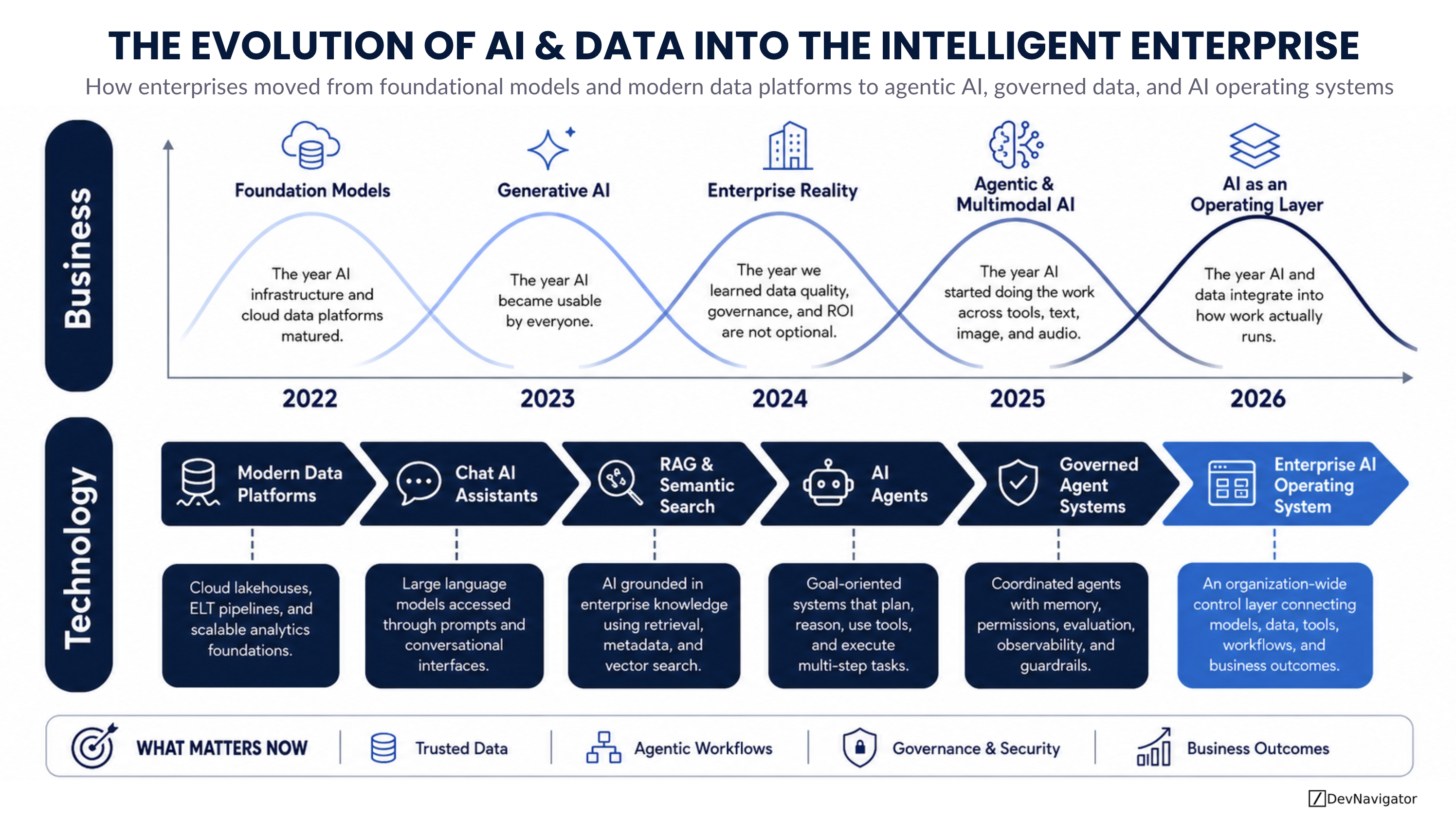
Enterprise AI has moved quickly from models and chat interfaces into systems capable of performing real work. The next stage is the Enterprise AI Operating System, an organization-wide layer that connects AI models, enterprise data, tools, agents, permissions, workflows, and governance.
This evolution changes the role of both AI and data. Data is no longer just used for dashboards and analytics. It becomes the context agents use to reason and act. AI is no longer simply a productivity tool. It increasingly becomes part of how work moves through the organization.
The companies that succeed will not be the ones with the most AI pilots. They will be the ones that build trusted data foundations, governed agentic workflows, and a scalable Enterprise AI Operating System tied directly to business outcomes.
Table of Contents
Executive Takeaways
- AI is moving from interaction to execution. Chat assistants helped employees access intelligence. AI agents increasingly plan, reason, use tools, and complete multi-step work.
- Data becomes operational infrastructure for AI. Trusted data, metadata, semantic context, permissions, and governance determine whether enterprise agents can produce reliable outcomes.
- The destination is an Enterprise AI Operating System. Individual agents will increasingly sit inside a governed enterprise layer connecting models, data, tools, workflows, and business decisions.
Expanded Insights
2022: AI and Data Become Infrastructure
The current transformation started with two foundations.
Cloud data platforms made it possible to centralize larger volumes of enterprise information, while foundation models demonstrated that general-purpose AI could perform tasks across language, code, analysis, and reasoning.
At this stage, systems were still largely model-centric. Companies built data pipelines, deployed individual models, and depended heavily on technical teams to turn data into usable applications.
The foundation was important, but intelligence was still separated from everyday business processes.
2023: Generative AI Makes Intelligence Accessible
Generative AI changed the interface.
Instead of requiring specialized analytics tools or machine learning applications, employees could interact with large language models using natural language.
Chat assistants rapidly became the most visible form of enterprise AI.
This significantly lowered the barrier to using artificial intelligence, but the model still depended on the employee to provide instructions, interpret the result, and perform the next action.
AI could answer the question. It rarely owned the workflow.
2024: Enterprise Reality Sets In
Once organizations began deploying generative AI broadly, the limitations became much clearer.
Models did not automatically understand proprietary terminology, internal processes, current enterprise information, or organizational rules.
That pushed companies toward retrieval-augmented generation, semantic search, metadata, vector search, and stronger data governance.
The lesson was simple: better models cannot compensate for unreliable enterprise context.
This is where data strategy and AI strategy began converging. Building an Enterprise AI Operating System requires AI-ready data that is trusted, discoverable, governed, and accessible in the right context.
2025: AI Starts Doing the Work
The next major change was agentic AI.
Instead of responding to an isolated prompt, an agent can receive a goal, determine a sequence of actions, retrieve information, use tools, interact with applications, evaluate intermediate results, and continue until the task is complete.
This moves enterprise AI from assistance toward execution.
A traditional assistant might explain why inventory is below target. An agentic system could identify the problem, retrieve relevant supply information, evaluate alternatives, prepare a recommendation, execute approved actions, and escalate exceptions.
The unit of automation is shifting from the individual task toward the workflow.
2026: Governance Becomes Part of the Technology
As agents gain autonomy, organizations need more than capable models.
They need identity, permissions, memory, evaluation, observability, cost management, security controls, and human approval rules.
This creates governed agent systems where multiple agents can safely collaborate across functions.
Governance can no longer exist only as policy. It must become part of the architecture.
An effective Enterprise AI Operating System needs to know what an agent can access, what it can change, which decisions require approval, how its performance is measured, and how every action can be traced.
The Next Stage: AI as an Enterprise Operating Layer
The long-term destination is not thousands of disconnected AI agents.
It is an Enterprise AI Operating System that coordinates them.
At this stage, models become one component of a larger architecture:
Trusted Data → Enterprise Context → Models → Tools → Agents → Governance → Workflows → Business Outcomes
The underlying model may change depending on performance, cost, security, or task requirements. The strategic value increasingly sits in the enterprise layer surrounding the model.
That layer contains the organization’s proprietary context, processes, decision rights, tools, data, and institutional knowledge.
What Matters Now
Executives should focus on four capabilities.
Trusted Data. Agents need reliable information and clear business meaning.
Agentic Workflows. Companies need to redesign processes around what humans and AI each do best.
Governance and Security. Autonomy must increase alongside control, observability, and accountability.
Business Outcomes. AI activity is not the goal. Revenue growth, efficiency, risk reduction, quality, speed, and better decisions are.
The evolution from models to agents is only part of the story.
The more important shift is from deploying AI applications to building an Enterprise AI Operating System that becomes part of how the business actually runs.