Find the visual for the conversation you need to lead.
Search all 157 DevNavigator articles and infographics by keyword, category, or tag.
7 visualsPage 1 of 1
AI & Data Science · Aug 3, 2026
AI Transformation Framework: 7 Strategic Phases That Drive Successful Enterprise Adoption
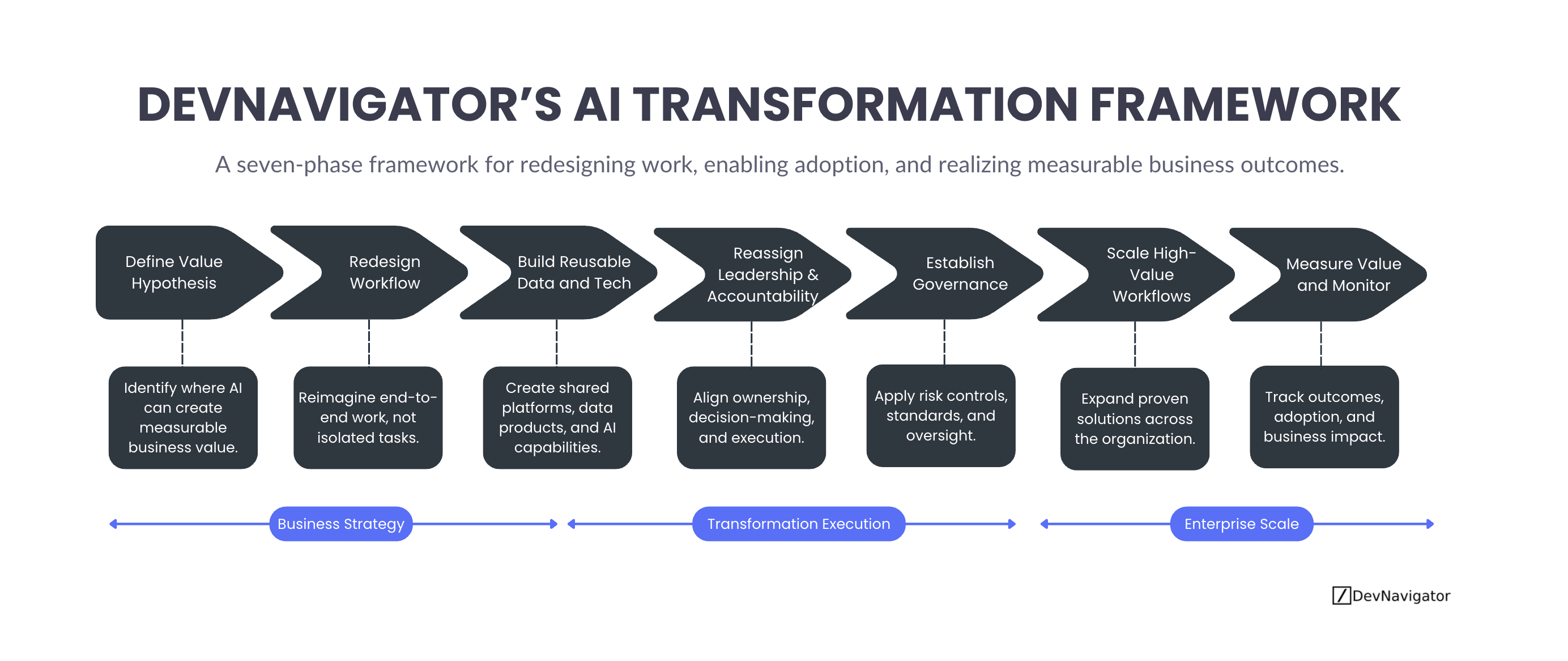
Many organizations approach AI by automating individual tasks, deploying chatbots, or experimenting with new models. While these efforts can generate short-term wins, they often fail to produce lasting business value. The reason is simple: AI adoption is not primarily a technology challenge. It is a transformation challenge.
The AI Transformation Framework provides a structured seven-phase approach for identifying value, redesigning work, building reusable capabilities, establishing governance, and scaling successful solutions across the enterprise. Rather than focusing on isolated tools, the framework focuses on how work is performed, who owns outcomes, and how organizations sustain change over time.
Organizations that follow a disciplined AI Transformation Framework are better positioned to achieve measurable improvements in productivity, quality, speed, and decision-making.
Enterprise AI Transformation: The 3 Horizons That Drive Sustainable Competitive Advantage
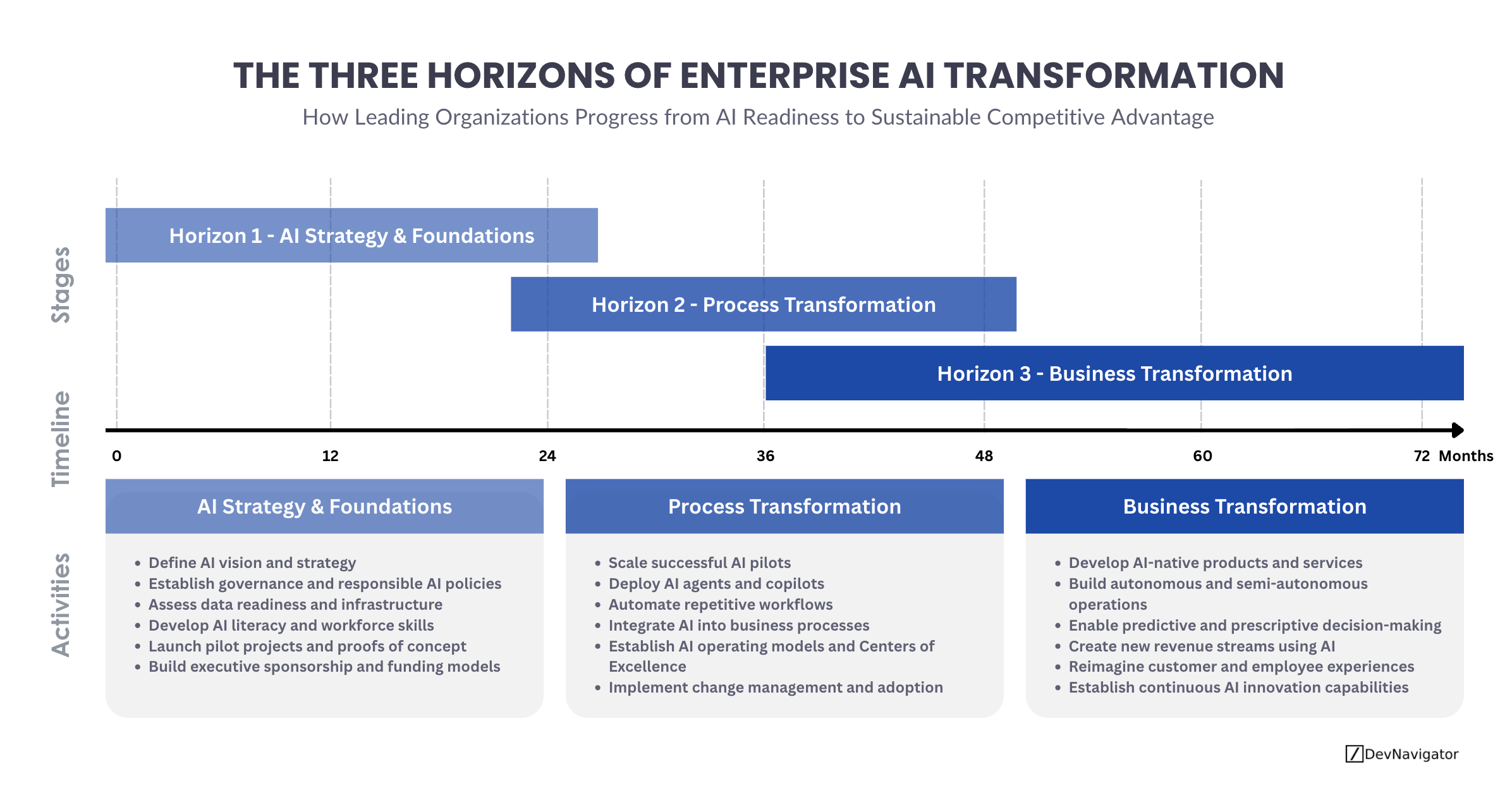
Enterprise AI Transformation is no longer a technology initiative. It has become a business imperative. While many organizations have successfully launched AI pilots and proof-of-concept projects, far fewer have developed a structured roadmap for scaling AI across the enterprise and ultimately transforming how they operate.
The challenge is that AI adoption does not occur overnight. Organizations typically progress through distinct stages of maturity, each with different objectives, investments, risks, and expected outcomes. Understanding these stages can help leaders allocate resources effectively, manage expectations, and build momentum toward long-term value creation.
This framework introduces the three horizons of Enterprise AI Transformation, providing a practical view of how organizations move from foundational readiness to operational transformation and ultimately to AI-enabled business reinvention.
Agentic AI Deployment in 2026: 5 Domains Where AI Agents Are Effectively Transforming Work
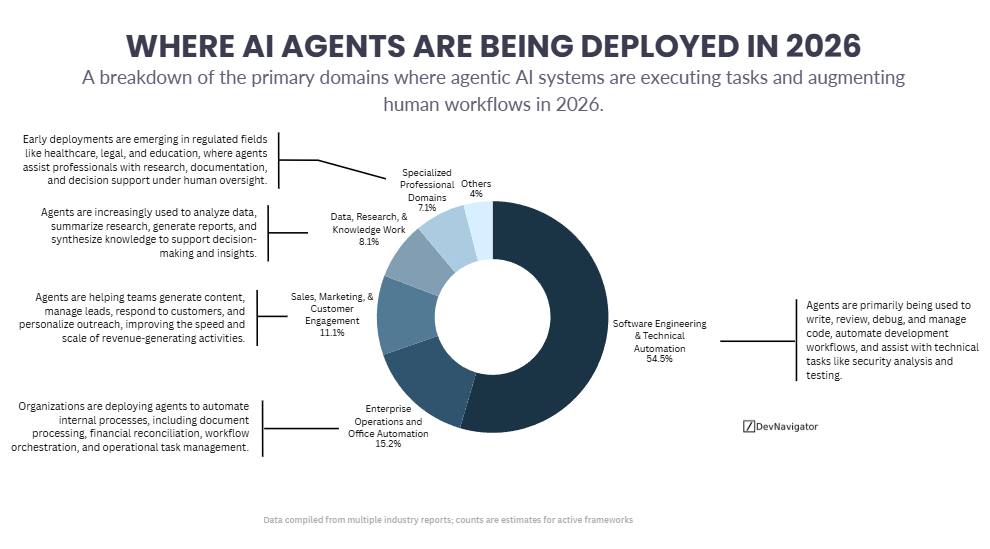
Agentic AI deployment in 2026 is beginning to reveal a clear pattern. While AI agents are often discussed as a general-purpose technology capable of transforming every industry, the reality is more focused. Most real-world usage is concentrated in a few specific domains where agents can reliably execute tasks, integrate with digital systems, and deliver measurable productivity gains.
The largest share of agentic AI deployment is happening in software engineering, where agents assist with coding, debugging, and technical workflows. From there, adoption expands outward into enterprise operations, customer-facing functions, and knowledge work. Smaller but growing deployments are appearing in professional fields such as healthcare, legal services, and education.
Understanding where agentic AI deployment is occurring today provides an important signal for where the technology will expand next. The distribution highlights both the strengths of current AI agents and the practical constraints organizations face when integrating autonomous systems into real-world workflows.
AI Transformation: The 5 Leadership Shifts That will Define AI Adoption in 2026
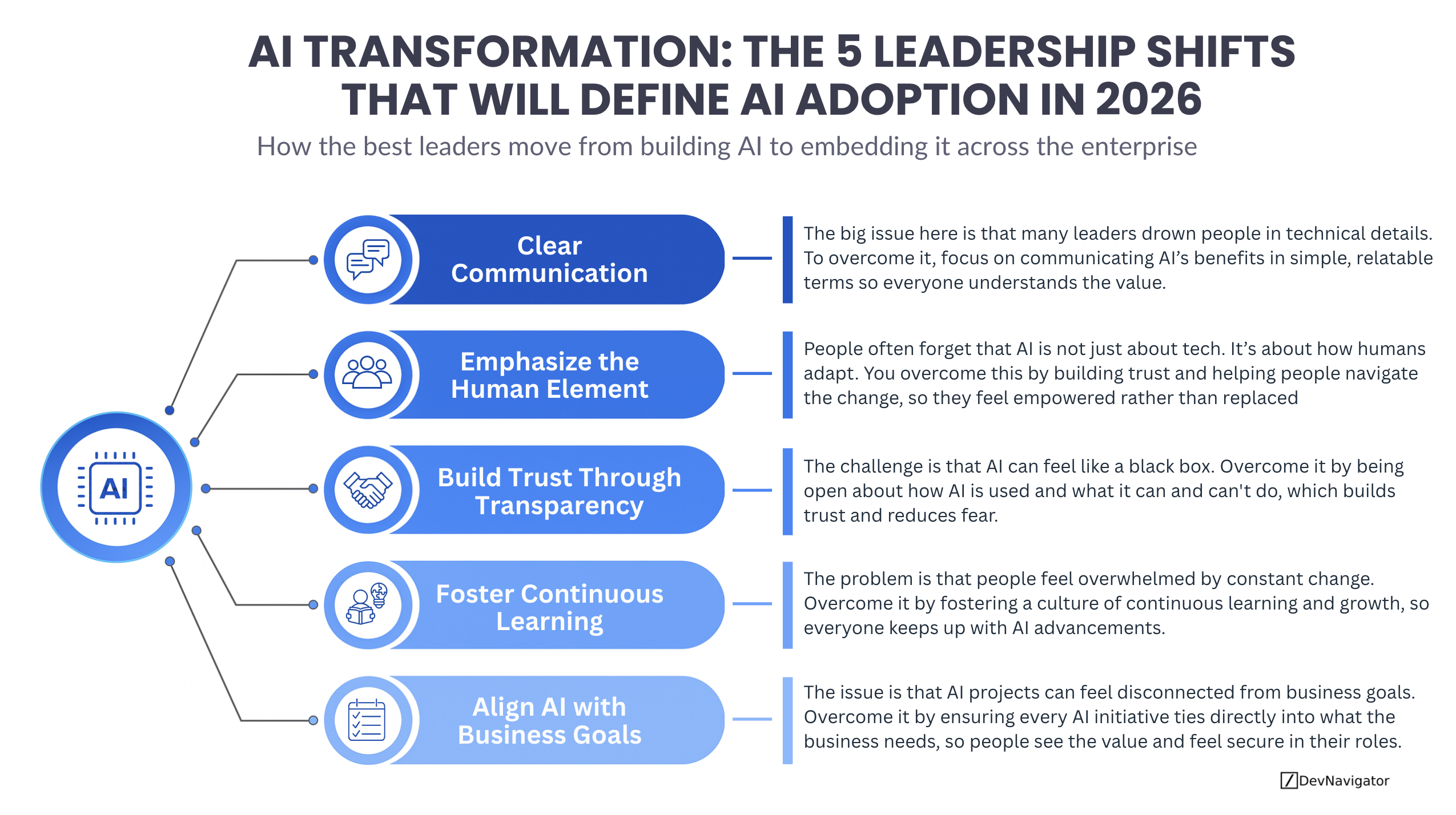
Most organizations spent 2025 building AI pilots, experimenting with models, and proving technical feasibility. In 2026, the real work begins. The challenge is no longer whether AI can work, but whether it can stick. This is where AI Change Management becomes the defining leadership capability. Embedding AI into daily operations, decision-making, and culture requires more than tools. It requires trust, clarity, and human-centered systems. This article outlines five leadership shifts that separate short-term experimentation from durable transformation. Together, they form a practical playbook for leaders who want AI to become an everyday advantage rather than another fleeting initiative.
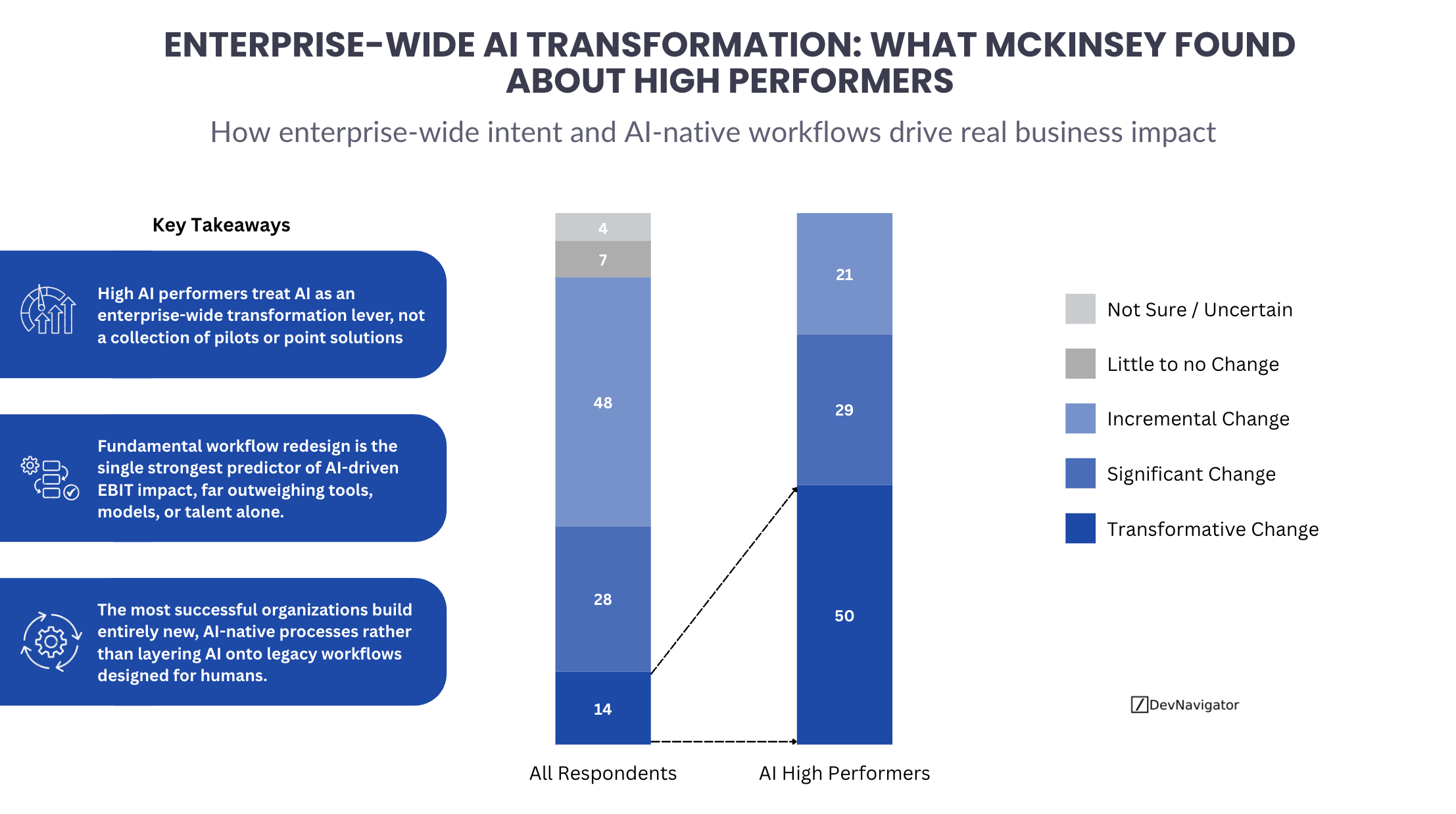
Enterprise-Wide AI Transformation: What McKinsey Found About High Performers
AI Transformation has moved past experimentation. For most organizations, the question is no longer whether to use AI, but whether it will meaningfully change how the business operates. A recent McKinsey study makes one point unmistakably clear: high AI performers approach transformation very differently from everyone else. Their advantage does not come from better models, […]
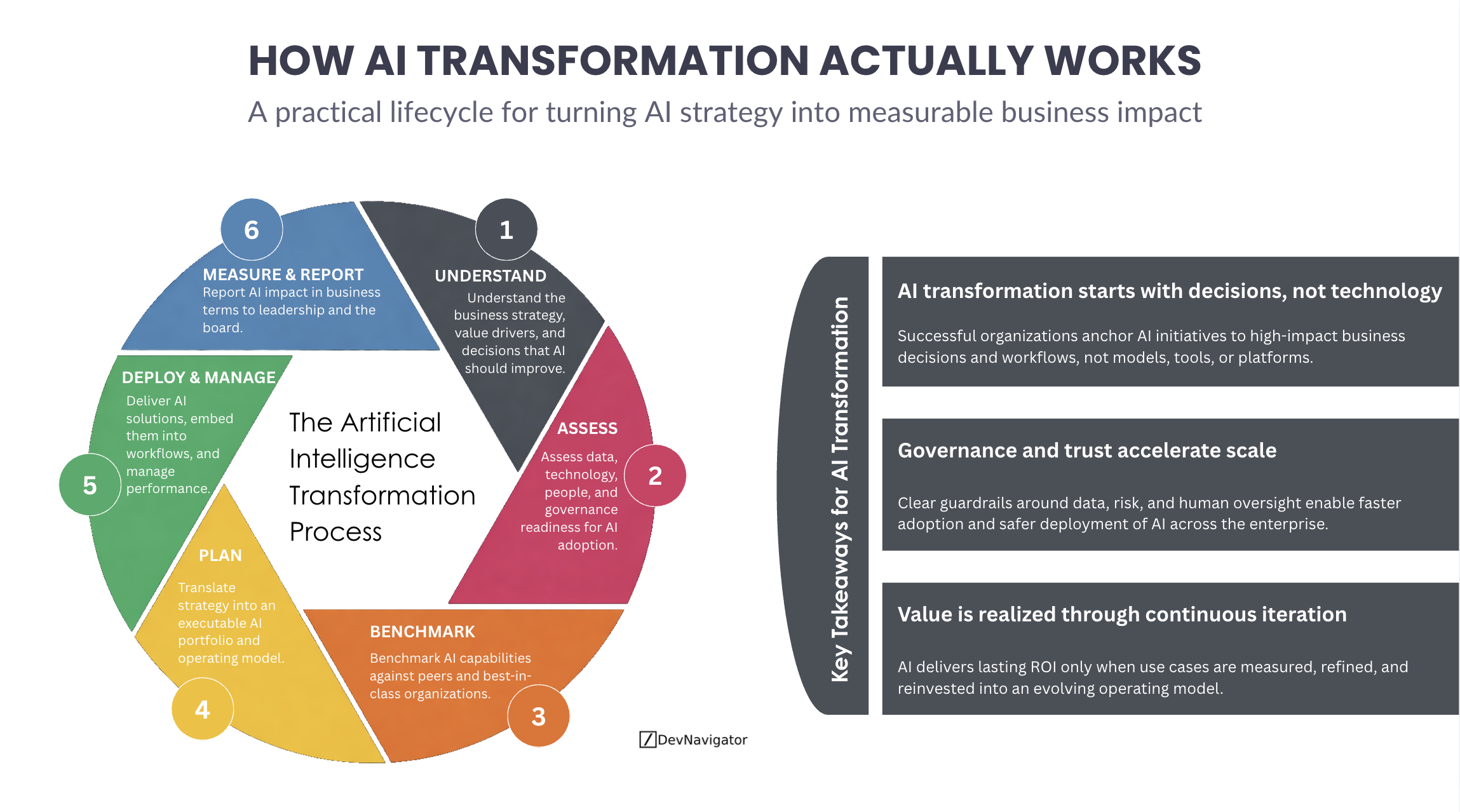
AI transformation is often discussed as a technology upgrade, but organizations that approach it this way rarely see sustained results. In practice, successful AI transformation is a business discipline. It requires clarity on decisions, strong governance, disciplined execution, and continuous measurement. The lifecycle shown in this framework reflects how AI transformation actually works inside organizations that move beyond pilots and achieve real impact.
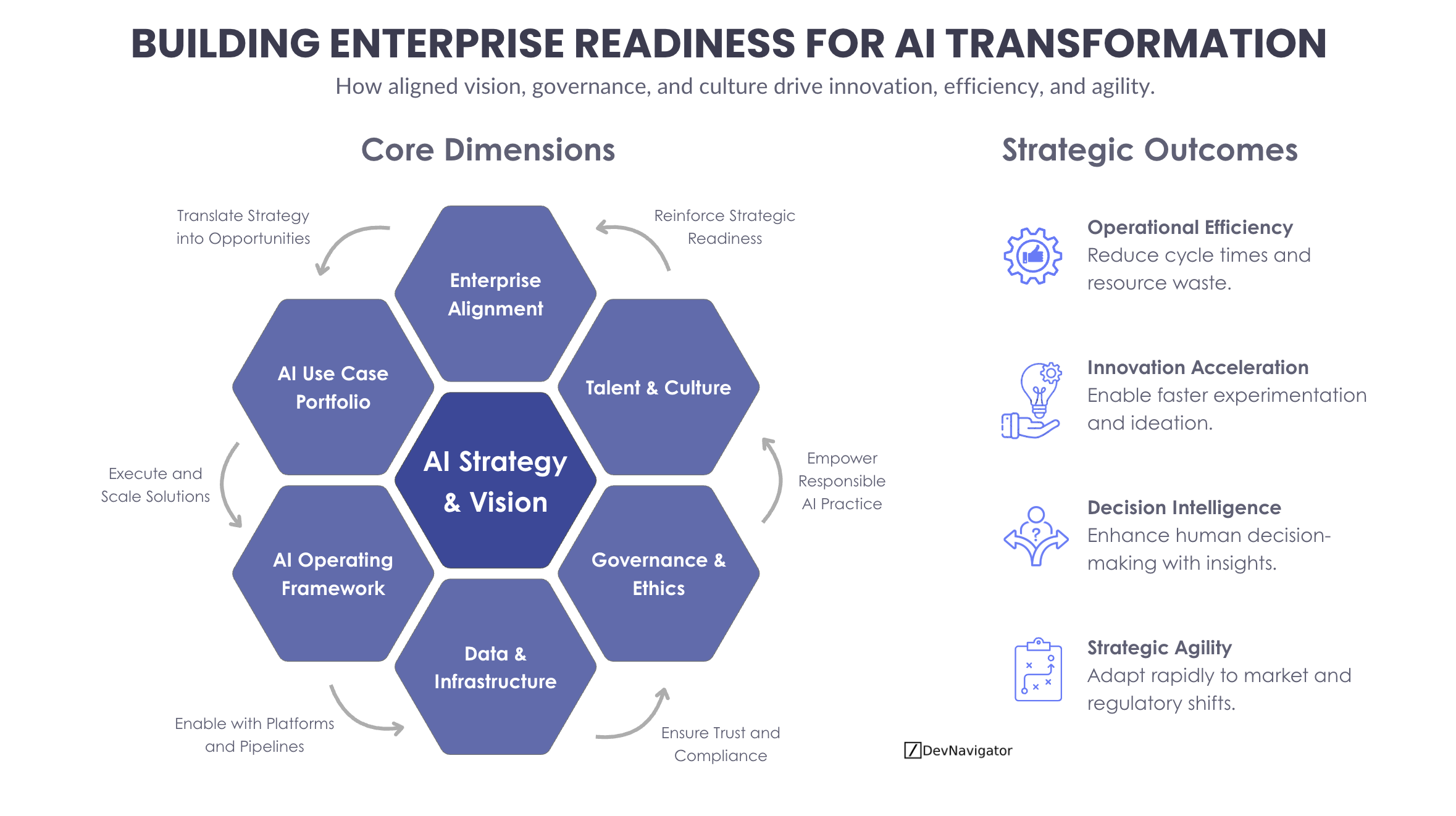
Building Enterprise Readiness for AI Transformation
This framework illustrates how a unified AI Strategy and Vision translates into measurable business value by aligning six core dimensions: enterprise alignment, talent and culture, governance and ethics, data and infrastructure, operating frameworks, and use case portfolios. Together, these strategic enablers create a foundation that drives four key outcomes: operational efficiency, innovation acceleration, decision intelligence, […]

 AI & Data Science · Aug 3, 2026
 Strategy & Governance · Jun 8, 2026
 AI & Data Science · Mar 28, 2026
 Strategy & Governance · Jan 16, 2026
 Strategy & Governance · Dec 27, 2025
 Business Performance & KPIs · Dec 20, 2025
 AI & Data Science · Nov 6, 2025