Domain-Specific Language Models: The Powerful 8-Step Lifecycle That Makes or Breaks Enterprise AI
Domain-specific language models are no longer experimental tools. They are becoming core enterprise systems that influence decisions, automate workflows, and shape how organizations operate. Yet many initiatives fail because they treat these models as static artifacts rather than evolving capabilities. This article breaks down the full lifecycle of domain-specific language models, showing how enterprises move from foundation model selection to continuous improvement through feedback, monitoring, and retraining. When approached as a closed loop rather than a linear project, domain-specific language models become more accurate, compliant, and valuable over time.
Table of Contents
Executive Takeaways
- Domain-specific language models deliver real value only when treated as continuously evolving systems, not one-off implementations.
- Human expertise, feedback loops, and performance monitoring are just as critical as data and model selection.
- Enterprises that operationalize the full lifecycle gain accuracy, compliance, and trust advantages that compound over time.
Expanded Insights
From General Models to Domain Intelligence
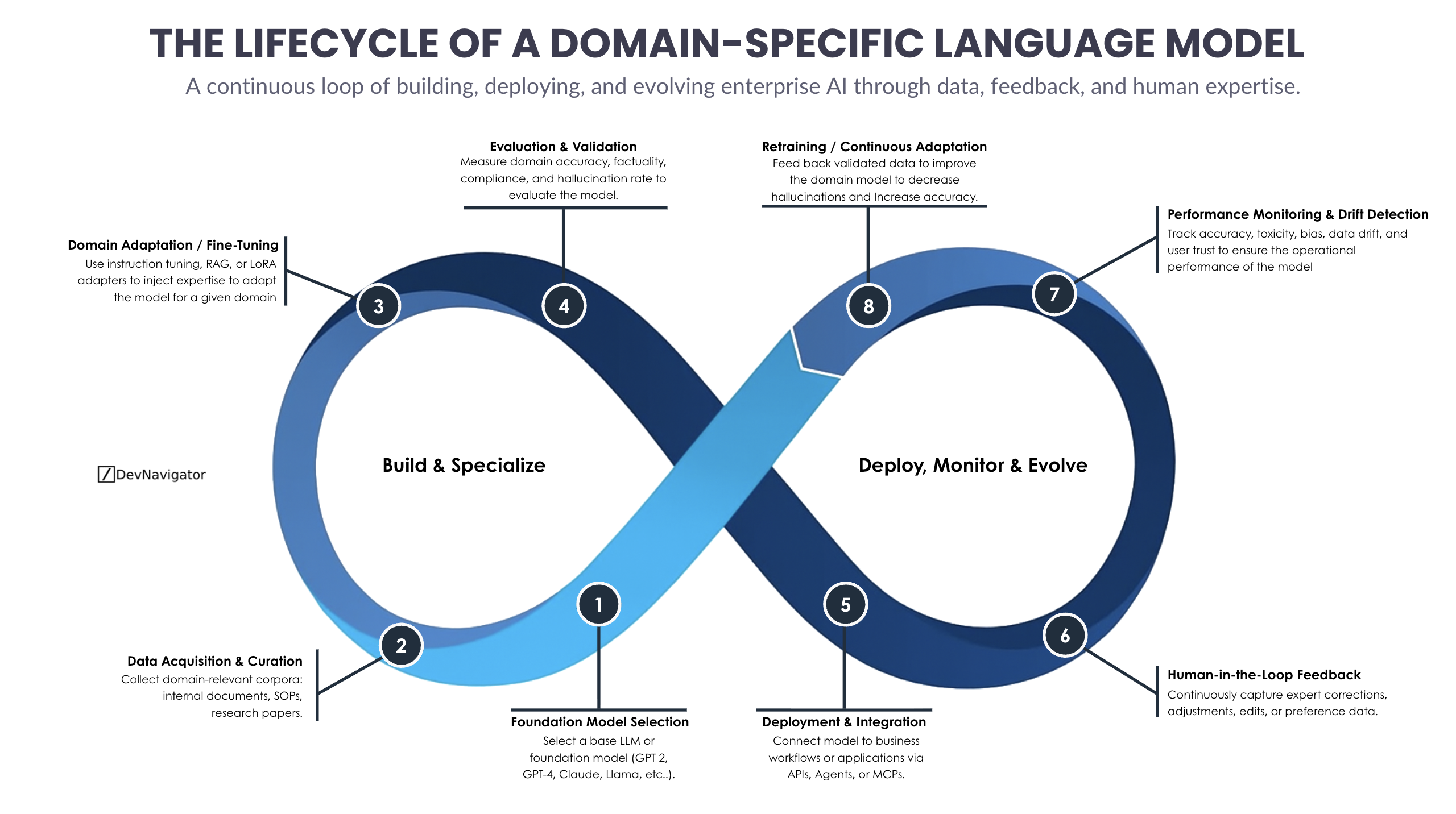
Every successful deployment of domain-specific language models starts with the right foundation. Enterprises typically begin by selecting a general-purpose model capable of strong reasoning and language understanding. On its own, however, a foundation model lacks the context needed to operate safely and accurately within regulated or specialized environments. This gap is where domain-specific language models begin to take shape.
The transformation requires curated domain data such as internal documents, SOPs, research artifacts, and historical decisions. This data grounds the model in how the business actually operates, rather than how generic language models assume it does. Without this step, accuracy plateaus quickly and trust erodes.
Specialization Through Domain Adaptation
Once data is curated, domain-specific language models are adapted using techniques such as instruction tuning, retrieval-augmented generation, or lightweight fine-tuning methods. The goal is not to retrain intelligence from scratch, but to align reasoning with domain rules, terminology, and decision boundaries.
This specialization step is where organizations often underestimate effort. Domain adaptation requires close collaboration between technical teams and subject matter experts. It is also where compliance considerations begin to surface, especially in regulated industries. Done correctly, domain-specific language models start producing outputs that feel familiar, consistent, and usable to domain experts.
Validation Before Value
Before deployment, domain-specific language models must be evaluated against more than generic benchmarks. Enterprises validate factual accuracy, domain alignment, hallucination rates, and policy compliance. This validation phase determines whether the model is ready to operate inside real workflows.
Skipping or rushing validation creates downstream risk. Errors introduced at this stage propagate once the model is embedded into operational systems. Strong validation establishes a baseline that later improvements can be measured against.
Deployment Into Real Workflows
Deployment is where domain-specific language models transition from technical assets into business systems. Models are integrated through APIs, agents, or orchestration layers that connect them to applications, data sources, and user interfaces.
At this stage, the model begins influencing real outcomes. That influence makes governance, traceability, and observability essential. Enterprises that succeed treat deployment as the midpoint of the lifecycle, not the finish line.
Human-in-the-Loop as a Strategic Advantage
Once deployed, domain-specific language models benefit most from structured human feedback. Corrections, approvals, and preference signals provide high-quality data that generic training datasets cannot replicate.
Human-in-the-loop feedback serves two purposes. It improves accuracy while reinforcing trust. Users become collaborators rather than passive consumers of AI output. Over time, this feedback becomes one of the most valuable assets in the lifecycle of domain-specific language models.
Monitoring Performance and Drift
Real-world environments change. Policies evolve, data distributions shift, and business priorities move. Domain-specific language models must be monitored continuously to detect performance degradation, bias drift, or emerging failure modes.
Monitoring is not just a technical exercise. It informs risk management, compliance reviews, and retraining priorities. Enterprises that invest here prevent small issues from becoming systemic failures.
Retraining as Continuous Improvement
The lifecycle closes with retraining and adaptation. Feedback data, performance metrics, and new domain knowledge feed back into the model. This retraining improves accuracy, reduces hallucinations, and aligns outputs with current reality.
Crucially, this step restarts the loop. Domain-specific language models are never finished. They evolve alongside the organizations they serve.
Why the Lifecycle Matters
The competitive advantage of domain-specific language models does not come from the model alone. It comes from the discipline of maintaining the full lifecycle. Organizations that embrace this loop build AI systems that improve with use, earn trust through transparency, and deliver sustained value over time.