
Decision Intelligence Agent: 6 Strategic Steps to Improving Enterprise Decisions
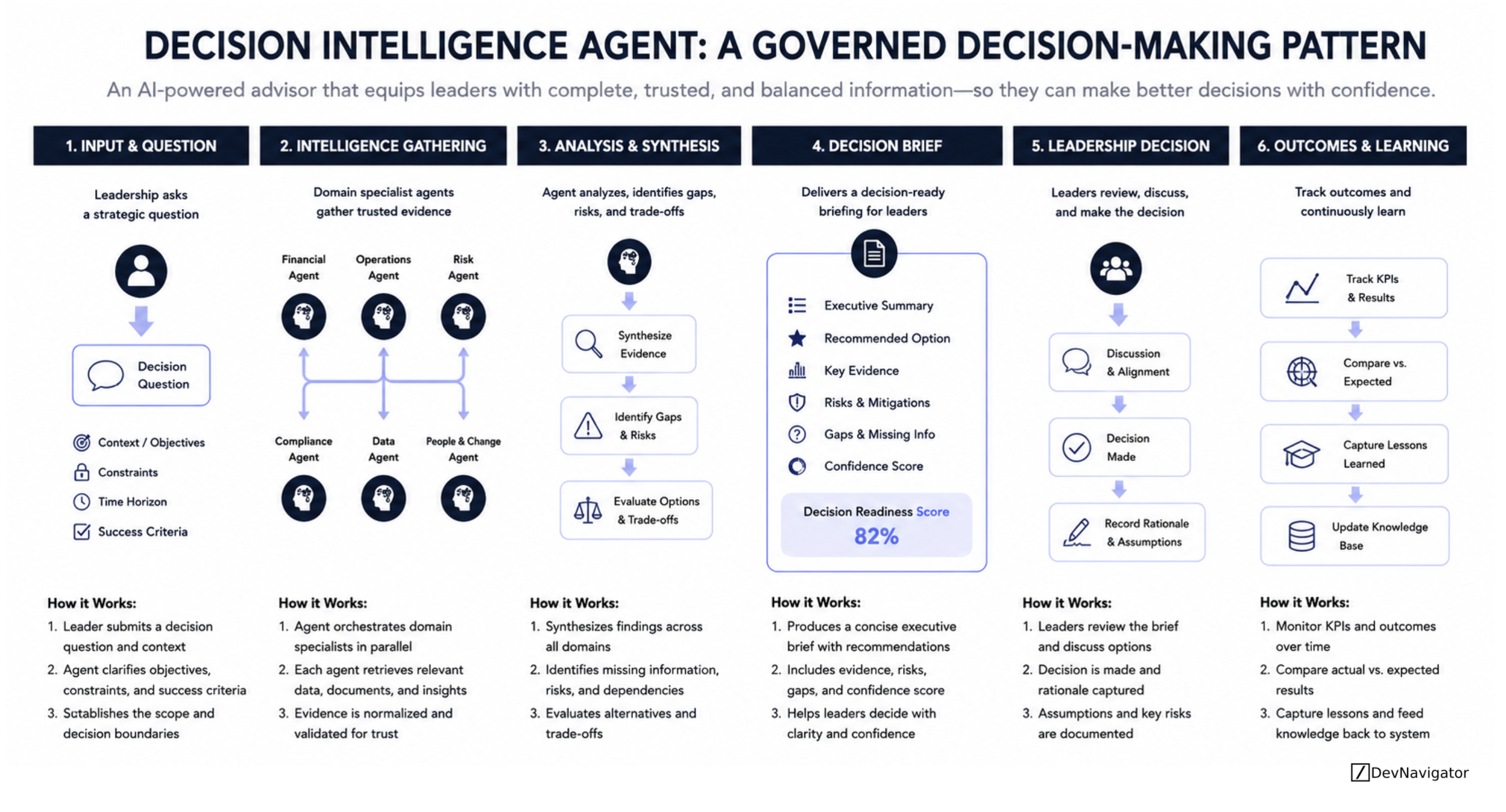
Enterprise leaders make decisions every day that affect operations, investments, compliance, and long term strategy. The challenge is rarely a lack of data. It is knowing which information to trust, understanding competing perspectives, and making decisions with confidence. A Decision Intelligence Agent addresses this challenge by orchestrating specialized AI agents, synthesizing evidence across business domains, and delivering structured decision briefs for leadership. Instead of replacing executives, it strengthens decision quality by ensuring every recommendation is supported by trusted evidence, transparent reasoning, and governance.
Table of Contents
Executive Takeaways
- A Decision Intelligence Agent transforms scattered enterprise data into a structured, evidence based decision brief that helps leaders evaluate options faster and with greater confidence.
- Specialized domain agents collect and validate information from across finance, operations, risk, compliance, data, and organizational change before recommendations are generated.
- Human leaders remain accountable for every decision while the Decision Intelligence Agent provides transparent evidence, trade offs, risks, and continuous learning from business outcomes.
Expanded Insights
Enterprise Decisions Need More Than Data
Most organizations have no shortage of information. Financial reports, operational dashboards, compliance records, customer metrics, and AI generated insights continue to grow. The real challenge is assembling the right evidence quickly enough to support an important decision.
A Decision Intelligence Agent solves this problem by acting as an intelligent orchestration layer rather than another chatbot. Instead of simply answering questions, it coordinates multiple domain specialists, validates trusted sources, identifies knowledge gaps, and prepares information that leadership can actually use. The result is less time searching for information and more time evaluating strategic choices.
Domain Agents Gather Trusted Evidence
Every major business decision touches multiple functions across the organization. A supply chain investment may affect finance, operations, quality, regulatory compliance, workforce planning, and enterprise risk.
Rather than relying on a single AI model, a Decision Intelligence Agent coordinates specialized domain agents that retrieve relevant documents, data, policies, and historical decisions from their respective business areas. Each agent contributes expertise while maintaining clear ownership of its domain.
This distributed approach creates a more complete picture and reduces the likelihood that important evidence is overlooked.
AI Synthesizes Information Into Actionable Insights
Collecting information is only the first step. Leaders still need to understand what it means.
The Decision Intelligence Agent synthesizes findings across domains, identifies conflicting evidence, highlights risks, evaluates alternative courses of action, and exposes important trade offs. It also identifies missing information that may reduce confidence in the final recommendation.
Rather than presenting hundreds of pages of documentation, the agent produces concise analysis that helps executives focus on the decisions that matter most.
Decision Briefs Improve Leadership Alignment
Executives rarely want raw data. They want a clear recommendation supported by transparent evidence.
The output of a Decision Intelligence Agent is a structured decision brief containing an executive summary, recommended course of action, supporting evidence, identified risks, knowledge gaps, and an overall assessment of decision readiness. Because the supporting rationale is visible, leadership teams can challenge assumptions, debate alternatives, and align more quickly around the facts.
This creates consistency across decision making while preserving executive judgment and accountability.
Human Judgment Remains Central
Despite rapid advances in AI, organizations are not delegating strategic authority to autonomous systems.
A Decision Intelligence Agent is designed to support leaders, not replace them. Executives remain responsible for evaluating recommendations, considering organizational context, discussing trade offs, and making the final decision. This human centered approach also supports governance, regulatory expectations, and organizational trust by ensuring important decisions remain transparent and accountable.
Continuous Learning Makes Future Decisions Better
The value of a Decision Intelligence Agent does not end after a decision is made. Organizations can monitor business outcomes, compare actual performance against expected results, capture lessons learned, and feed those insights back into future decision cycles. Over time, the knowledge base becomes richer, recommendations become more informed, and institutional knowledge is preserved instead of being lost when projects conclude or employees leave. This continuous learning cycle transforms individual decisions into organizational capability.
Final Thoughts
A Decision Intelligence Agent represents a practical evolution in enterprise AI. Instead of replacing leadership with automation, it combines trusted evidence, specialized expertise, transparent reasoning, and human judgment into a repeatable decision making process. As organizations continue adopting AI across the enterprise, those that invest in structured and governed decision intelligence will be better positioned to make faster, more informed, and more consistent strategic decisions.