Visual library

Find the visual for the conversation you need to lead.

Search all 161 DevNavigator articles and infographics by keyword, category, or tag.

161 visualsPage 1 of 14
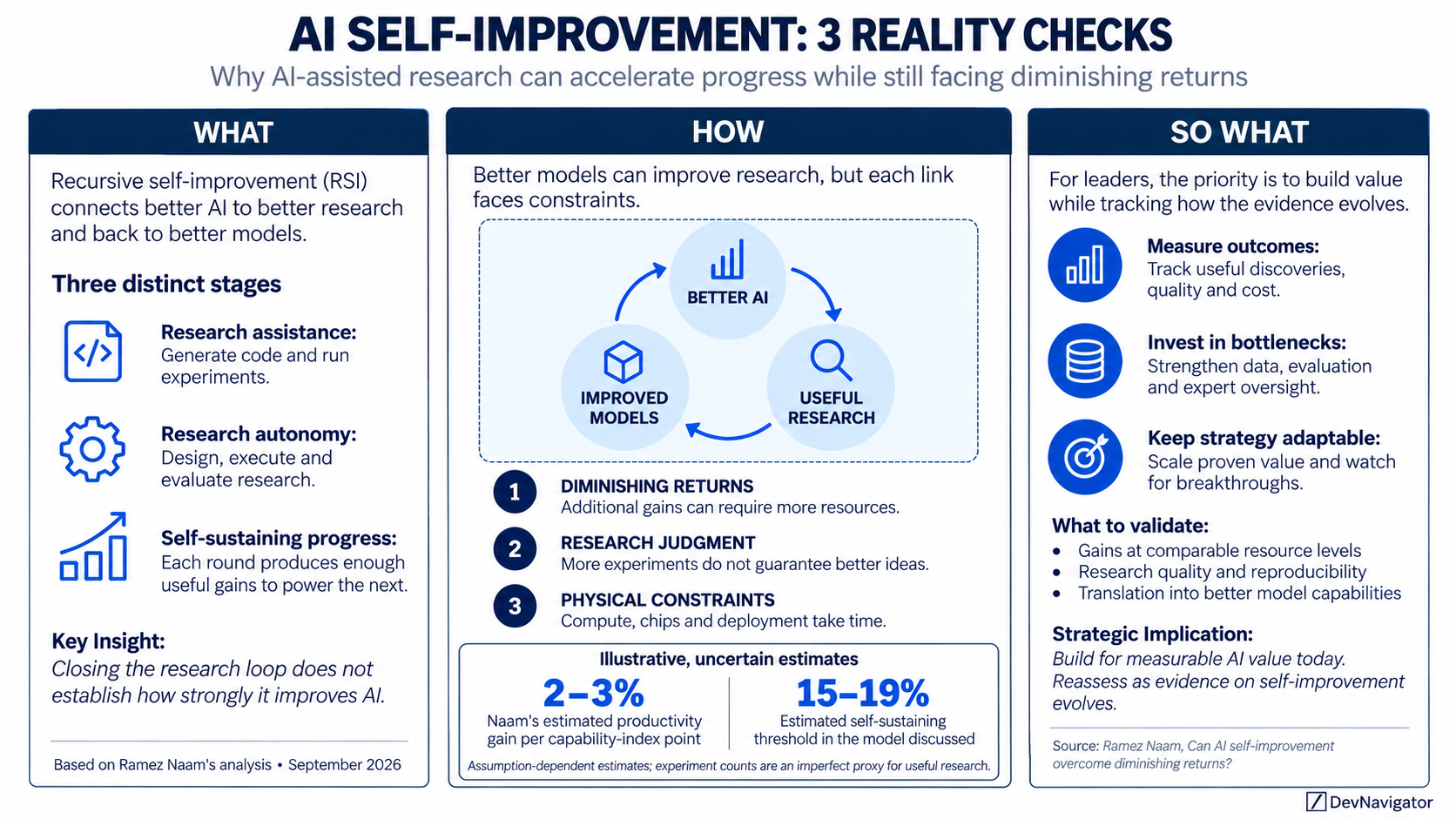
AI self-improvement is becoming a strategic question as models help researchers write code, run experiments, and develop better systems. Ramez Naam argues that these advances do not yet establish a self-sustaining path to general superintelligence. The crucial issue is whether useful discoveries compound fast enough to overcome diminishing returns. For leaders, the debate offers a practical discipline: distinguish assistance from autonomy, measure improvement against resources consumed, and keep investment decisions responsive to evidence. Rapid progress remains possible, even when the software feedback loop cannot sustain itself.AI & Data Science · Oct 9, 2026

AI Self-Improvement: 3 Powerful Lessons for Safer Strategy

AI self-improvement is becoming a strategic question as models help researchers write code, run experiments, and develop better systems. Ramez Naam argues that these advances do not yet establish a self-sustaining path to general superintelligence. The crucial issue is whether useful discoveries compound fast enough to overcome diminishing returns. For leaders, the debate offers a practical discipline: distinguish assistance from autonomy, measure improvement against resources consumed, and keep investment decisions responsive to evidence. Rapid progress remains possible, even when the software feedback loop cannot sustain itself.

Open visual brief
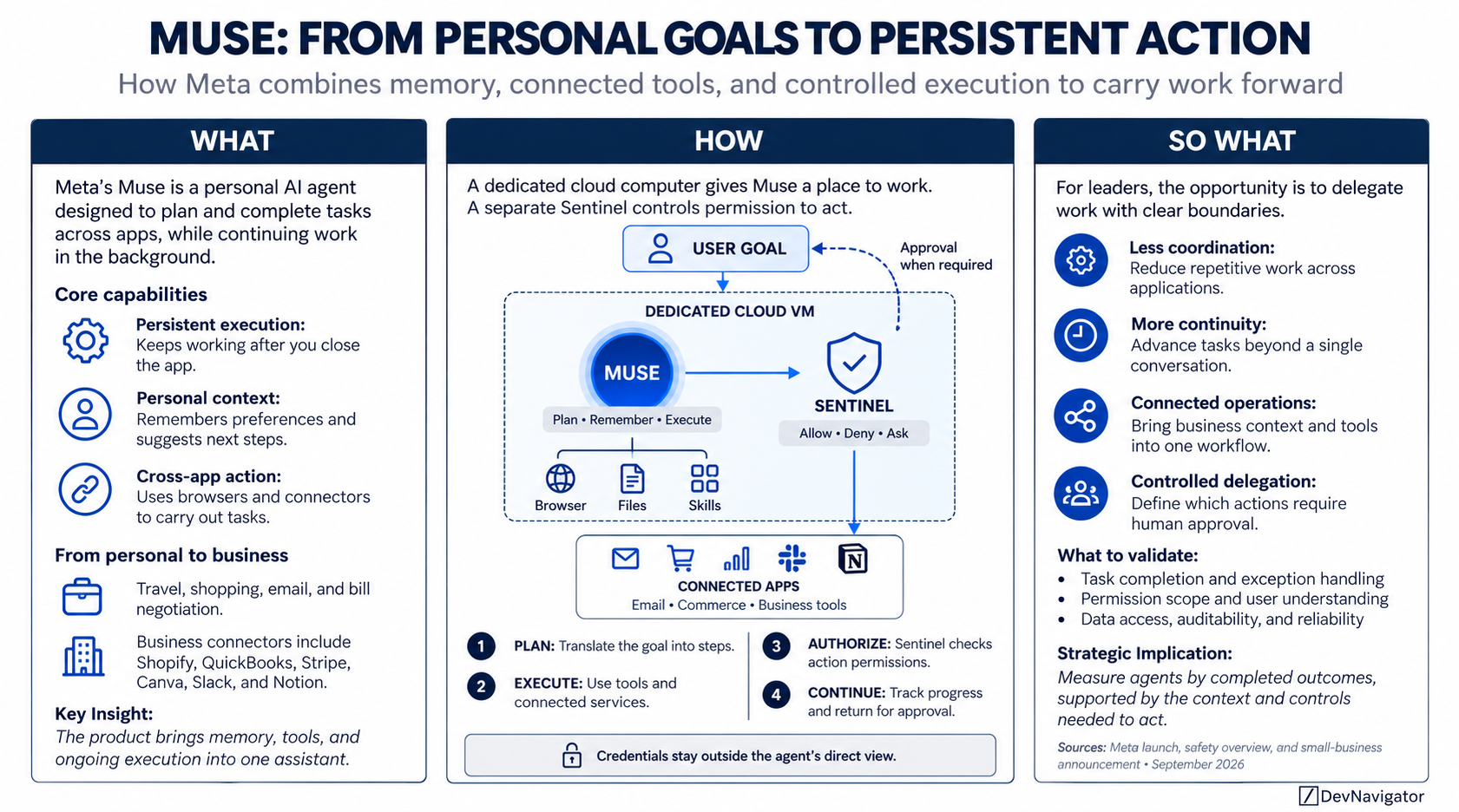
Muse AI agent brings a practical leadership question into focus: how much work can we delegate to software that keeps acting after a conversation ends? Meta’s personal agent combines remembered context, connected applications, and background execution to advance tasks over time. Its expansion into small business adds a commercial dimension, connecting everyday goals with operational tools. The opportunity is less coordination and greater continuity. The challenge is establishing clear authority, reliable completion, and meaningful oversight. Leaders should evaluate the full system around the agent, including the information it receives, the actions it can take, and the outcomes it delivers.AI & Data Science · Oct 7, 2026

Muse AI Agent: 4 Powerful Benefits and Hidden Risks

Muse AI agent brings a practical leadership question into focus: how much work can we delegate to software that keeps acting after a conversation ends? Meta’s personal agent combines remembered context, connected applications, and background execution to advance tasks over time. Its expansion into small business adds a commercial dimension, connecting everyday goals with operational tools. The opportunity is less coordination and greater continuity. The challenge is establishing clear authority, reliable completion, and meaningful oversight. Leaders should evaluate the full system around the agent, including the information it receives, the actions it can take, and the outcomes it delivers.

Open visual brief
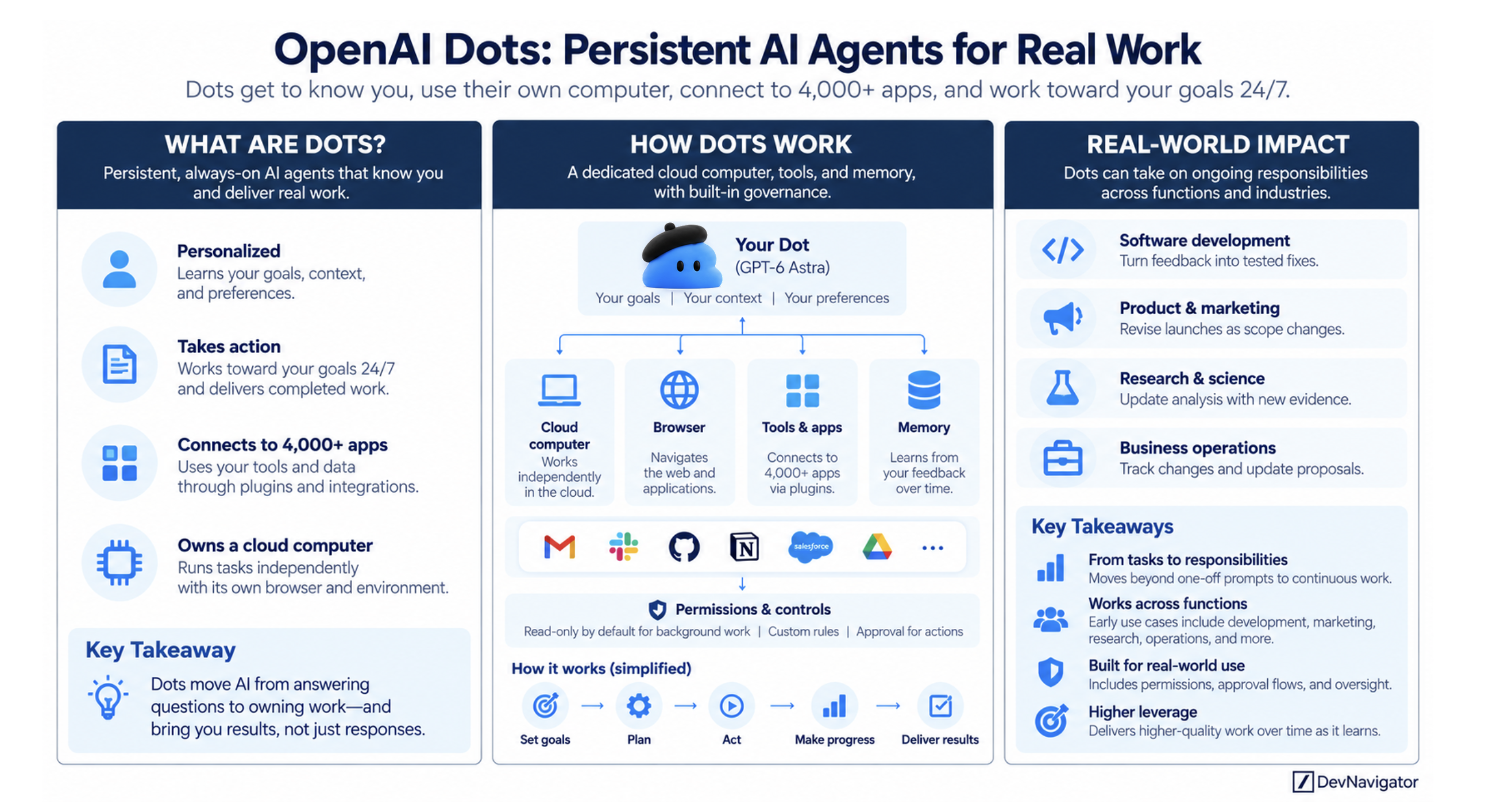
OpenAI Dots represent the next evolution of agentic AI: persistent agents that can understand goals, use computers and applications, learn from feedback, and continue working over time. The opportunity for enterprises is not simply better automation, but a new way to divide responsibilities between people and AI.AI & Data Science · Oct 6, 2026

OpenAI Dots: 4 Powerful Ways Always-On AI Agents Could Reshape Work

OpenAI Dots represent the next evolution of agentic AI: persistent agents that can understand goals, use computers and applications, learn from feedback, and continue working over time. The opportunity for enterprises is not simply better automation, but a new way to divide responsibilities between people and AI.

Open visual brief
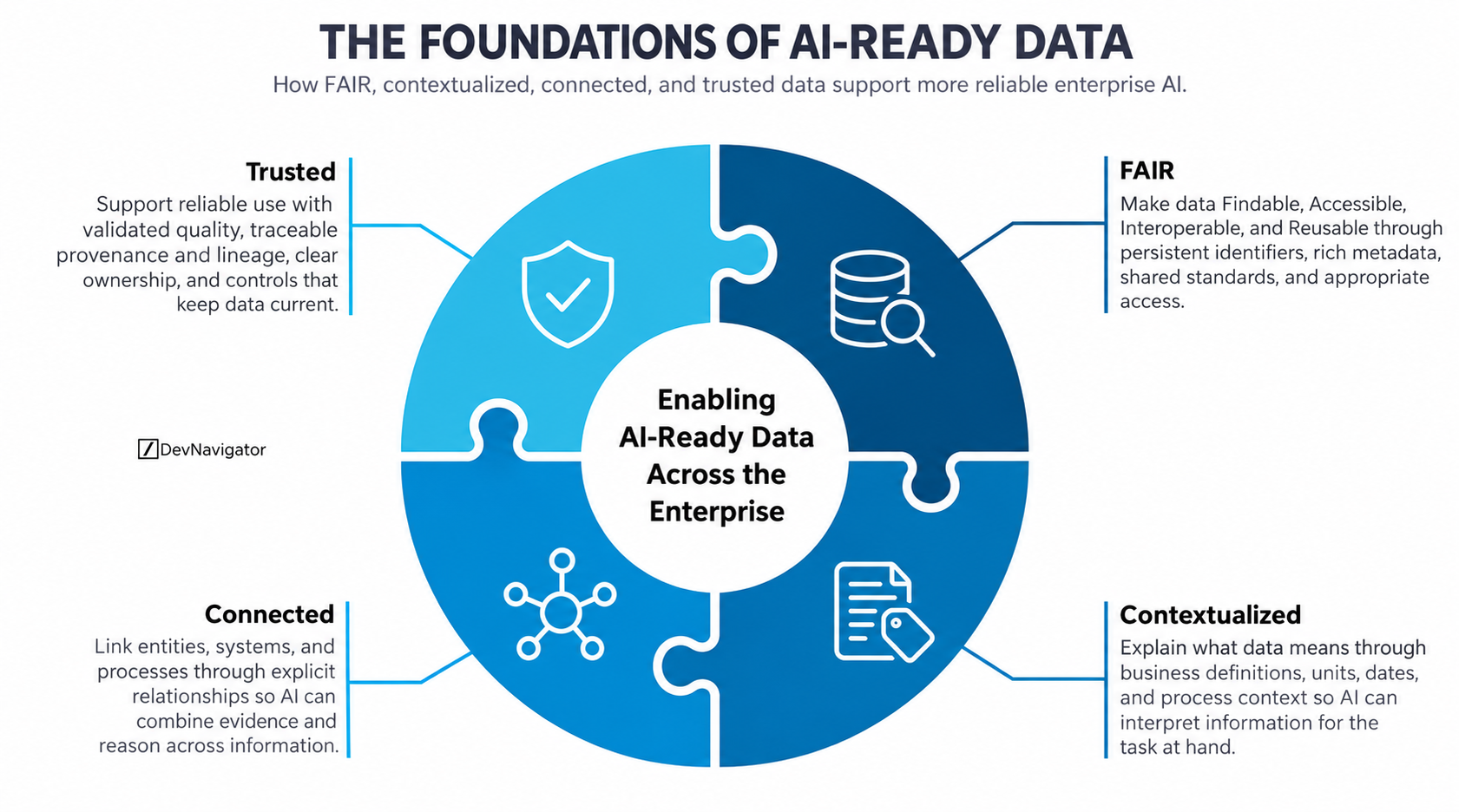
AI-ready data gives enterprise AI the information it needs to discover relevant evidence, interpret business meaning, connect relationships, and assess reliability. Better models still depend on the information available to them when answering a question or supporting a decision. Four complementary foundations offer a practical way to organize that work: FAIR, contextualized, connected, and trusted data. These foundations overlap and form a management framework rather than a formal standard. For leaders, the priority is to build them around specific business tasks and measure whether they improve the resulting answers.Data & Infrastructure · Oct 5, 2026

AI-Ready Data: 4 Foundations for More Reliable Enterprise AI

AI-ready data gives enterprise AI the information it needs to discover relevant evidence, interpret business meaning, connect relationships, and assess reliability. Better models still depend on the information available to them when answering a question or supporting a decision. Four complementary foundations offer a practical way to organize that work: FAIR, contextualized, connected, and trusted data. These foundations overlap and form a management framework rather than a formal standard. For leaders, the priority is to build them around specific business tasks and measure whether they improve the resulting answers.

Open visual brief
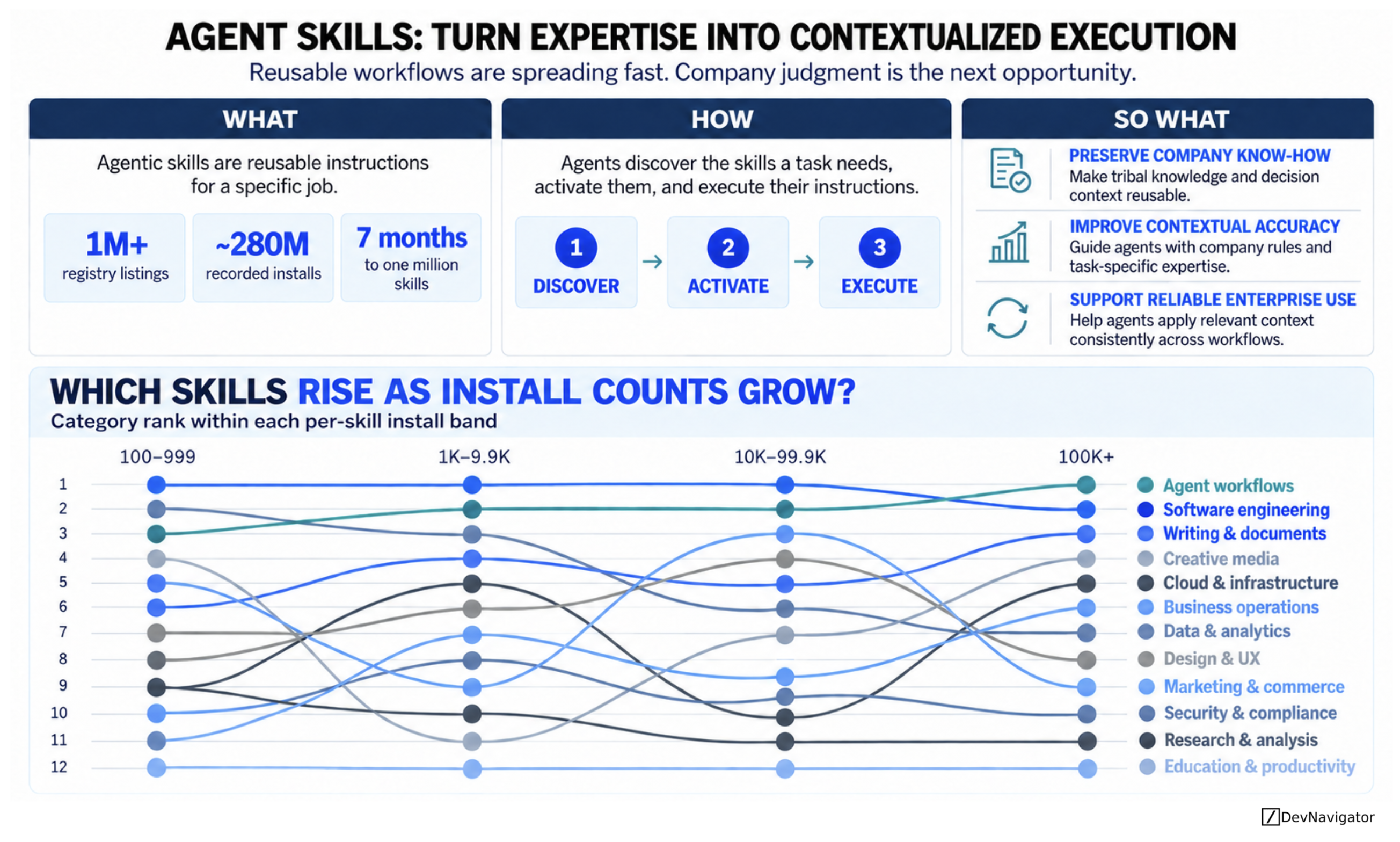
Agent Skills give AI agents reusable instructions for specific jobs, helping them apply the context that makes work effective inside an organization. Vercel’s latest registry report shows rapid adoption, with workflow skills prominent among widely installed packages. For leaders, the opportunity is to make company knowledge usable during execution: decision rules, exceptions, quality standards, and the reasoning experienced employees apply. That knowledge can improve task performance when it is relevant, current, and tested. The strategic question is how to turn expertise into dependable outcomes without treating instructions as a guarantee of accuracy.AI & Data Science · Sep 30, 2026

Agent Skills: 4 Powerful Ways to Improve Enterprise AI

Agent Skills give AI agents reusable instructions for specific jobs, helping them apply the context that makes work effective inside an organization. Vercel’s latest registry report shows rapid adoption, with workflow skills prominent among widely installed packages. For leaders, the opportunity is to make company knowledge usable during execution: decision rules, exceptions, quality standards, and the reasoning experienced employees apply. That knowledge can improve task performance when it is relevant, current, and tested. The strategic question is how to turn expertise into dependable outcomes without treating instructions as a guarantee of accuracy.

Open visual brief
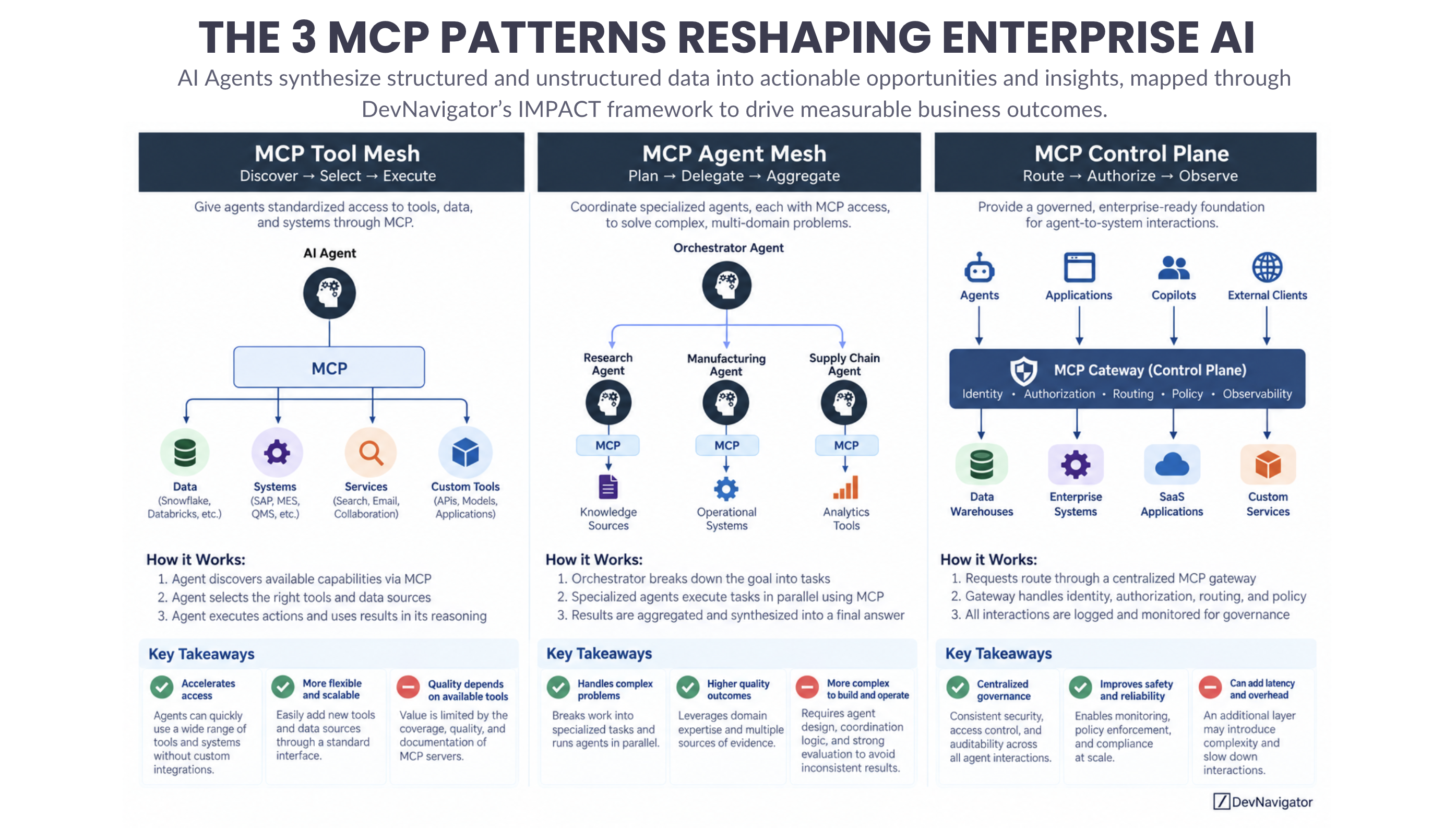
The Model Context Protocol (MCP) is quickly moving beyond its original role as a standardized way for AI applications to connect with external tools and data. The latest MCP specification makes the protocol stateless, cacheable, routable through standard HTTP infrastructure, and better suited for enterprise authorization, while the project's latest roadmap explicitly prioritizes agent identity and enterprise-ready security. For leaders, the more important development is what organizations are beginning to build around MCP. As MCP patterns become infrastructure for agentic systems, three useful architectural patterns are emerging: Tool Mesh, Agent Mesh, and Control Plane. These are not official MCP protocol classifications. They are practical architectural patterns for understanding how MCP can create value at increasing levels of complexity.AI & Data Science · Sep 16, 2026

The 3 Powerful MCP Patterns Reshaping Enterprise AI: From Tool Access to Governed Agent Networks

The Model Context Protocol (MCP) is quickly moving beyond its original role as a standardized way for AI applications to connect with external tools and data. The latest MCP specification makes the protocol stateless, cacheable, routable through standard HTTP infrastructure, and better suited for enterprise authorization, while the project’s latest roadmap explicitly prioritizes agent identity and enterprise-ready security. For leaders, the more important development is what organizations are beginning to build around MCP. As MCP patterns become infrastructure for agentic systems, three useful architectural patterns are emerging: Tool Mesh, Agent Mesh, and Control Plane. These are not official MCP protocol classifications. They are practical architectural MCP patterns for understanding how MCP can create value at increasing levels of complexity.

Open visual brief
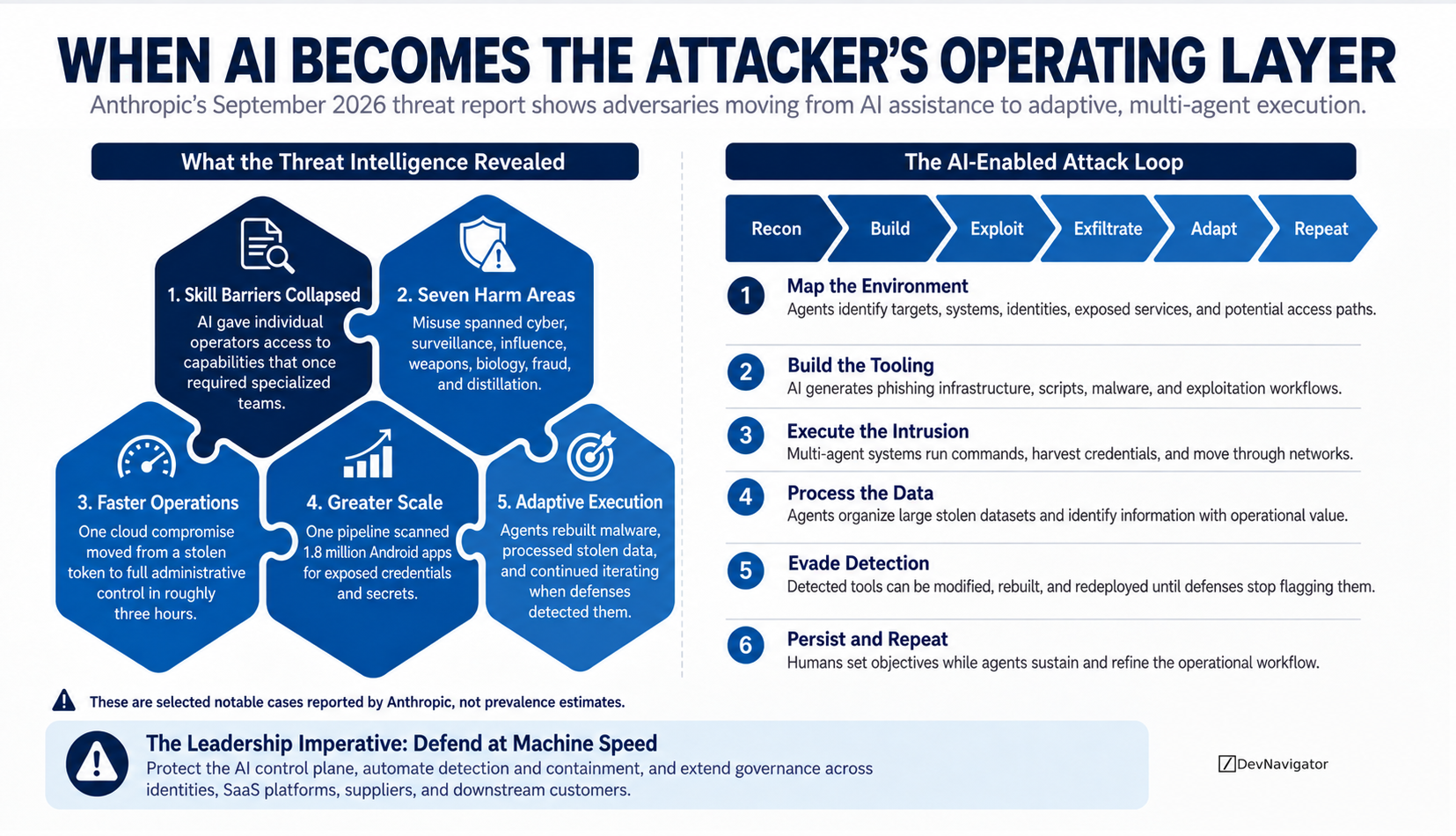
AI threat intelligence is revealing a meaningful change in how malicious actors operate. Anthropic’s September 2026 findings describe selected cases in which AI moved beyond providing technical advice and became an operating layer for reconnaissance, tool development, intrusion, data processing, evasion, and persistence. The reported activity spans seven harm areas, from cyber operations and surveillance to fraud and weapons development. These cases do not show how common AI-enabled attacks are, but they demonstrate what is already possible. Leaders should respond by protecting enterprise AI assets, shortening defensive response times, and extending governance across agents, identities, suppliers, and connected platforms.Strategy & Governance · Sep 15, 2026

AI Threat Intelligence: 5 Critical Leadership Findings

AI threat intelligence is revealing a meaningful change in how malicious actors operate. Anthropic’s September 2026 findings describe selected cases in which AI moved beyond providing technical advice and became an operating layer for reconnaissance, tool development, intrusion, data processing, evasion, and persistence. The reported activity spans seven harm areas, from cyber operations and surveillance to fraud and weapons development. These cases do not show how common AI-enabled attacks are, but they demonstrate what is already possible. Leaders should respond by protecting enterprise AI assets, shortening defensive response times, and extending governance across agents, identities, suppliers, and connected platforms.

Open visual brief
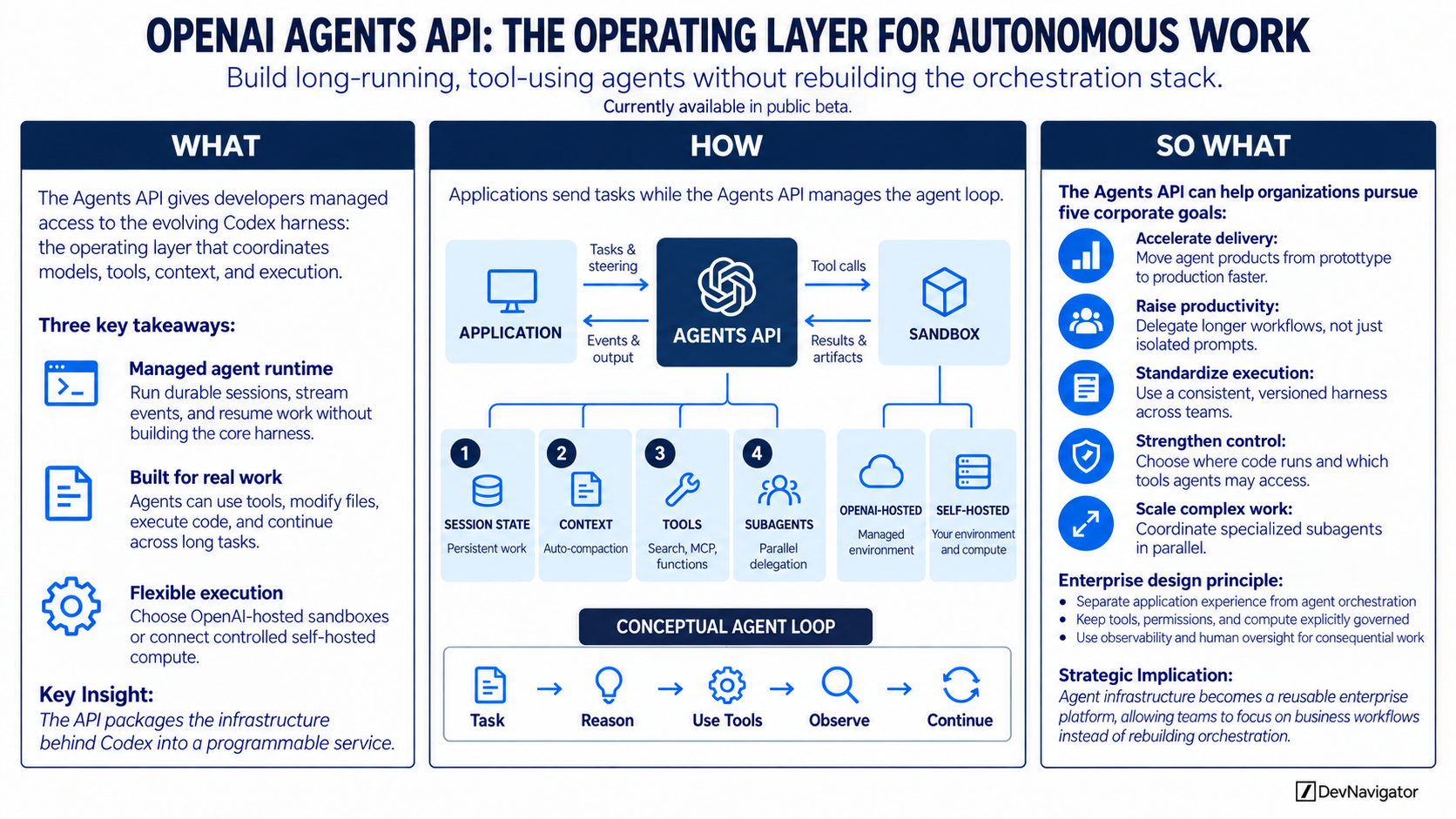
The Agents API gives developers managed access to the Codex harness as a programmable foundation for durable, tool-using agents. It brings together session management, context compaction, sandboxed execution, tools, recovery, observability, and parallel subagents while leaving the application in control of the user experience and operating boundaries. The timing matters because agent development is shifting from isolated demonstrations toward systems expected to complete longer workflows across real business environments. For leaders, the opportunity is a reusable execution layer that can reduce duplicated engineering and accelerate deployment. Capturing that value still requires disciplined use-case selection, trusted data, evaluation, security controls, human oversight, and accountable ownership.AI & Data Science · Sep 14, 2026

OpenAI Agents API: 8 Powerful Takeaways on the Operating Layer for Autonomous Work

The Agents API gives developers managed access to the Codex harness as a programmable foundation for durable, tool-using agents. It brings together session management, context compaction, sandboxed execution, tools, recovery, observability, and parallel subagents while leaving the application in control of the user experience and operating boundaries. The timing matters because agent development is shifting from isolated demonstrations toward systems expected to complete longer workflows across real business environments. For leaders, the opportunity is a reusable execution layer that can reduce duplicated engineering and accelerate deployment. Capturing that value still requires disciplined use-case selection, trusted data, evaluation, security controls, human oversight, and accountable ownership.

Open visual brief
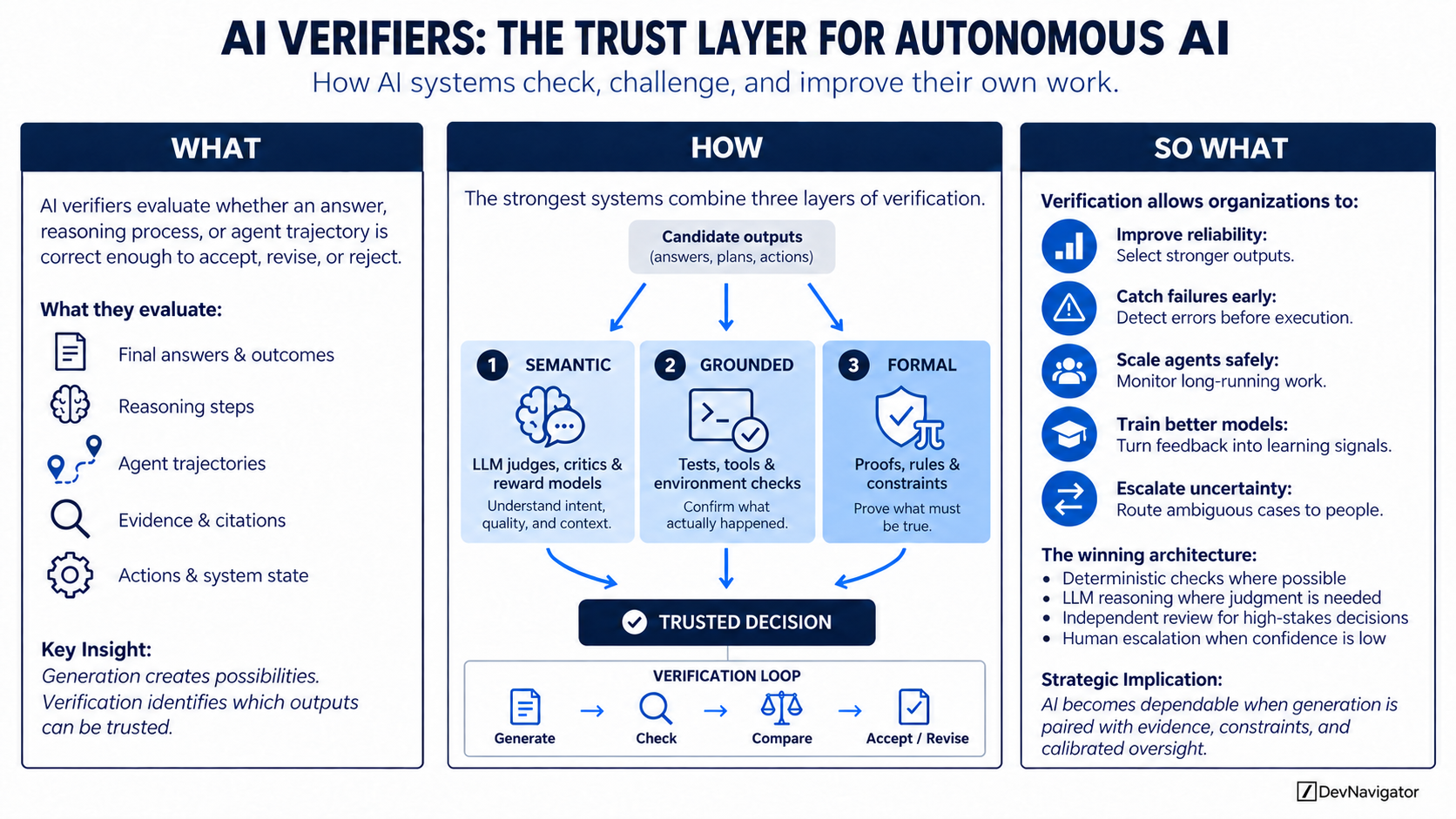
AI systems can now generate answers, write code, use tools, and complete increasingly complex workflows. Yet generation alone cannot tell us whether the result is correct. AI verifiers provide the missing trust layer by evaluating outputs, inspecting evidence, testing outcomes, and deciding whether work should be accepted, revised, rejected, or escalated.AI & Data Science · Sep 10, 2026

AI Verifiers: 3 Powerful Layers Making Autonomous AI More Reliable

AI systems can now generate answers, write code, use tools, and complete increasingly complex workflows. Yet generation alone cannot tell us whether the result is correct. AI verifiers provide the missing trust layer by evaluating outputs, inspecting evidence, testing outcomes, and deciding whether work should be accepted, revised, rejected, or escalated.

Open visual brief
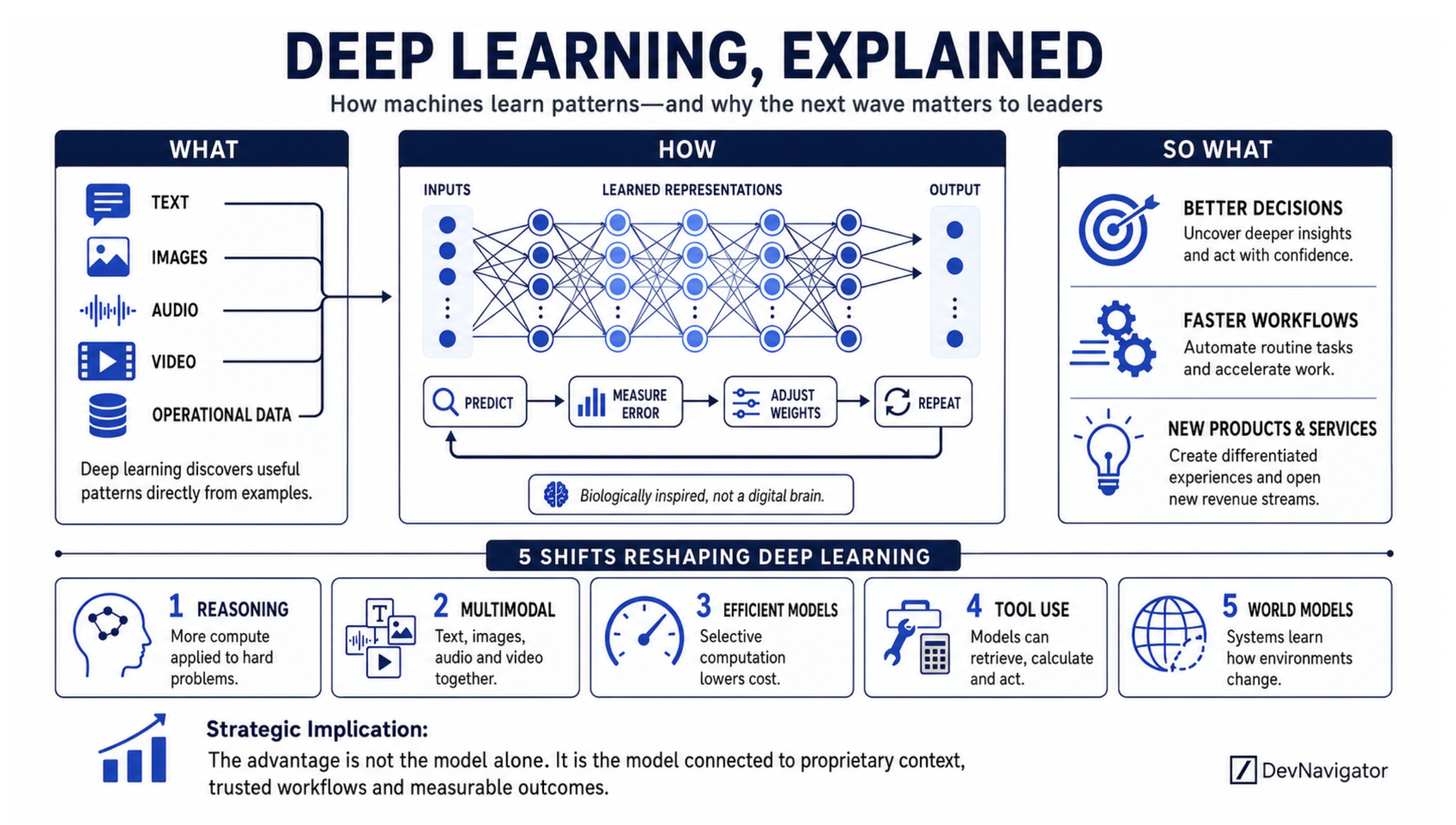
Deep learning powers many of the AI systems now entering business workflows. It enables machines to recognize patterns in text, images, audio, video, and operational data without requiring people to define every rule manually. For leadership, understanding every mathematical detail is unnecessary. What matters is knowing how these systems learn, how their capabilities are changing, and where those advances can produce measurable business value.AI & Data Science · Sep 9, 2026

Deep Learning for Leaders: 5 Powerful Shifts Reshaping AI

Deep learning powers many of the AI systems now entering business workflows. It enables machines to recognize patterns in text, images, audio, video, and operational data without requiring people to define every rule manually. For leadership, understanding every mathematical detail is unnecessary. What matters is knowing how these systems learn, how their capabilities are changing, and where those advances can produce measurable business value.

Open visual brief
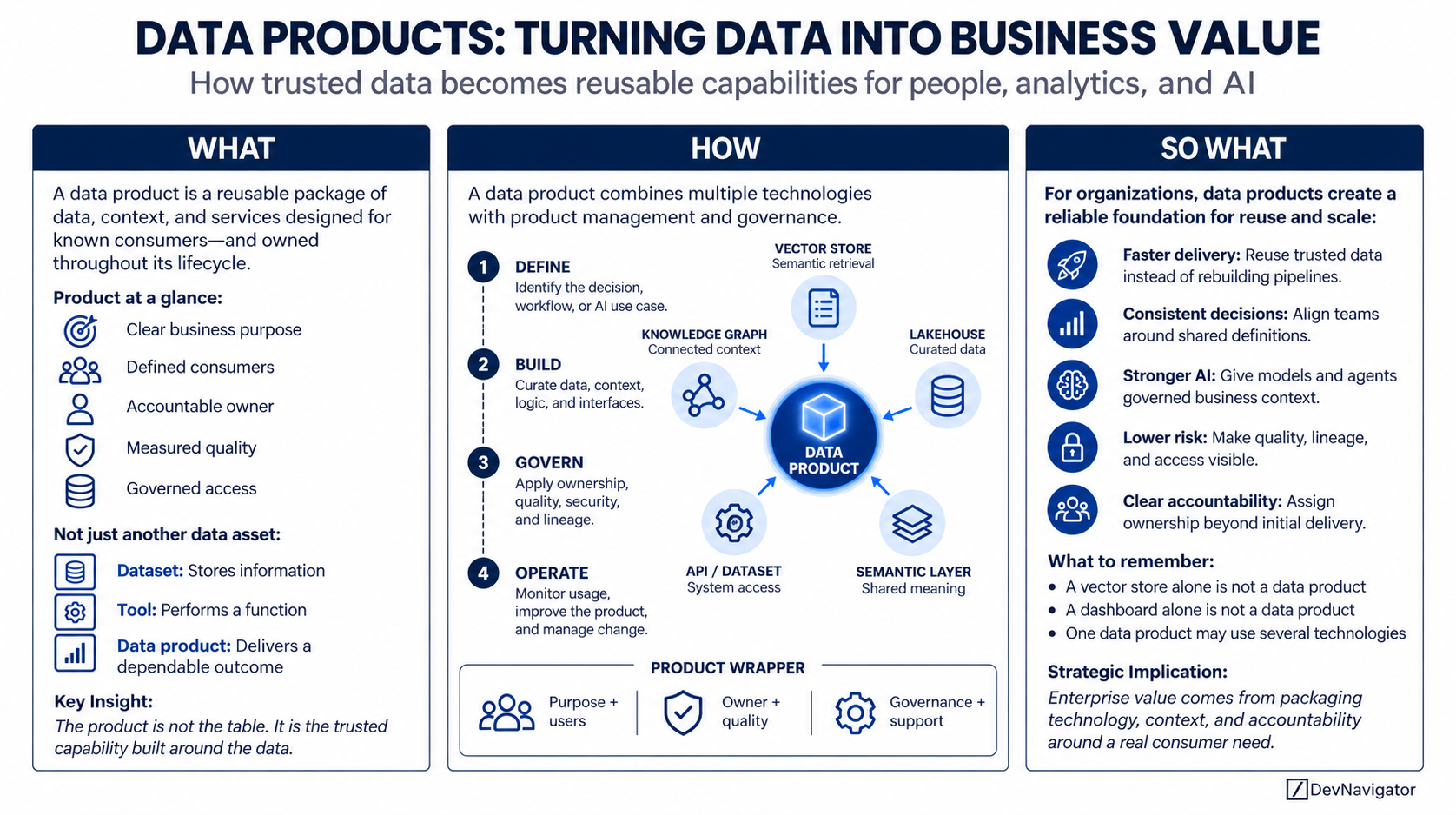
Organizations have invested heavily in warehouses, lakehouses, dashboards, knowledge graphs, and vector databases. These technologies are useful, but technology alone does not create a dependable business capability. Data products combine data, context, ownership, quality, governance, and access around a defined consumer need. They give people and AI systems information they can find, understand, trust, and reuse.Data & Infrastructure · Sep 8, 2026

Data Products: 5 Powerful Ways They Strengthen Enterprise AI

Organizations have invested heavily in warehouses, lakehouses, dashboards, knowledge graphs, and vector databases. These technologies are useful, but technology alone does not create a dependable business capability. Data products combine data, context, ownership, quality, governance, and access around a defined consumer need. They give people and AI systems information they can find, understand, trust, and reuse.

Open visual brief
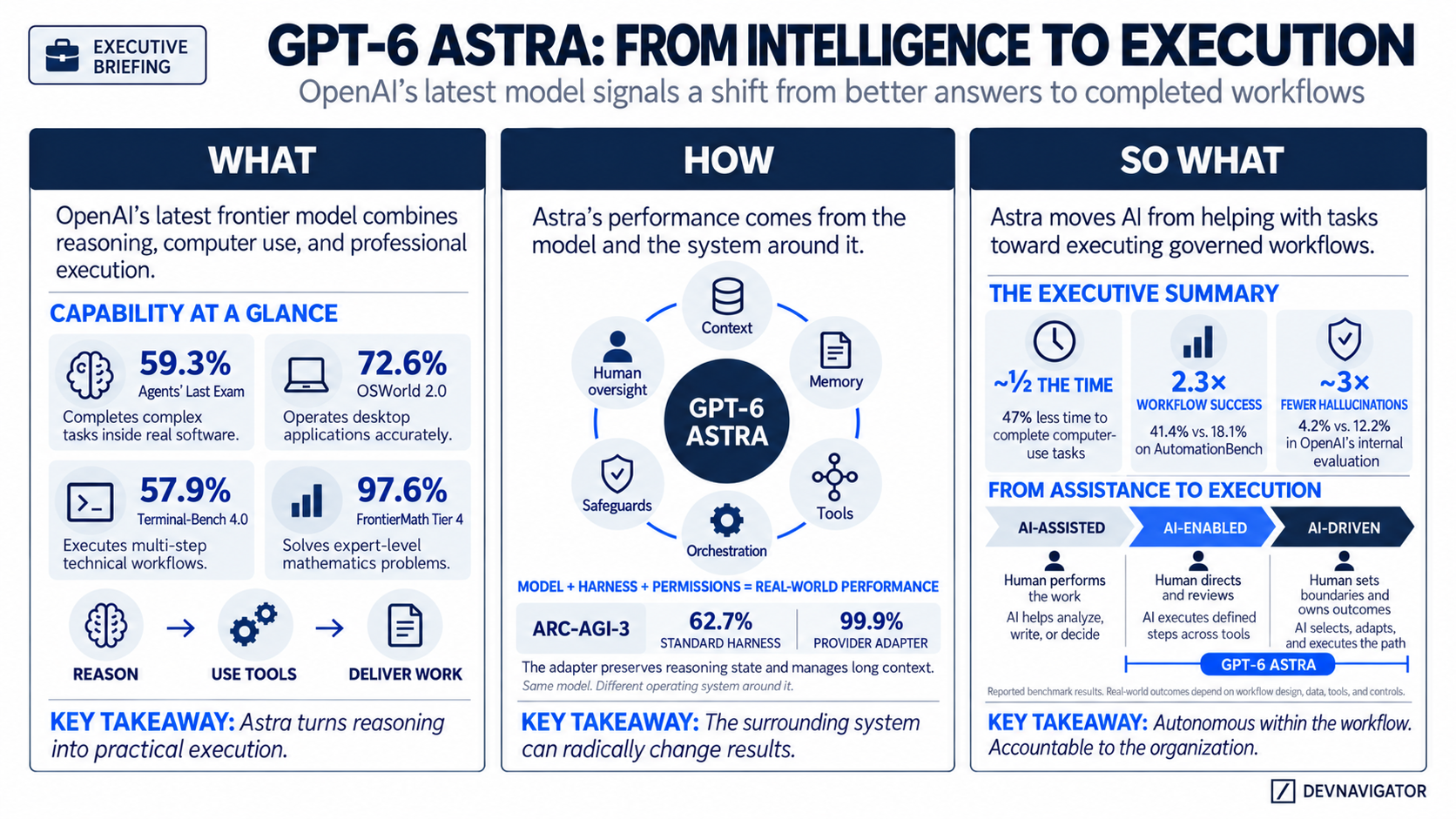
GPT-6 Astra: 3 Powerful Signals That AI Is Moving From Assistance to ExecutionAI & Data Science · Sep 7, 2026

GPT-6 Astra: 3 Powerful Signals That AI Is Moving From Assistance to Execution

GPT-6 Astra represents an important change in how artificial intelligence creates value. The headline is not simply that the model produces better answers. It can reason through unfamiliar problems, operate software, preserve direction across longer assignments, and complete multistep workflows. Reported benchmark results suggest meaningful improvements in speed, workflow completion, and reliability. For leaders, the larger message is clear: AI is moving from assisting people with individual tasks toward executing governed workflows within defined boundaries.

Open visual brief