Muse AI Agent: 4 Powerful Benefits and Hidden Risks
Muse AI agent brings a practical leadership question into focus: how much work can we delegate to software that keeps acting after a conversation ends? Meta’s personal agent combines remembered context, connected applications, and background execution to advance tasks over time. Its expansion into small business adds a commercial dimension, connecting everyday goals with operational tools. The opportunity is less coordination and greater continuity. The challenge is establishing clear authority, reliable completion, and meaningful oversight. Leaders should evaluate the full system around the agent, including the information it receives, the actions it can take, and the outcomes it delivers.
Table of Contents
Executive Takeaways
- Delegate outcomes. Persistent agents create an opportunity to assign bounded work that continues beyond an individual interaction.
- Connect useful context. Business value depends on relevant information and usable tools, supported by clear ownership and access rules.
- Control authority. Approval policies and completion checks should grow alongside an agent’s ability to act.
Strategic Insights
What the Muse AI agent changes about delegation
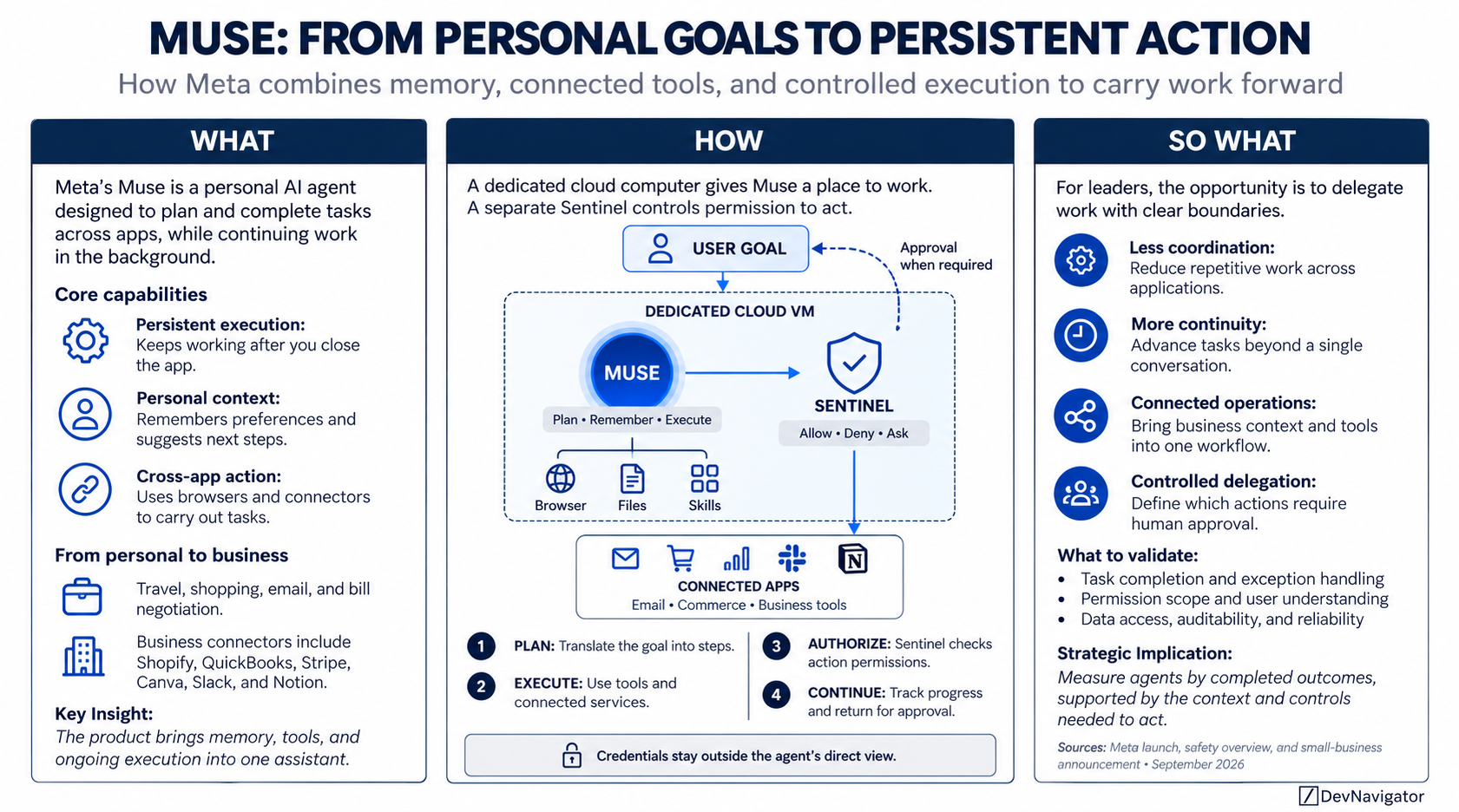
Meta describes Muse as a personal agent that can remember preferences, develop plans, and continue tasks in the background. Its advertised applications range from travel and shopping to email and bill negotiation. These capabilities suggest a workflow in which a person sets a goal and returns when a decision needs attention.
The business implication is continuity. Consider a hypothetical campaign preparation task: gathering sales information, identifying promising products, drafting content, and waiting for review. The useful outcome is a prepared campaign with supporting evidence. Producing several disconnected drafts would leave much of the coordination with the user.
For leaders, Muse AI agent offers a reason to reconsider the unit of delegation. A good assignment specifies the intended result, constraints, deadline, and escalation conditions. That discipline also makes success easier to assess.
How a cloud workspace supports ongoing execution
According to Meta’s technical safety overview, Muse operates within a dedicated cloud virtual machine containing a browser and working environment. Connectors provide access to services, while skills supply instructions for using them. A separate Sentinel governs connector actions and outbound network requests.
This separation matters: the component proposing an action does not hold sole authority to approve it. Meta also describes credential handling that keeps actual secrets outside the agent’s direct view, with permissions scoped to particular uses.
These are architectural protections, not evidence of universal reliability. A permitted action can still be mistaken. A correctly executed action can still pursue an outdated goal. Evaluating Muse AI agent therefore requires checking both execution and judgment: did the system perform the operation correctly, and was that operation appropriate?
Connected business context makes delegation useful
Meta’s September 29 small-business announcement adds connectors including Shopify, QuickBooks, Stripe, Canva, Slack, and Notion. Suggested applications include financial reviews, campaign preparation, and growth planning. These are company-described use cases, rather than independently established productivity gains.
Connecting systems could reduce the effort required to assemble business context. However, access alone cannot resolve inconsistent definitions, incomplete records, or conflicting instructions. An agent reviewing revenue needs to understand the reporting period, treatment of refunds, and which source is authoritative.
For a Muse AI agent pilot, context preparation deserves explicit attention. Identify the records needed for the assignment, the business definitions that govern interpretation, and the person responsible for resolving ambiguity. Better context should improve the conditions for useful work, while measured results establish whether that improvement actually occurs.
Measure completed work and retained control
The practical opportunity is to reduce repetitive coordination while preserving accountability. Start with a bounded workflow, such as preparing a weekly performance review, where outputs can be checked before consequential actions occur.
Measure accepted task completion, elapsed time, reviewer effort, and correction rates. Include the cost of supervision: an agent that saves preparation time but creates extensive review work may deliver little net benefit.
Permission design should be equally concrete. Reading records, drafting messages, sending communications, and spending money represent different authorities. Users need to understand what they have granted and how to revoke it.
Muse AI agent illustrates a broader operating-model question: which work can move forward independently, and where must human judgment remain involved? The strongest adoption case will connect a clear outcome with sufficient context, bounded authority, and evidence that the work was completed well.