
Eight-Layer Architecture for Agentic Systems
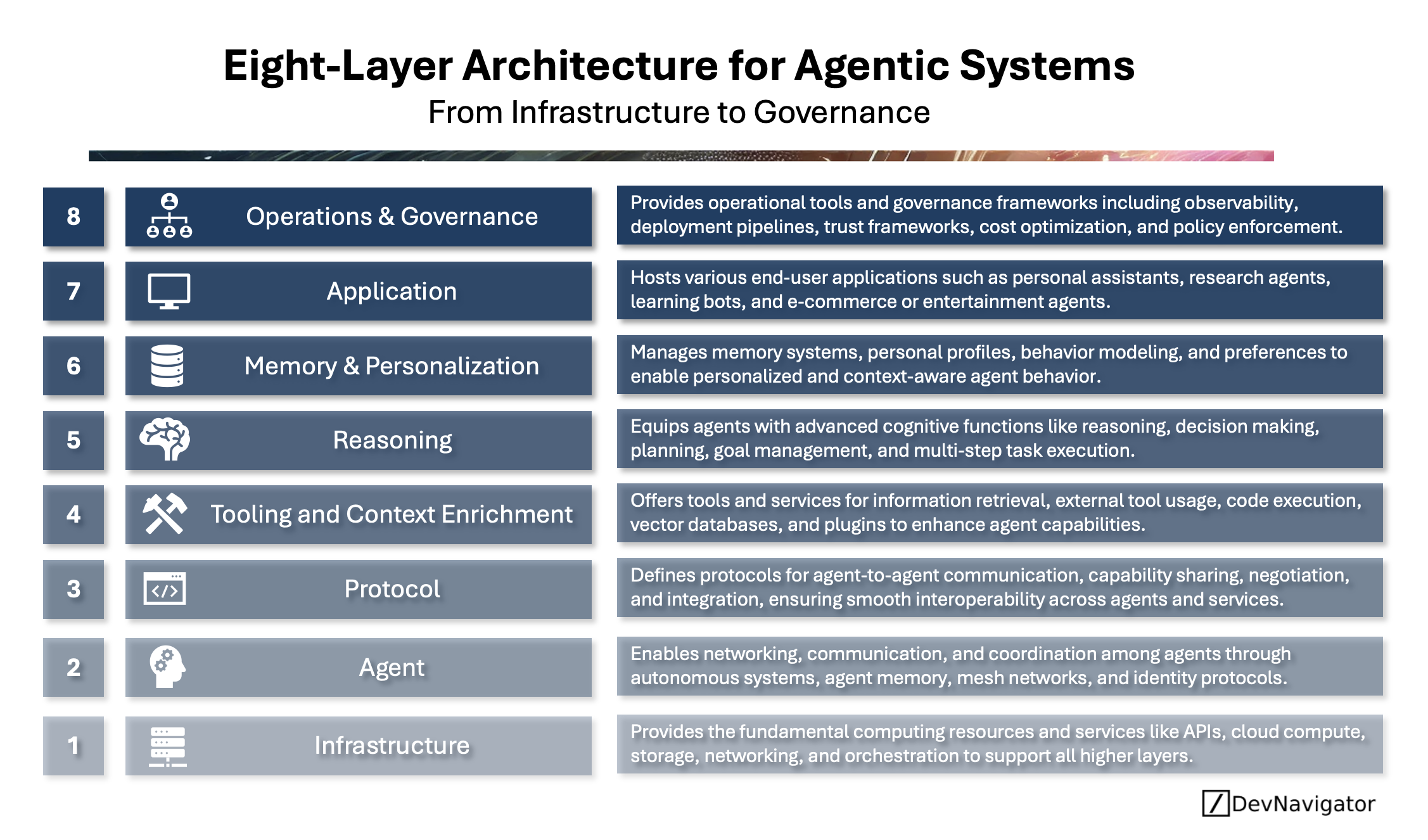
Building truly intelligent, autonomous systems requires more than powerful models, it demands a cohesive architecture that connects reasoning, memory, communication, and governance into a unified ecosystem. This eight-layer framework illustrates how agentic systems evolve from foundational infrastructure and protocol layers to high-level applications and governance mechanisms. Lower layers ensure stability and interoperability, enabling agents to access compute, communicate, and act reliably. The middle layers: reasoning, memory, and context enrichment, form the system’s cognitive core, allowing agents to plan, adapt, and personalize their behavior. At the top, applications deliver real-world value while operations and governance establish oversight, ethics, and accountability. The key takeaway: as AI systems become more autonomous, success will hinge not on raw intelligence alone, but on how effectively these eight layers are integrated to balance performance, trust, and control.