
Data Products: 5 Powerful Ways They Strengthen Enterprise AI
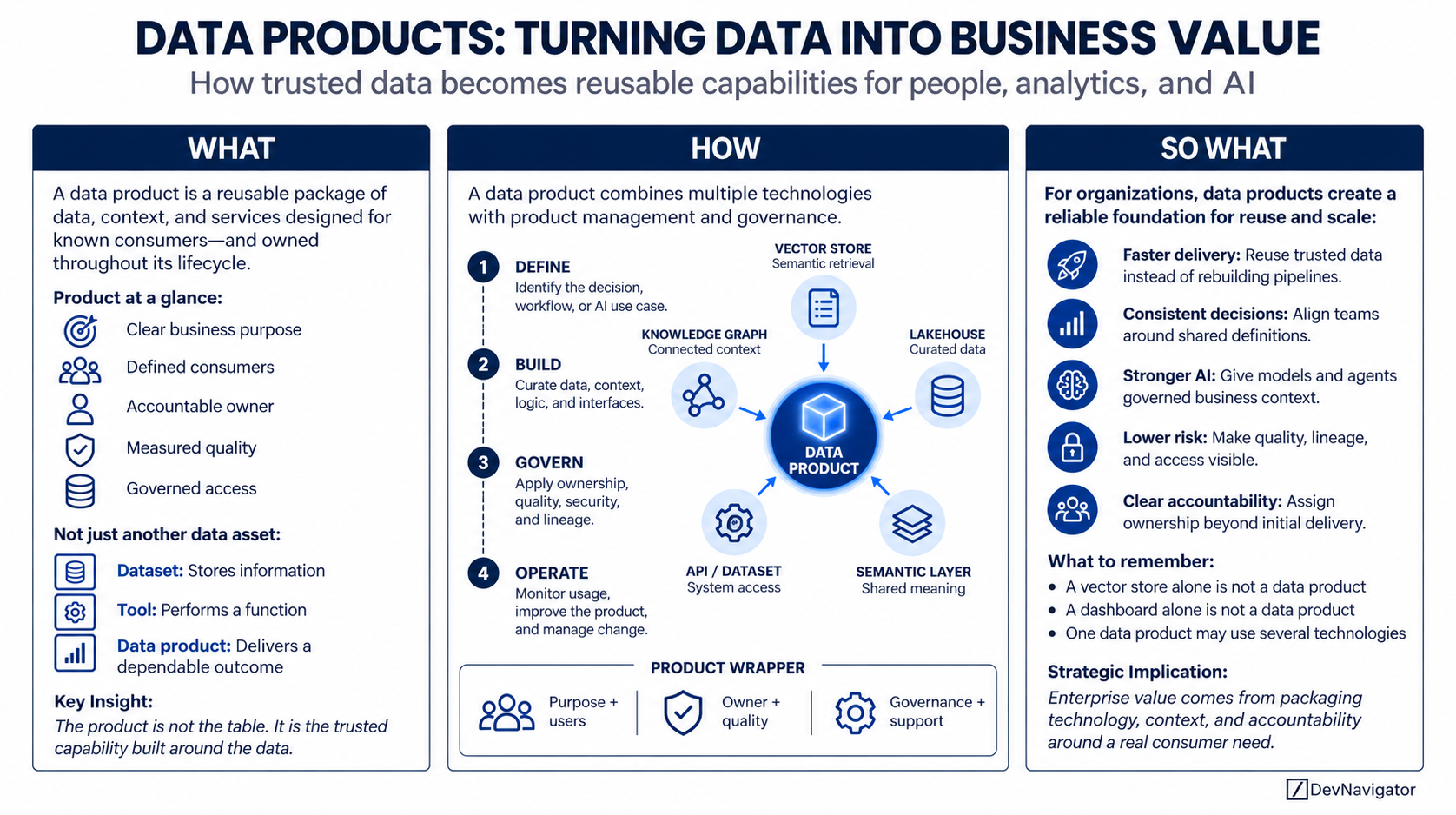
Organizations have invested heavily in warehouses, lakehouses, dashboards, knowledge graphs, and vector databases. These technologies are useful, but technology alone does not create a dependable business capability. Data products combine data, context, ownership, quality, governance, and access around a defined consumer need. They give people and AI systems information they can find, understand, trust, and reuse.
Table of Contents
Executive Takeaways
- Data products package trusted data and supporting services around a specific business purpose.
- A vector store, knowledge graph, dashboard, or lakehouse can support a data product, but none automatically qualifies as one.
- Strong data products establish clear ownership, documented meaning, measurable quality, governed access, and reliable consumption.
- AI agents become more dependable when they consume governed data products instead of searching disconnected enterprise systems.
Strategic Insights
What Makes Data a Product?
A dataset becomes a product when it is intentionally designed for consumers and managed throughout its lifecycle. That requires more than cleaning a table or publishing it to a catalog, often with FAIR guiding principles.
Every data product should have a clear purpose. It should identify the decision, workflow, application, model, or AI agent it supports. It should also define who will use it, how they will access it, what the data means, and who is responsible when something changes or fails.
The central distinction is simple: a dataset stores information, while a data product delivers a dependable outcome.
For example, a manufacturing batch data product might combine process parameters, equipment events, material genealogy, deviations, and quality results. Engineers could analyze process performance, leaders could monitor operational risk, and AI agents could support investigations. The underlying data is valuable because it has been packaged with context, controls, and a stable method of access.
How Supporting Technologies Fit Together
Data products are not a replacement for existing data technologies. They organize those technologies around a consumer need.
A lakehouse or warehouse can provide the structured analytical foundation. It stores curated historical data and supports reporting, analytics, and machine learning.
A vector store supports semantic retrieval. It converts content into embeddings so an AI application can find information based on meaning rather than exact keywords. A vector store may power part of a data product, but a collection of embeddings without ownership, quality controls, or a defined use case remains a technical asset.
A knowledge graph represents entities and their relationships. It can connect products, batches, equipment, materials, suppliers, documents, and organizational concepts. This connected context can make data products more useful for investigation, reasoning, and AI.
An API, dataset, or event stream provides a consumption interface. It gives applications and users a consistent way to access the product.
A semantic layer defines shared metrics and business terminology, while a dashboard presents selected information to users. Both can form part of the experience, but a dashboard alone is not necessarily a data product. One data product may use several of these technologies at the same time.
How Data Products Are Built
Development begins with a consumer and a problem, not with an available table. The team first defines the outcome and determines what information is required. It then curates the data, adds business context, selects appropriate interfaces, and documents how the product should be used.
Governance is built into the product rather than applied at the end. This includes ownership, security, lineage, retention, quality expectations, and approved use. The team also establishes measures for freshness, completeness, accuracy, availability, and adoption.
Once released, data products must be operated like other enterprise products. Usage is monitored, consumer feedback is collected, changes are communicated, and obsolete versions are retired. This lifecycle separates a maintained product from a one-time delivery.
Why Data Products Matter for AI
Enterprise AI often struggles because the underlying information is fragmented, poorly documented, or difficult to trust. Models and agents may retrieve technically relevant information without understanding whether it is current, authoritative, complete, or appropriate for the user.
Data products provide a controlled layer between enterprise systems and AI. They give agents governed access to trusted information, common definitions, relationships, provenance, and known limitations.
This does not eliminate the need for model evaluation or human oversight. It does, however, give AI a stronger foundation. Instead of asking an agent to interpret the entire enterprise data estate, organizations can give it access to purpose-built data products designed for specific tasks.
The long-term advantage will not come from accumulating more disconnected data tools. It will come from turning enterprise knowledge into reusable, governed capabilities that both people and intelligent systems can confidently consume.