
AI Value Creation: 3 Powerful Ways to Transform Business
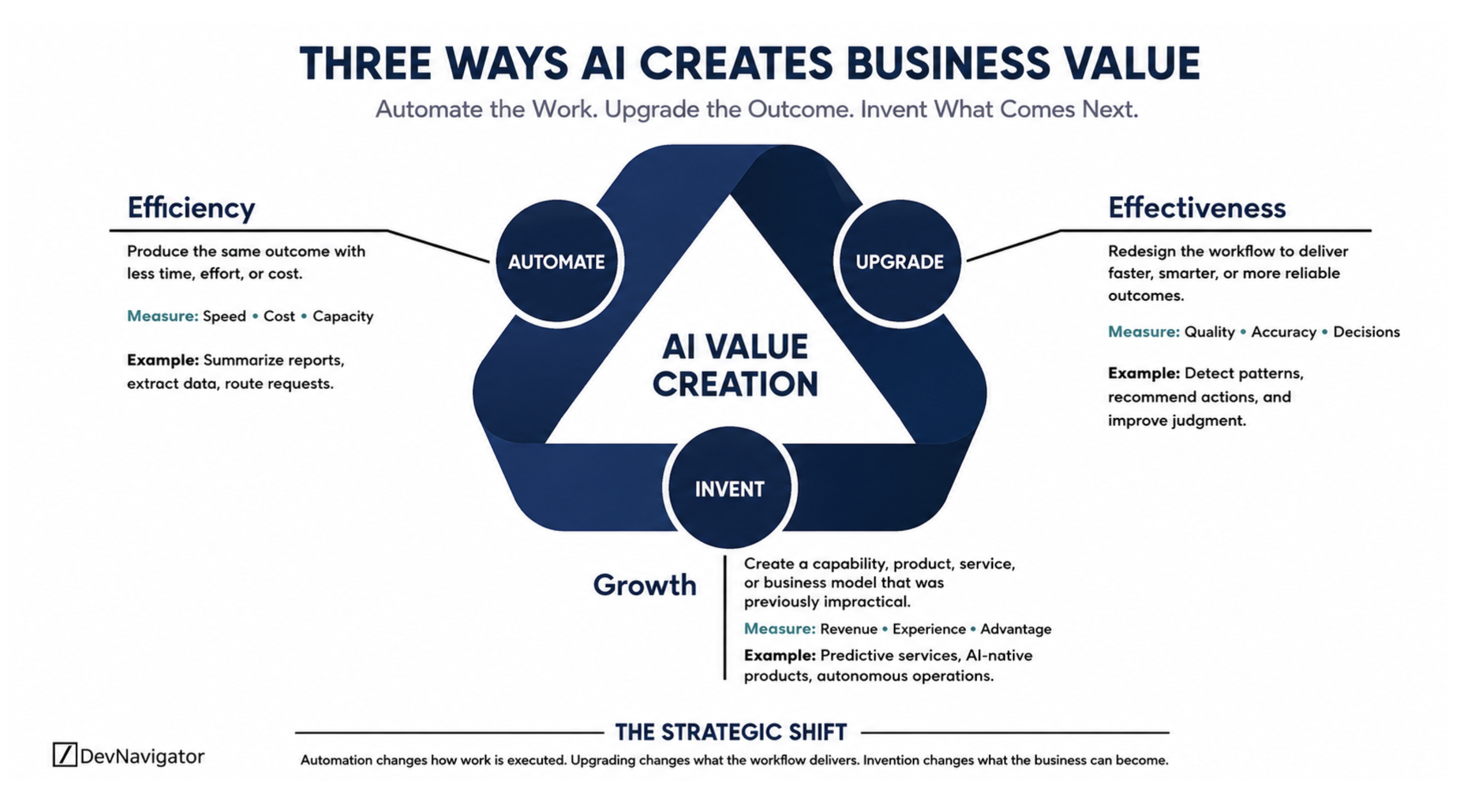
AI creates business value in three ways: by making existing work more efficient, improving the outcomes a workflow delivers, or enabling something entirely new.
AI investment is accelerating, but many organizations still struggle to explain what value they expect it to create. Individual use cases get described as automation, transformation, innovation, or productivity tools, often without a clear distinction between them. A simpler model separates AI value creation into three plays: Automate, Upgrade, and Invent. Each represents a different ambition, requires different operating changes, and should be measured differently.
Table of Contents
Executive Takeaways
- Automate produces substantially the same outcome with less time, effort, or cost. Its primary value is efficiency.
- Upgrade redesigns the workflow to improve quality, accuracy, speed, or decision-making. Its primary value is effectiveness.
- Invent creates a new capability, product, service, or business model. Its primary value is growth and differentiation.
Strategic Insights
Automate the Work
The first form of AI value creation is automation. The objective is straightforward: produce the same basic output while reducing the human effort, cost, or elapsed time required to create it.
Examples include summarizing reports, extracting information from documents, classifying requests, generating first drafts, or routing work to the appropriate team. The output already exists today. AI changes how efficiently the organization produces it.
Automation should be measured through cycle time, cost, capacity, throughput, and the reduction of repetitive work. These use cases often provide the fastest path to measurable value because the current process and baseline performance are already understood.
However, automating an inefficient workflow does not necessarily fix it. It can simply make the existing process run faster. That is useful, but it represents only the first level of AI value creation.
Upgrade the Outcome
The second play goes beyond task acceleration. Upgrade means redesigning how work happens so the workflow delivers a materially better result.
An upgraded process might use AI to detect patterns, retrieve relevant organizational knowledge, recommend actions, anticipate risk, or help people make more consistent decisions. The objective is not simply to prepare the same report faster. It is to create a report that identifies issues earlier and directs attention toward the decisions that matter.
This distinction is increasingly important. MIT Sloan research suggests that AI’s greatest value may emerge when organizations redesign complete workflows instead of optimizing isolated tasks. How tasks are sequenced, grouped, and divided between humans and AI can matter as much as the performance of any single model.
This form of AI value creation should be measured through quality, accuracy, reliability, decision speed, user experience, and business outcomes. It usually requires more than introducing an AI tool. Roles, handoffs, decision rights, data access, and feedback loops may all need to change.
Invent What Comes Next
The third play is invention. Here, AI enables a capability, experience, product, service, or business model that was previously impossible or economically impractical.
Examples include predictive services that prevent problems before they occur, AI-native products that adapt to individual users, autonomous operations that respond continuously to changing conditions, or entirely new services built around organizational data and intelligence.
This is the most uncertain form of AI value creation, but it can also produce the strongest differentiation. The relevant measures shift toward revenue, customer adoption, market access, experience, strategic advantage, and the creation of new intellectual property.
BCG describes a similar progression through its Deploy, Reshape, Invent framework. Deploy improves performance through existing tools, Reshape transforms critical functions, and Invent creates new products and business models.
Match the Investment to the Value Play
Automate, Upgrade, and Invent should not be treated as mandatory maturity stages. An organization does not need to automate everything before pursuing innovation. Nor is invention automatically more valuable than automation.
The purpose of the framework is to make the intended source of AI value creation explicit. An automation use case should not be sold as transformation. A redesigned workflow should not be measured only by hours saved. An experimental product should not be evaluated using the certainty expected from a mature efficiency program.
Leaders should maintain a balanced portfolio across all three plays. Automation creates capacity. Upgrading converts that capacity into better performance. Invention turns new capabilities into future growth.