
AI Agent Skills: 5 Powerful Reasons Prompts and Tools Alone Fall Short
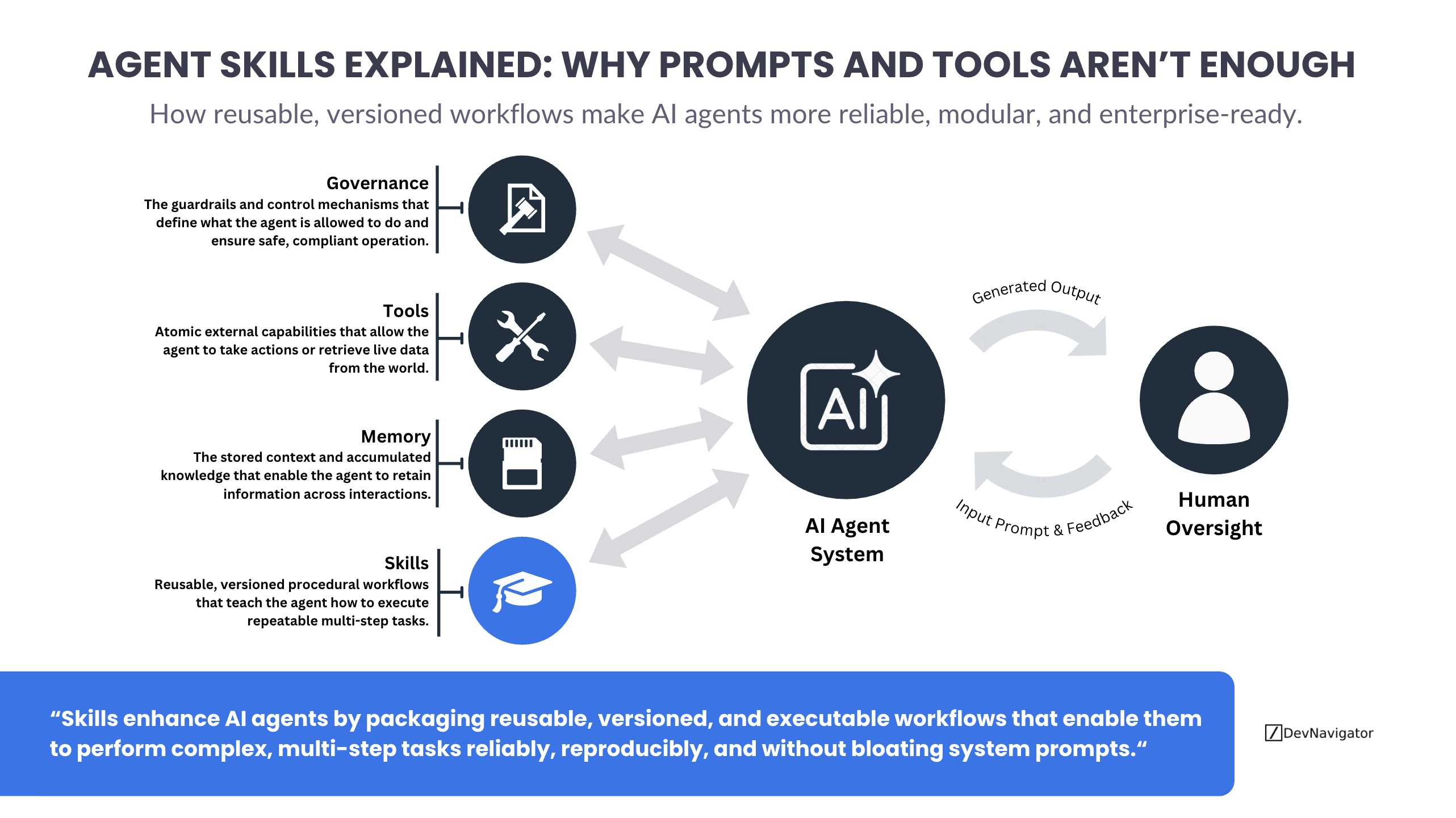
AI Agent Skills represent a structural shift in how modern AI systems are designed. While system prompts define behavior and tools enable external actions, neither is sufficient for managing complex, repeatable workflows at scale. AI Agent Skills fill this architectural gap by packaging instructions, scripts, and assets into reusable, versioned modules that can be mounted and executed when needed. This article explains why AI Agent Skills matter, how they differ from prompts and tools, and why they are becoming foundational for enterprise AI architecture.
Table of Contents
1. Executive Takeaways
- AI Agent Skills provide reusable, versioned workflows that prevent prompt bloat and improve architectural clarity.
- AI Agent Skills enable reproducibility and governance, making them particularly valuable in enterprise and regulated environments.
- AI Agent Skills complement prompts and tools, forming a structured middle layer that strengthens reliability and scalability.
2. Expanded Insights
The Architectural Gap Between Prompts and Tools
Modern AI agents typically rely on two building blocks: system prompts and tools. System prompts define global behavior such as tone, safety boundaries, and high-level instructions. Tools allow the agent to take atomic actions in the world, such as querying a database, sending an email, or retrieving live data.
However, neither prompts nor tools are designed to handle structured, repeatable procedures. When multi-step workflows are embedded directly into system prompts, they quickly become long, brittle, and difficult to maintain. When procedural logic is forced into tool schemas, clarity and reusability suffer.
AI Agent Skills solve this problem. They act as a modular layer between prompts and tools, packaging instructions, scripts, and assets into a dedicated bundle anchored by a required SKILL.md manifest. This allows agents to execute complex procedures without overloading the core prompt or misusing tool definitions.
What Makes AI Agent Skills Different
AI Agent Skills are not simply enhanced prompts. They are structured workflow packages that can include executable code, templates, dependencies, and routing instructions. When mounted into an execution environment, the model becomes aware that these skills exist and can invoke them when appropriate.
The defining characteristics of AI Agent Skills are reuse, versioning, and conditional invocation. A skill can be uploaded once and shared across agents or teams. It can be version-pinned for reproducibility. It is not baked into every interaction but triggered when needed.
This design introduces a level of operational discipline. Instead of rewriting the same logic repeatedly in prompts, teams can maintain a standard library of AI Agent Skills that encapsulate approved workflows. This improves modularity and reduces architectural drift.
Reliability and Reproducibility at Scale
As AI systems move from experimentation to production, reliability becomes a central concern. Enterprises need to know which logic executed, which version was used, and whether outputs can be reproduced.
AI Agent Skills directly support this need. Because they are versioned artifacts, teams can pin a specific version in production. That means a workflow executed today can be replicated tomorrow under the same configuration. This is particularly important in environments where auditability and traceability matter.
By separating global behavior in prompts from procedural logic in AI Agent Skills, organizations gain cleaner change management. Updates to a workflow can be published as a new version without altering every agent prompt in the system.
Keeping Prompts Lean and Focused
System prompts should define who the agent is and what principles it follows. They are not ideal for encoding complex step-by-step instructions. Overloaded prompts reduce clarity and increase fragility.
AI Agent Skills allow prompts to remain lean. Stable procedures move into skills, while the system prompt focuses on safety, tone, and high-level constraints. This separation of concerns mirrors established software engineering practices and leads to more maintainable AI systems.
The result is an agent architecture where AI Agent Skills handle the how, tools handle the what, and prompts define the why.
Enterprise Readiness and Governance Alignment
In enterprise environments, governance and human oversight are not optional. AI systems must operate within defined boundaries and often require approval loops or audit trails.
AI Agent Skills strengthen governance by making procedural logic explicit and inspectable. Instead of hidden instructions buried in a prompt, workflows are packaged as discoverable modules. This transparency makes it easier to review, validate, and standardize behavior across teams.
When combined with tools, memory, and human oversight, AI Agent Skills contribute to a more complete agent capability model. They support modular design, enforce consistency, and create a foundation for scalable AI deployment.