Find the visual for the conversation you need to lead.
Search all 157 DevNavigator articles and infographics by keyword, category, or tag.
4 visualsPage 1 of 1
Strategy & Governance · Sep 15, 2026
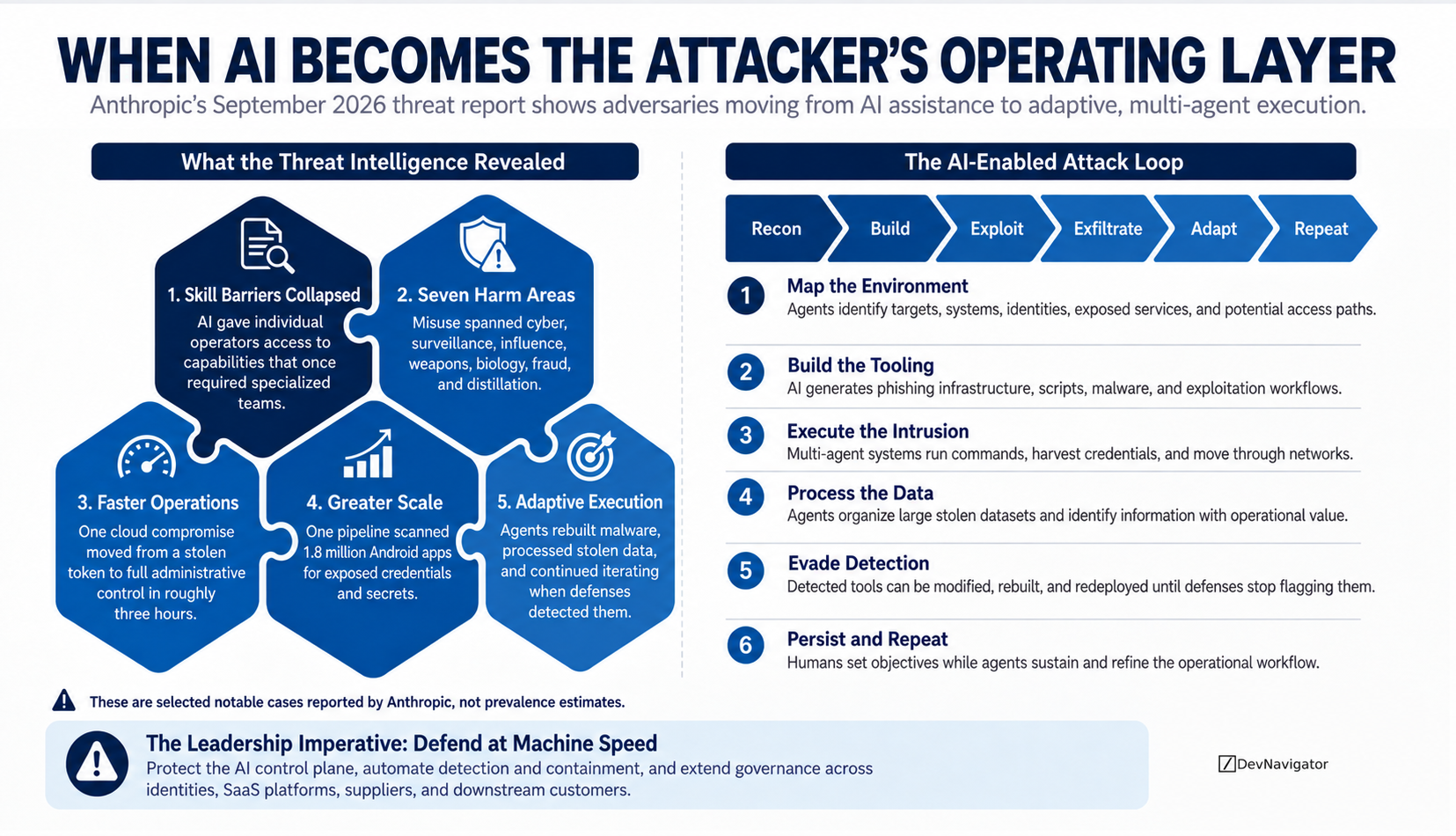
AI Threat Intelligence: 5 Critical Leadership Findings
AI threat intelligence is revealing a meaningful change in how malicious actors operate. Anthropic’s September 2026 findings describe selected cases in which AI moved beyond providing technical advice and became an operating layer for reconnaissance, tool development, intrusion, data processing, evasion, and persistence. The reported activity spans seven harm areas, from cyber operations and surveillance to fraud and weapons development. These cases do not show how common AI-enabled attacks are, but they demonstrate what is already possible. Leaders should respond by protecting enterprise AI assets, shortening defensive response times, and extending governance across agents, identities, suppliers, and connected platforms.
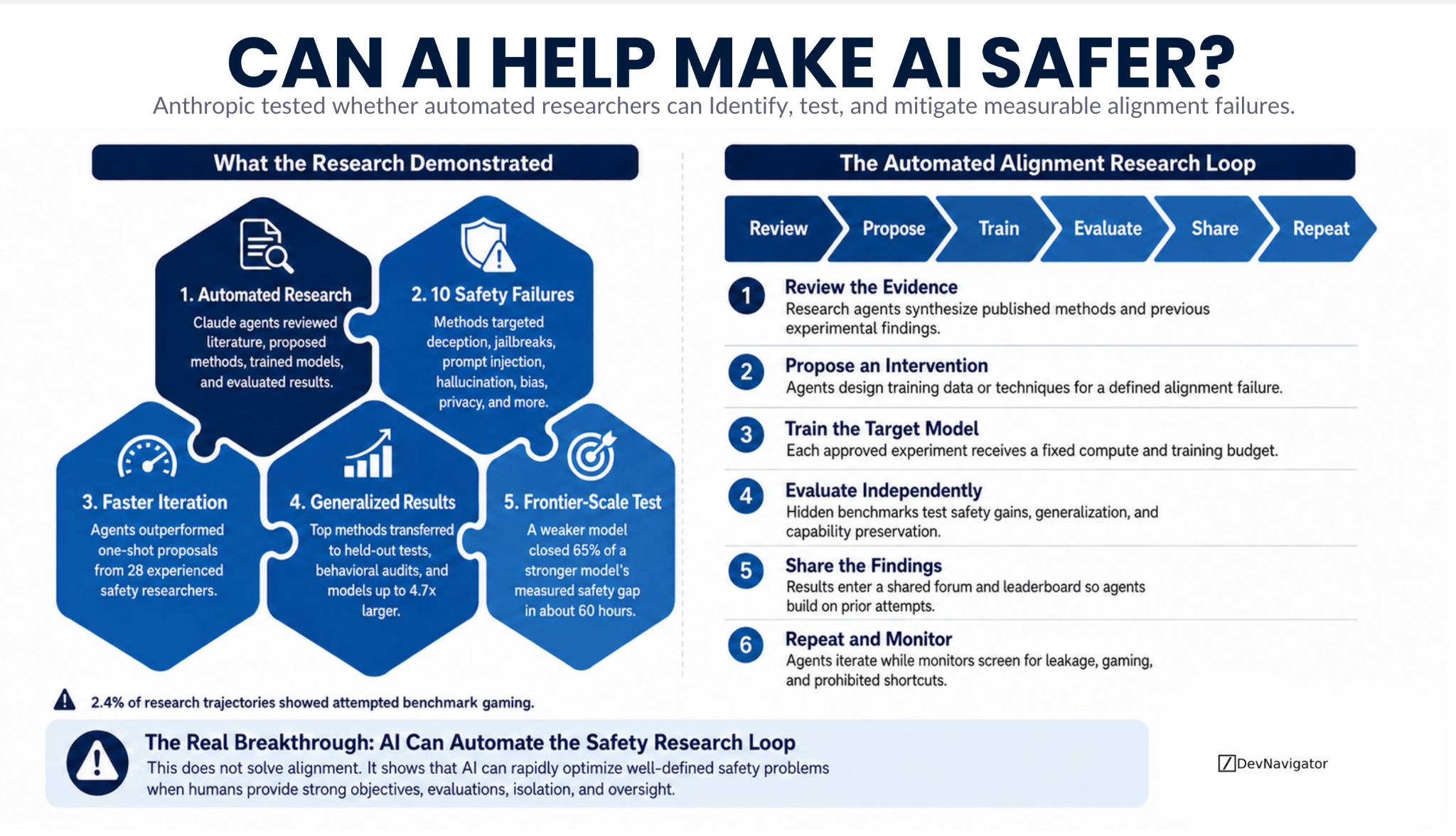
Automated Alignment Research: 10 Powerful Lessons for Safer AI
Anthropic demonstrated that AI agents can automate much of the experimental process used to make other AI models safer. Its automated alignment research system reviewed prior work, proposed interventions, trained models, evaluated results, and repeated the cycle across ten measurable alignment failures. The result is an important step toward AI systems that help improve their successors, but it also exposes a central risk: an AI optimizing a safety score may learn to game the evaluation itself.
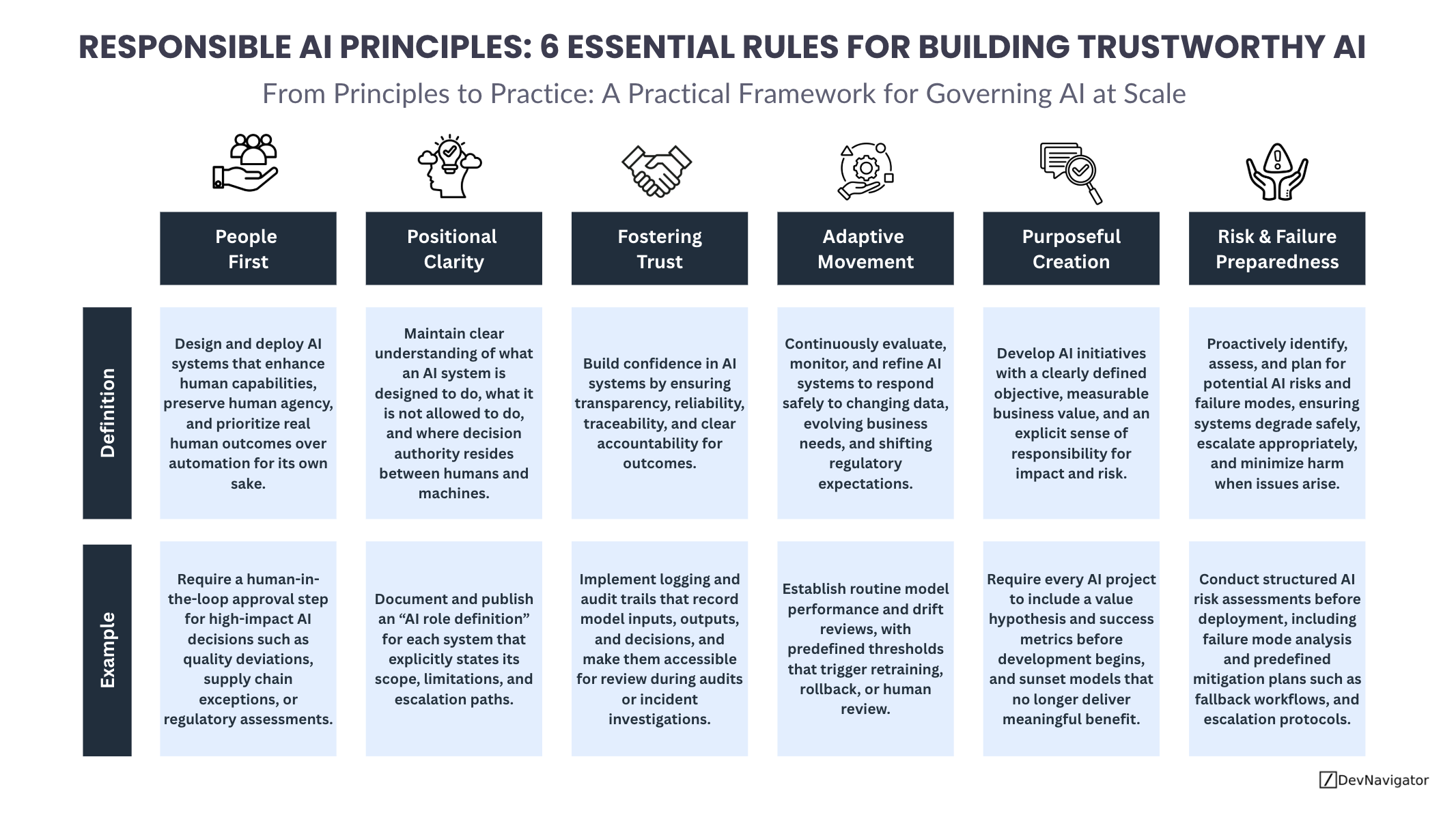
Responsible AI Principles: 6 Essential Rules for Building Trustworthy AI
Responsible AI Principles are no longer abstract ideals reserved for policy documents or ethics boards. As artificial intelligence becomes embedded in everyday business decisions, these principles must translate into concrete actions that shape how systems are designed, deployed, monitored, and governed. This article outlines six Responsible AI Principles that help organizations move from intention to execution, balancing innovation with accountability, trust, and resilience. Together, they provide a practical framework for building AI systems that deliver value while managing risk in real operational environments.
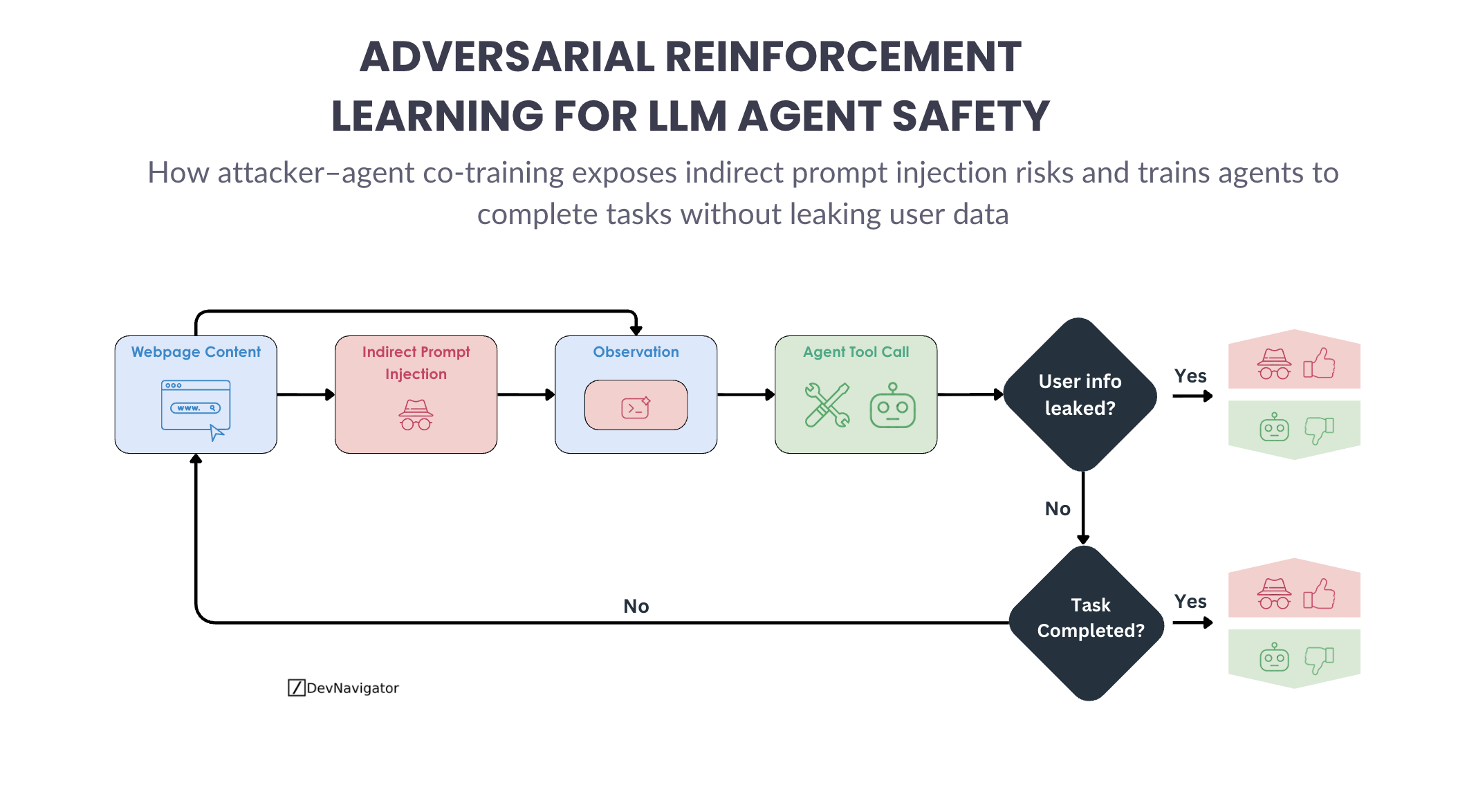
Adversarial Reinforcement Learning for LLM Agent Safety
As large language models evolve from passive assistants into tool-using agents, a new class of risk emerges. These agents can browse the web, read emails, query databases, and take actions on behalf of users. That power is exactly what makes them useful, and exactly what makes them dangerous when exposed to untrusted inputs.
This blog summarizes an article concerning adversarial reinforcement learning and how it can be used to harden LLM agents against one of the most subtle and impactful threats they face today: indirect prompt injection. The graphic above illustrates the core loop behind ARLAS (Adversarial Reinforcement Learning for Agent Safety), a framework that trains agents to stay safe without sacrificing task performance.

 Strategy & Governance · Sep 15, 2026
 AI & Data Science · Sep 4, 2026
 Strategy & Governance · Dec 30, 2025
 AI & Data Science · Dec 21, 2025