Find the visual for the conversation you need to lead.
Search all 157 DevNavigator articles and infographics by keyword, category, or tag.
3 visualsPage 1 of 1
AI & Data Science · Dec 26, 2025
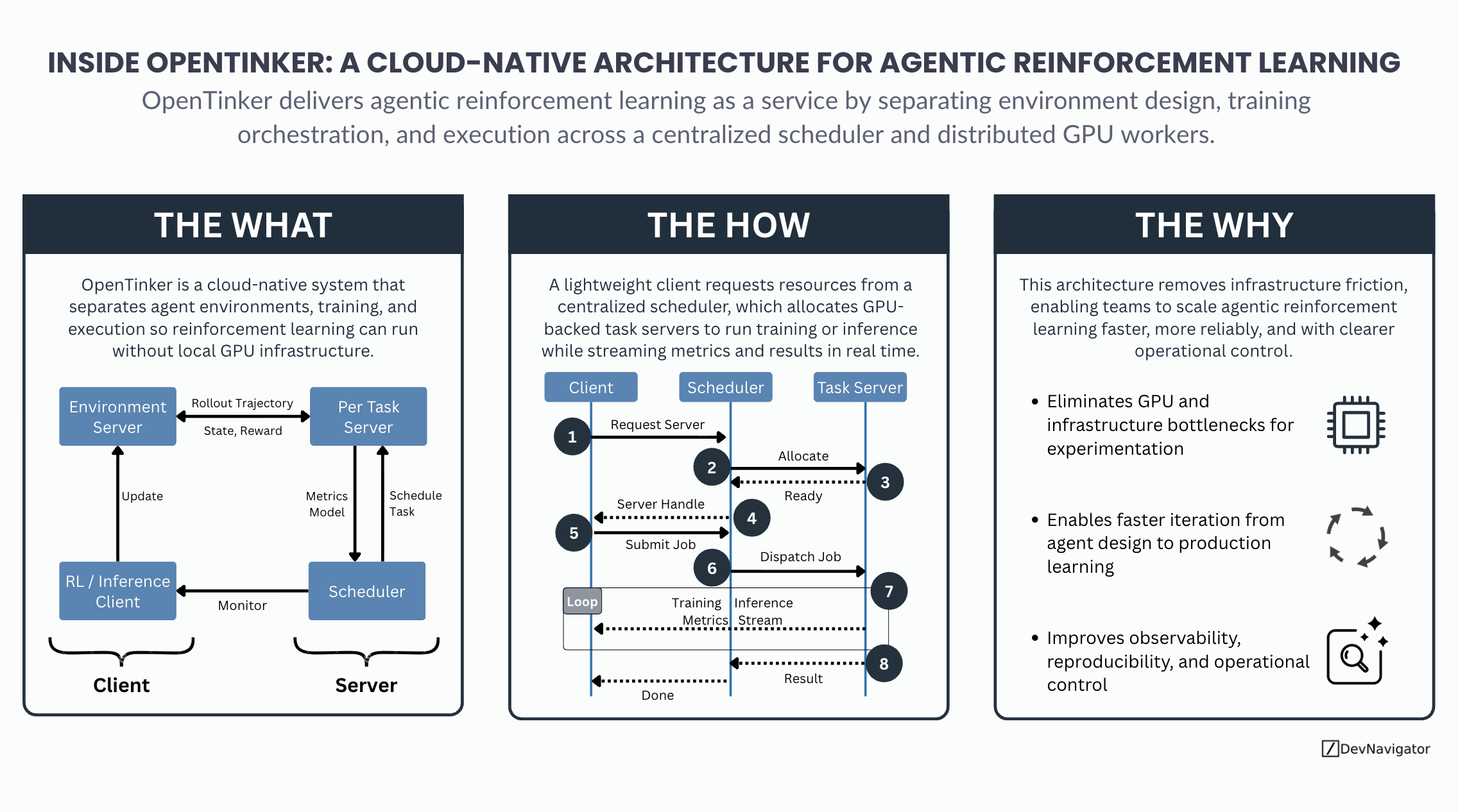
Reinforcement Learning Made Powerful: 3 Architectural Insights from OpenTinker’s Cloud-Native Agentic Platform
As reinforcement learning increasingly shifts from isolated research experiments to agentic systems embedded in real workflows, infrastructure has become the limiting factor. Training modern AI agents often requires distributed GPUs, complex orchestration, and tight coupling between environment design and execution. OpenTinker addresses this challenge by delivering agentic reinforcement learning as a service. Its cloud-native architecture cleanly separates environment design, training orchestration, and execution, allowing teams to scale learning without owning or managing GPU infrastructure. This article breaks down what OpenTinker is, how it works, and why this design matters as organizations move toward production-grade AI agents.
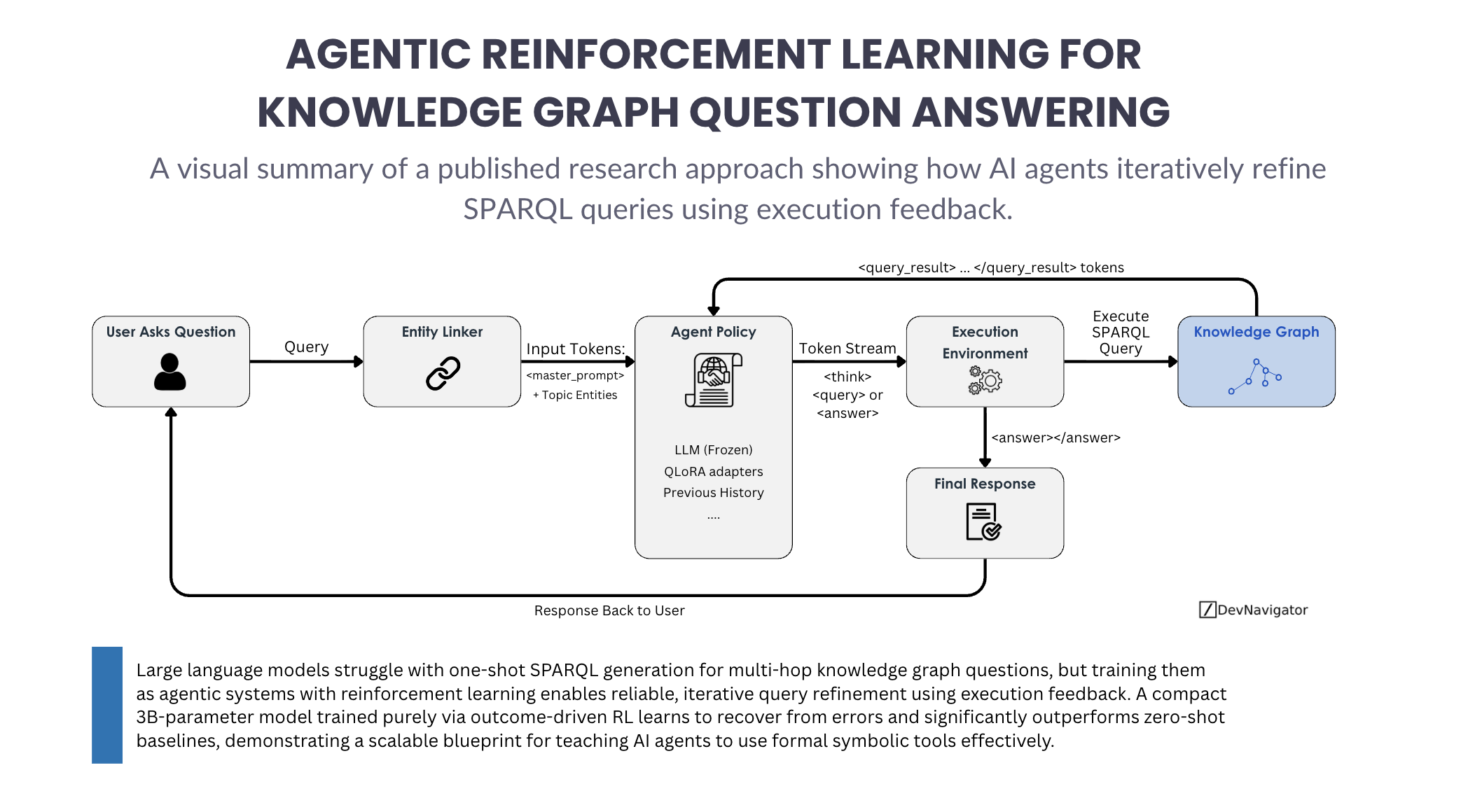
Agentic Reinforcement Learning for Improving Knowledge Graph Question Answering Reliability
Large language models struggle with one-shot SPARQL generation for multi-hop knowledge graph questions, but training them as agentic systems with reinforcement learning enables reliable, iterative query refinement using execution feedback. A compact 3B-parameter model trained purely via outcome-driven RL learns to recover from errors and significantly outperforms zero-shot baselines, demonstrating a scalable blueprint for teaching AI agents to use formal symbolic tools effectively.
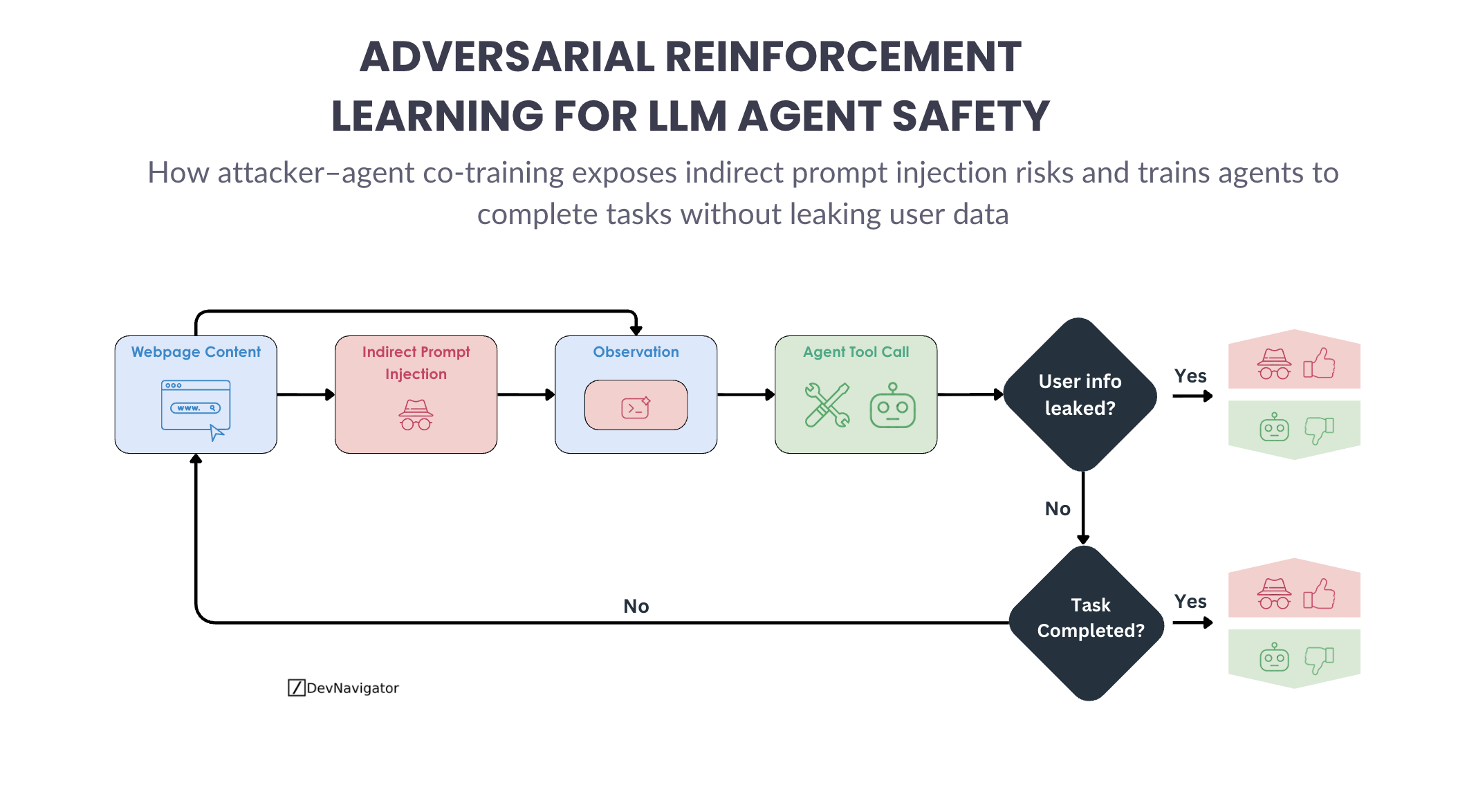
Adversarial Reinforcement Learning for LLM Agent Safety
As large language models evolve from passive assistants into tool-using agents, a new class of risk emerges. These agents can browse the web, read emails, query databases, and take actions on behalf of users. That power is exactly what makes them useful, and exactly what makes them dangerous when exposed to untrusted inputs.
This blog summarizes an article concerning adversarial reinforcement learning and how it can be used to harden LLM agents against one of the most subtle and impactful threats they face today: indirect prompt injection. The graphic above illustrates the core loop behind ARLAS (Adversarial Reinforcement Learning for Agent Safety), a framework that trains agents to stay safe without sacrificing task performance.

 AI & Data Science · Dec 26, 2025
 AI & Data Science · Dec 22, 2025
 AI & Data Science · Dec 21, 2025