Find the visual for the conversation you need to lead.
Search all 157 DevNavigator articles and infographics by keyword, category, or tag.
2 visualsPage 1 of 1
Strategy & Governance · Sep 7, 2026
AI System Architecture: 5 Essential Building Blocks
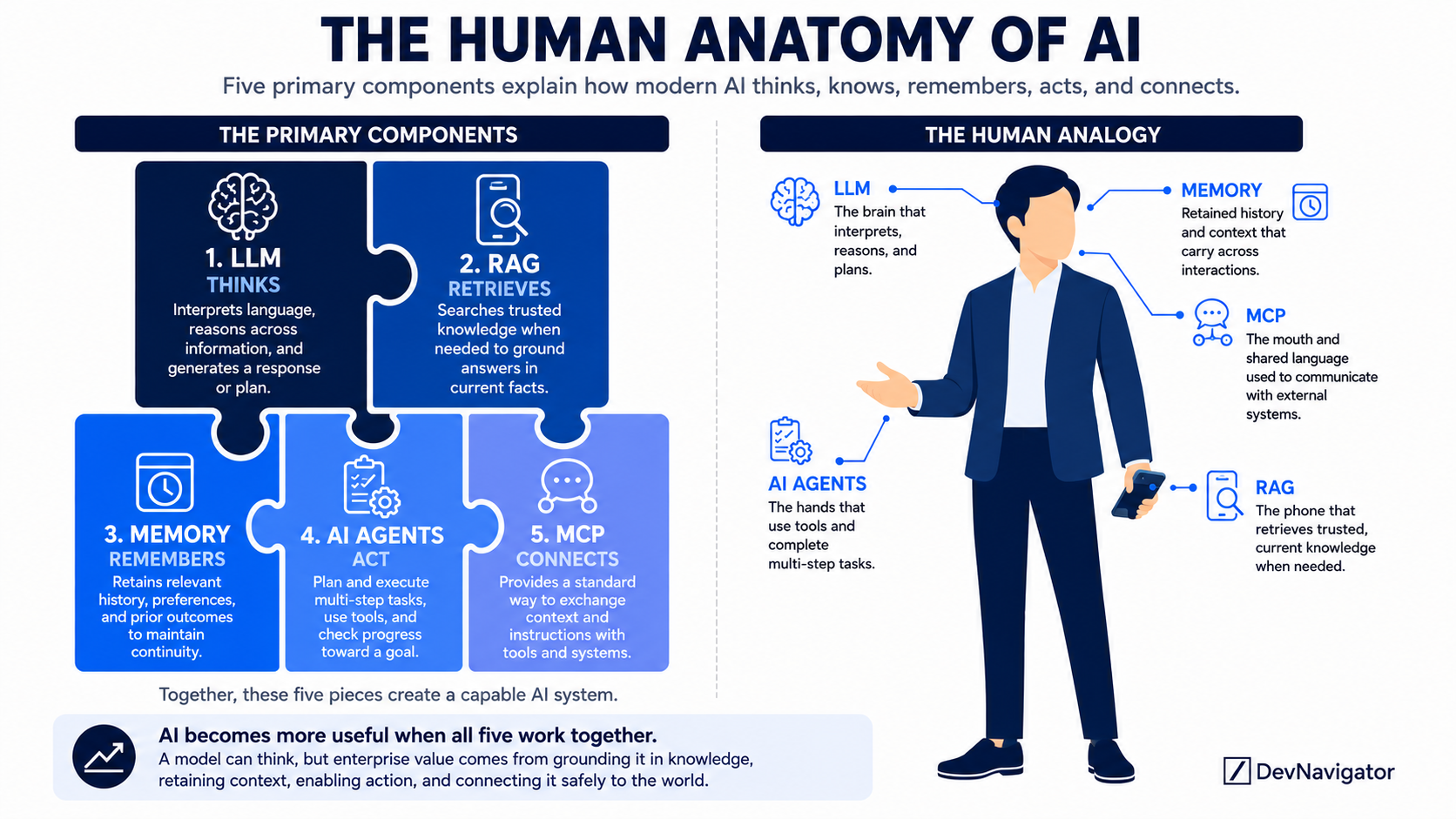
Modern AI is often described as if the model does everything. It answers questions, searches for information, recalls prior conversations, completes tasks, and connects to other systems. But the model is only one component within a larger AI system architecture.
A more useful way to understand modern AI is to compare it to a person. The large language model acts like the brain. Retrieval-augmented generation provides access to external knowledge. Memory preserves relevant history. AI agents coordinate actions. Model Context Protocol creates a standard way to connect the system with external tools and data. Each component serves a different purpose. The real value appears when all five work together.
Multi-Graph Agentic Memory: Why This Powerful Architecture Changes How AI Agents Reason
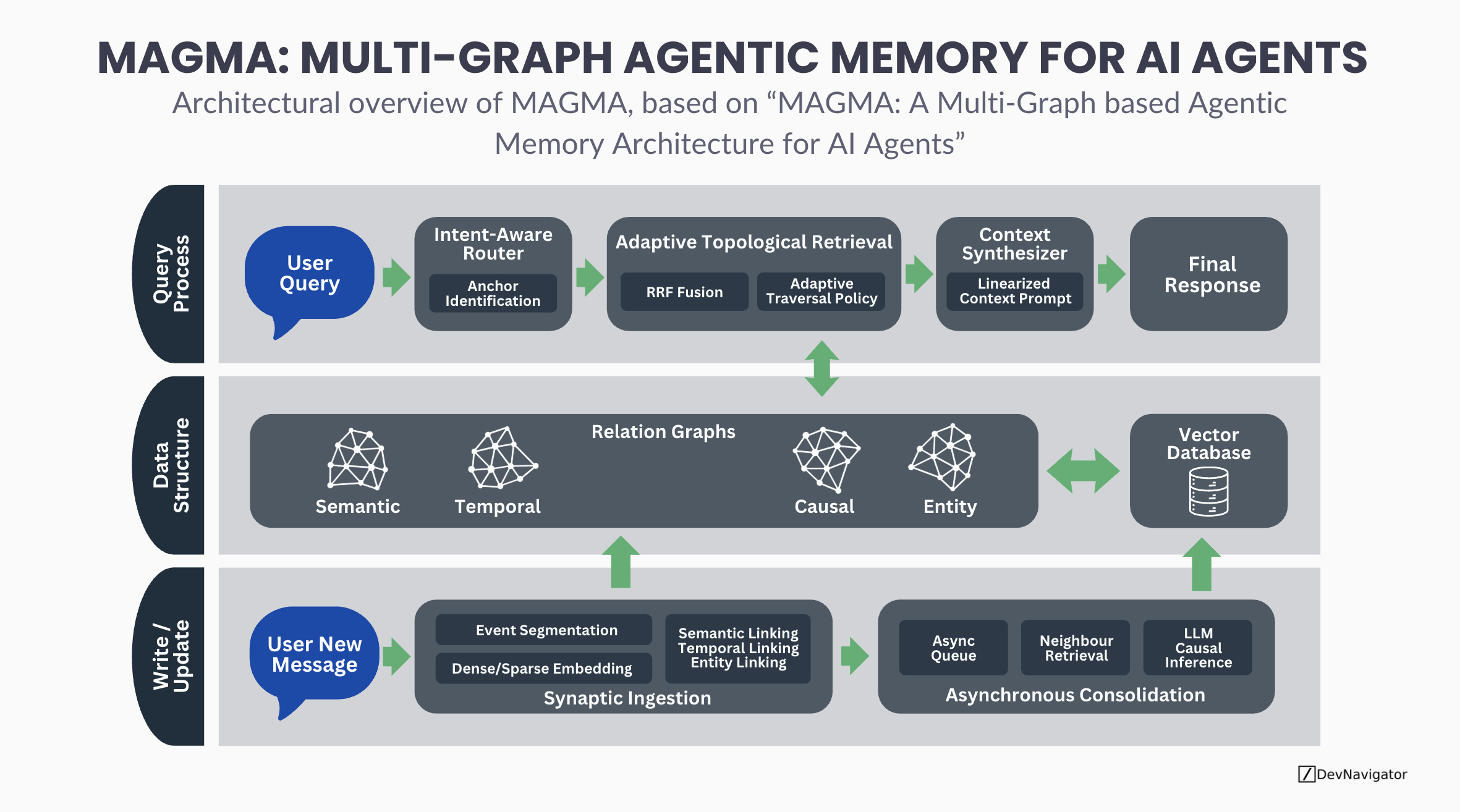
Multi-Graph Agentic Memory represents a fundamental shift in how AI agents store, retrieve, and reason over long-term information. Rather than relying on flat vector similarity or monolithic memory buffers, this architecture structures memory across semantic, temporal, causal, and entity dimensions, allowing agents to retrieve information in ways that align with human reasoning. This article explains the MAGMA architecture shown in the infographic, based on the research paper “MAGMA: A Multi-Graph based Agentic Memory Architecture for AI Agents”, and explores why Multi-Graph Agentic Memory enables more accurate, interpretable, and scalable agent behavior.

 Strategy & Governance · Sep 7, 2026
 AI & Data Science · Jan 9, 2026