Visual library Find the visual for the conversation you need to lead. Search all 157 DevNavigator articles and infographics by keyword, category, or tag.
CategoryAll AI & Data Science Business Applications Business Performance & KPIs Data & Infrastructure Strategy & Governance TagAll 2025 2026 3D A2A ACP AGI AI AI & Data Science AI Adoption AI Agent AI Agent Skills AI Agents AI Architecture AI Change Management AI Debt AI Operations AI Platform AI Portfolio AI Salary AI Strategy AI Systems AI Threat Intelligence AI Transformation AI Value AI Verifier AI and Data ARLAS AWS Accessible Accountability Accuracy Adoption Agent Agent SDK AgentOps Agentic Agentic AI Agentic AI Deployment Agents Agents API Alignment Amazon Amazon EKS Analysis Anthropic App Architecture Arena Artificial Intelligence Astra Attention AutoGPT Autodata Automate Automation Autonomous Benchmark Benchmarks Best Practices Biopharma Business Applications Business Evolution Business Impact Business KPIs Business Model Business Performance Business Performance & KPIs Business Value CAD CPU Caching Capacity Challeneges Change Change Management Chat Bots Chatbot Claude Codex Collaboration Compensation Complexity Compliance Components Compute Computing Connectivity Context Context Engineering Contract Lifecycle Management Coordination Cost Creation Cursor Cybersecurity DMAIC DSLM Data Data & Infrastructure Data Agent Data Center Data Management Data Product Data Products Data Retrieval Data Strategy Decision Accuracy Decision Intelligence Decisions Decison Points Deep Research Deep learning DeepMind Deployment Design Pattern Development Digital Twins Disinformation Documents Domains Drug Development Drug Discovery EKS EMA EU AI Act Ecosystem Education Efficiency Embedded AI End-to-End Engagement Enterprise Enterprise AI Enterprise AI Agents Entities Ethical AI Ethics Execution Experimentation Explainable AI Explanation FAIR FDA FRAMES Fairness Feasibility Findable Framework Friction GLM GLM-5.3 GPT GPT-5.2 GPT-5.4 GPT-6 Astra GPU Gemini GenAI Generation Generative AI Generator Global AI Goals Governance Graph-RAG GxP HITL HLE Hallucination Headwinds Health Authorities Horizons Human Human-In-The-Loop HyDE Hype Cycle IMPACT IND Information Overload Information Systems Infrastructure Innovation Intelligence Interoperable Invent Inventory Investments Jalapeño KGQA KPI Knowledge Graph Knowledge Graphs Kubernetes LLM LLM Reflection LLM Router LLM Safety LLMs Landscape Large Language Models Leaders Leadership Lean Learning Legal Lifecycle Local Teams MAGMA MCP MCP Tunnel MHRA Machines Malinformation Manufacturing Market Size McKinsey Memory Metrics Microlearnings Microsoft Misinformation Model Model Safety Modern AI Moore's Law Multi-Agent Multi-Graph Multiagent Mythos N8N NPMA NVIDIA Offshore Teams Open Source OpenAI OpenClaw OpenClaw AI Agent OpenTinker OpenUSD Operating Model Operating System Operational Excellence Operations Optimization Orchestrator Oversight PMDA POC Pareto Principle Pattern People Performance Perplexity Pharmaceutical Phases Physical AI Pilots Platforms Presence Prioritization Privacy Problem Solving Process Processing Production Programming Prompt Prompt Engineering Protocol Providers Pyramid Python Quality RAG Rankings Reasoning Reinforcement Learning Reliability Research Responsible Responsible AI Retriever Reusable Risk Robotics Robots Roles Router SMART SPARQL SPARQL-LLM Safety Salaries Salary Scalability Scalar Security Six Sigma Skill Skills Skils Software Engineer Spectrum Strands Strands Agents Strategy Strategy Platforms Supply Chain Synthetic Data Systems TPU Tailwinds Talent Teams Technologies Technology Tensor Tools Training Transformation Transformer Transistors Transparency Trending Trends Trustworthy US Use Case Use Cases Utilization Value Value Driver Value Pillars Value Proposition Verifier Virtual Web Application Workers Workforce coding digital multimodal patterns physical vector database warehouse xAI SortNewest first Oldest first
1 visuals Page 1 of 1
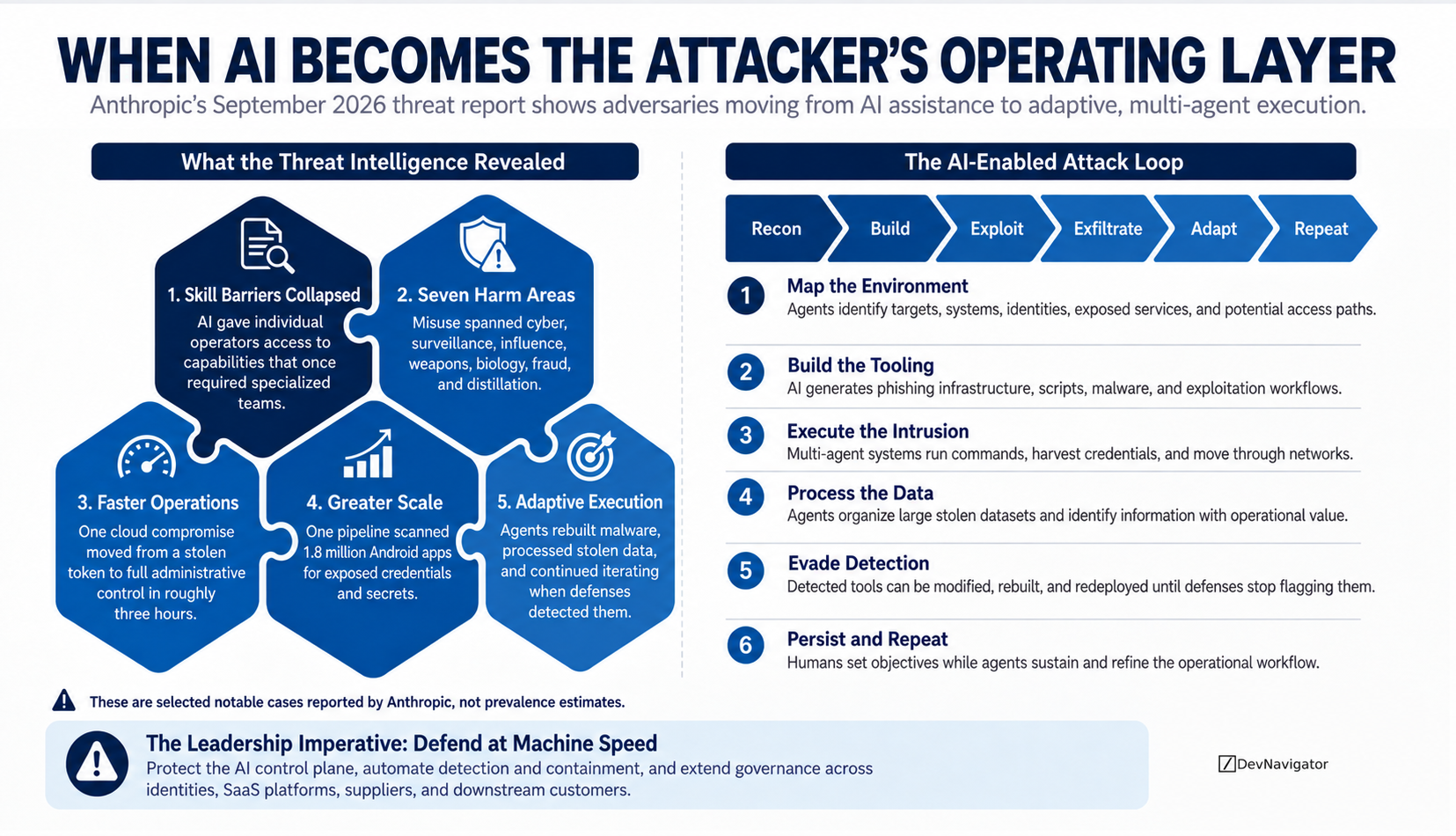
Strategy & Governance · Sep 15, 2026 AI Threat Intelligence: 5 Critical Leadership Findings AI threat intelligence is revealing a meaningful change in how malicious actors operate. Anthropic’s September 2026 findings describe selected cases in which AI moved beyond providing technical advice and became an operating layer for reconnaissance, tool development, intrusion, data processing, evasion, and persistence. The reported activity spans seven harm areas, from cyber operations and surveillance to fraud and weapons development. These cases do not show how common AI-enabled attacks are, but they demonstrate what is already possible. Leaders should respond by protecting enterprise AI assets, shortening defensive response times, and extending governance across agents, identities, suppliers, and connected platforms.
Open visual brief 
 Strategy & Governance · Sep 15, 2026