Find the visual for the conversation you need to lead.
Search all 157 DevNavigator articles and infographics by keyword, category, or tag.
3 visualsPage 1 of 1
Strategy & Governance · Jun 13, 2026
Agentic Enterprise: 7 Powerful Layers to Support AI Value Creation in 2026
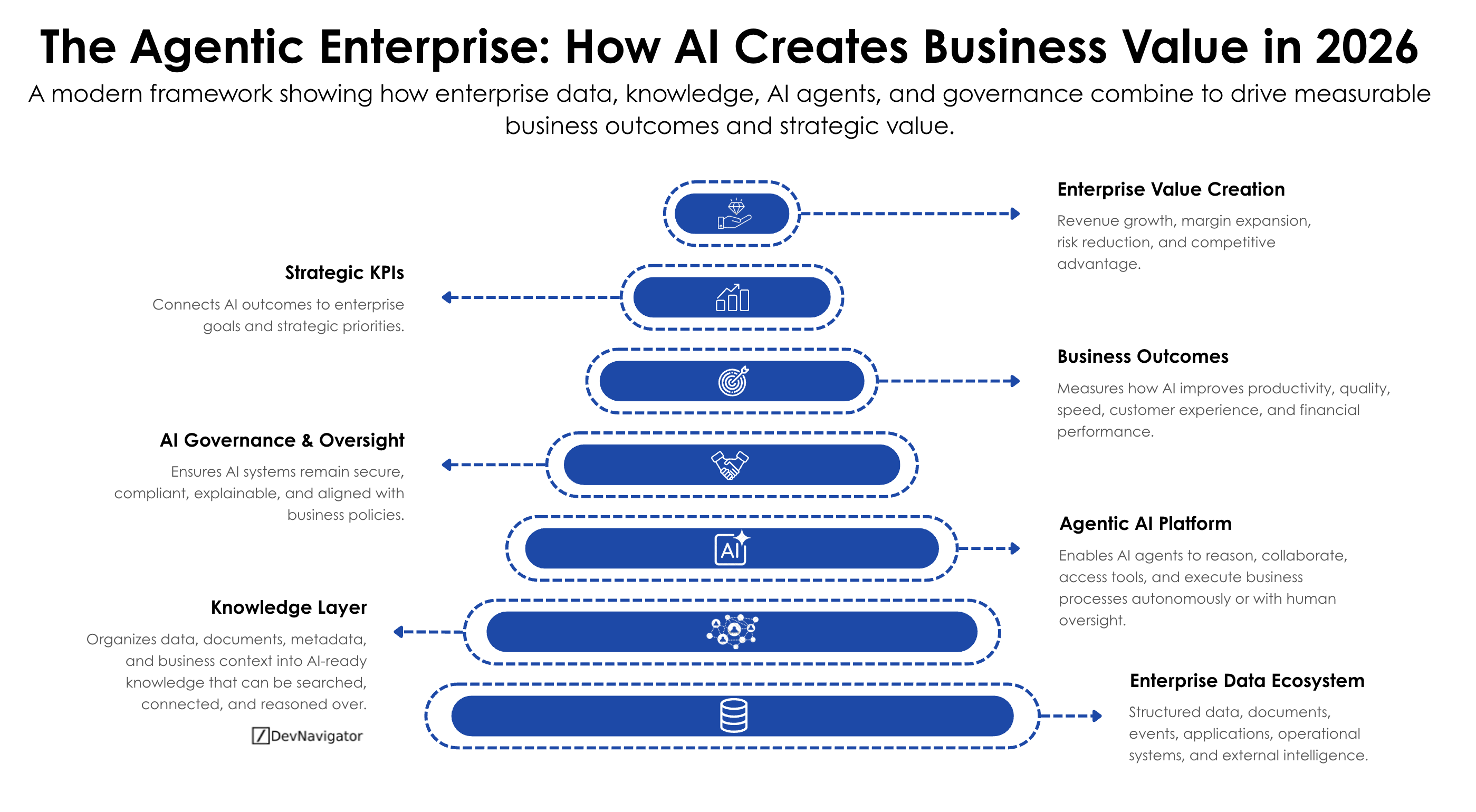
The Agentic Enterprise is emerging as the next stage of enterprise AI adoption. Early AI initiatives focused on chatbots, copilots, and isolated use cases. Today’s organizations are moving toward systems that can reason, access tools, retrieve knowledge, execute workflows, and generate business outcomes.
Success is not driven by AI models alone. An effective Agentic Enterprise requires a foundation of enterprise data, a knowledge layer that provides context, an agentic platform capable of taking action, governance to ensure responsible operation, and metrics that connect AI activity to business value.
Organizations that treat AI as a complete business system rather than a standalone technology project are more likely to achieve measurable results. This framework illustrates how the different layers of the Agentic Enterprise fit together and why each layer matters.
Agentic AI Deployment in 2026: 5 Domains Where AI Agents Are Effectively Transforming Work
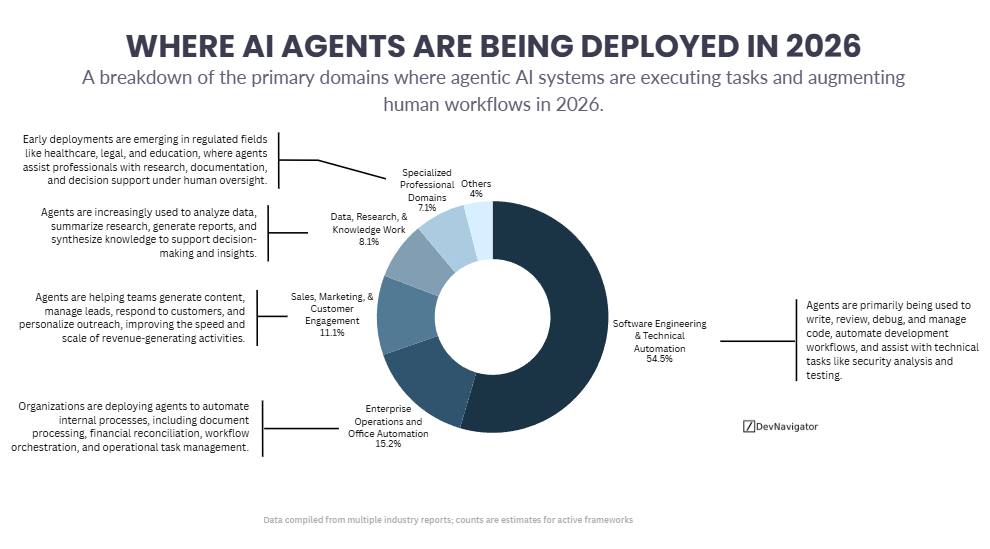
Agentic AI deployment in 2026 is beginning to reveal a clear pattern. While AI agents are often discussed as a general-purpose technology capable of transforming every industry, the reality is more focused. Most real-world usage is concentrated in a few specific domains where agents can reliably execute tasks, integrate with digital systems, and deliver measurable productivity gains.
The largest share of agentic AI deployment is happening in software engineering, where agents assist with coding, debugging, and technical workflows. From there, adoption expands outward into enterprise operations, customer-facing functions, and knowledge work. Smaller but growing deployments are appearing in professional fields such as healthcare, legal services, and education.
Understanding where agentic AI deployment is occurring today provides an important signal for where the technology will expand next. The distribution highlights both the strengths of current AI agents and the practical constraints organizations face when integrating autonomous systems into real-world workflows.
AI in 2026: 6 Powerful Trends That Signal the End of Experimentation
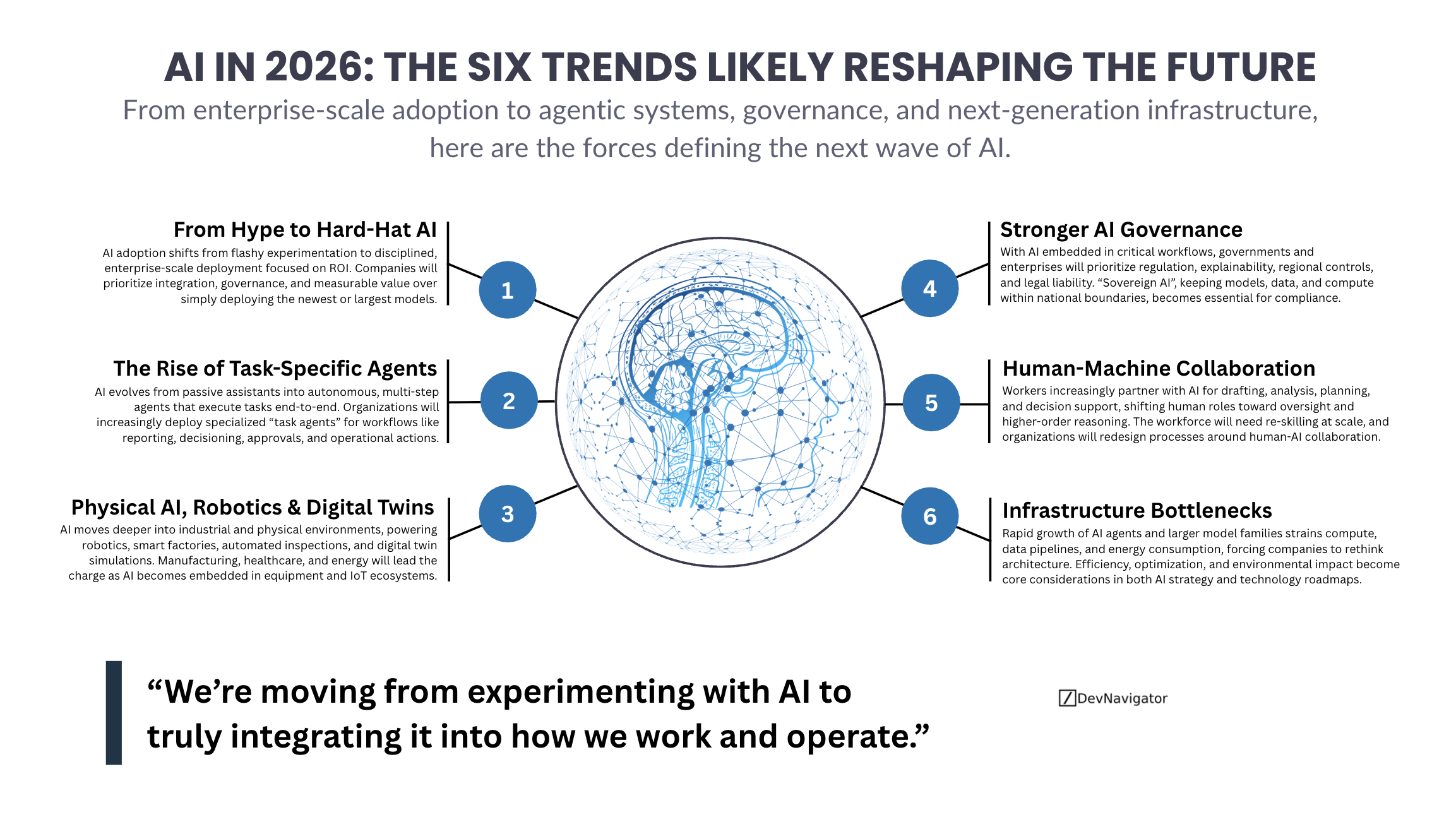
AI in 2026 marks a decisive turning point. After years of rapid experimentation and model-centric hype, organizations are shifting toward durable, production-grade integration. The focus is no longer on what AI can do in isolation, but on how reliably it can operate inside real workflows, regulated environments, and complex human systems. As AI in 2026 matures, six converging trends are reshaping enterprise strategy, from task-specific agents and physical AI to governance pressure and infrastructure constraints. Together, they signal that AI is becoming an operational backbone rather than a standalone capability.

 Strategy & Governance · Jun 13, 2026
 AI & Data Science · Mar 28, 2026
 Strategy & Governance · Nov 26, 2025